


The comedogenic scale rates how likely an ingredient is to clog pores, from 0 (won’t clog) to 5 (highly likely to clog), based on old rabbit ear tests and newer human skin studies. It’s a directional warning system, not a guarantee: a 4-rated oil in a low-concentration, well-formulated product can behave very differently to that same oil at full strength. The practical rule is simple. Flag high-rated ingredients when they sit near the top of an ingredient list, then patch test the finished product before trusting it on your face.
TL;DR:
- A high comedogenic rating does not guarantee a product will clog pores because dilution, formulation, and ingredient placement significantly influence actual risk.
- Rabbit ear testing historically overstates pore-clogging potential, especially since animal follicles are more reactive than human skin, leading to false positives.
- Ingredients like shea butter and cocoa butter vary in risk based on processing and location on the label, with unrefined shea being potentially more problematic than refined, and cocoa butter posing higher risk on the face.
- Testing on the back may not accurately represent facial skin response, making individual patch testing and attention to ingredient positioning essential for personalized skincare.
- Avoid relying solely on “non-comedogenic” labels, as they are not regulated, and your skin’s unique response can differ from general ratings.
Table of Contents
- What is comedogenic rating, and what do the numbers mean?
- How was the comedogenic scale developed?
- Why the comedogenic scale can mislead you
- What are typical comedogenic ratings for common oils and butters?
- How do you actually use the comedogenic scale when shopping?
- What After Hours has learned from real skin, not just lab data
- When the comedogenic scale helps, and when it misleads you
- Formulated with comedogenic risk in mind
- Sources
- FAQ
What is comedogenic rating, and what do the numbers mean?
Comedogenicity describes how likely a substance is to trigger comedones, the small plugs of keratin and sebum that block hair follicles and set off blackheads, whiteheads, and inflamed spots. A clinical overview of comedone formation shows this starts as a microscopic blockage inside the follicle, invisible to the eye, long before it becomes a visible breakout.
The scale itself runs from 0 to 5:
- 0 to 1 (low risk): minimal likelihood of clogging pores in most people. Water, glycerin, and many silicones sit here.
- 2 to 3 (moderate risk): some pore-clogging potential, especially in leave-on formulas or with prolonged skin contact. This is where a lot of everyday oils and butters land.
- 4 to 5 (high risk): strong evidence of pore-clogging in test conditions. These warrant real caution if you’re acne-prone, particularly on the face.
Here’s the part most product labels never explain: an ingredient rating is not the same as a finished-product rating. A raw oil scoring 4 out of 5 in isolation can drop dramatically once it’s diluted to 2% in a cream alongside emulsifiers and other actives. Lab Muffin Beauty Science makes this point directly: ratings are useful for narrowing down suspects when your skin reacts badly, but they were never designed to predict how a bottled product will behave on your particular face. Treat the number as a flag worth investigating, not a verdict.
How was the comedogenic scale developed?
The scale traces back to work by Kligman and Fulton, who needed a fast, repeatable way to screen cosmetic ingredients for pore-clogging potential before human trials became practical. Their answer was the rabbit ear assay.
Rabbit ears were chosen because the follicles inside a rabbit’s ear canal react strongly and visibly to comedogenic substances, producing results faster than waiting on human skin. That sensitivity is also the method’s biggest flaw.
- Rabbit follicles are considerably more reactive than human ones, which means the assay often flags substances as comedogenic that barely affect people at all.
- This hypersensitivity produces a meaningful rate of false positives, inflating some ingredients’ scores compared with how they behave on human skin.
- A PubMed entry on comedogenicity testing methods documents how these early rabbit results shaped the 0 to 5 scale still quoted across skincare today, decades on.
Human testing methods came later and offer far more relevance to anyone actually shopping for a moisturiser. Occlusion tests apply a substance under a patch on human skin and monitor for comedone development over weeks. Cyanoacrylate follicular biopsy goes further: a thin layer of adhesive is applied to the skin, peeled off, and examined under a microscope to count microcomedones directly. This method gives genuinely higher external validity than any rabbit model, because it measures the actual biological event in actual human follicles rather than inferring it from a more reactive animal proxy. The catch is that it’s typically performed on the back rather than the face, since the back offers a larger, more uniform testing surface, which introduces its own gap between test site and the place most people actually worry about breakouts.
Why the comedogenic scale can mislead you
The scale is a starting point for investigation, not a shopping rulebook, and treating it otherwise leads to two common mistakes: banning entire ingredient categories, or trusting a “non-comedogenic” label without question.
- Animal sensitivity skews the data. Rabbit ear results run hotter than human skin, so some long-feared ingredients may deserve less suspicion than their rating suggests.
- Concentration changes everything. An ingredient tested at 100% strength behaves nothing like that same ingredient at 2% in a finished cream, buffered by emulsifiers and other components.
- Face and back skin are not interchangeable. Most rigorous human testing happens on the back, where follicle density and sebum output differ from facial skin.
- “Non-comedogenic” isn’t a regulated term. No mandatory, standardised human testing sits behind that claim, so a dermatology review published on ScienceDirect notes manufacturers can print it on packaging without independent verification.
- Your skin isn’t the average skin. Individual variation and differences in the skin microbiome mean the same 2-rated ingredient can sit quietly on one person’s skin and trigger breakouts on another’s.
Dermatologists interviewed by Byrdie make this point repeatedly: a moderate rating is not a personal guarantee, and patch testing beats label-reading every time there’s genuine doubt.
Pro Tip: Keep a simple skin diary for two weeks whenever you introduce a new product. Note the date, where you applied it, and anything unusual three to five days later. Comedones take time to form, so judging a product after two days tells you almost nothing.
What are typical comedogenic ratings for common oils and butters?
Mapping the scale onto ingredients you’ll actually recognise from a label makes the whole concept click. Four names come up constantly in comedogenic ingredient lists, and each teaches a slightly different lesson.
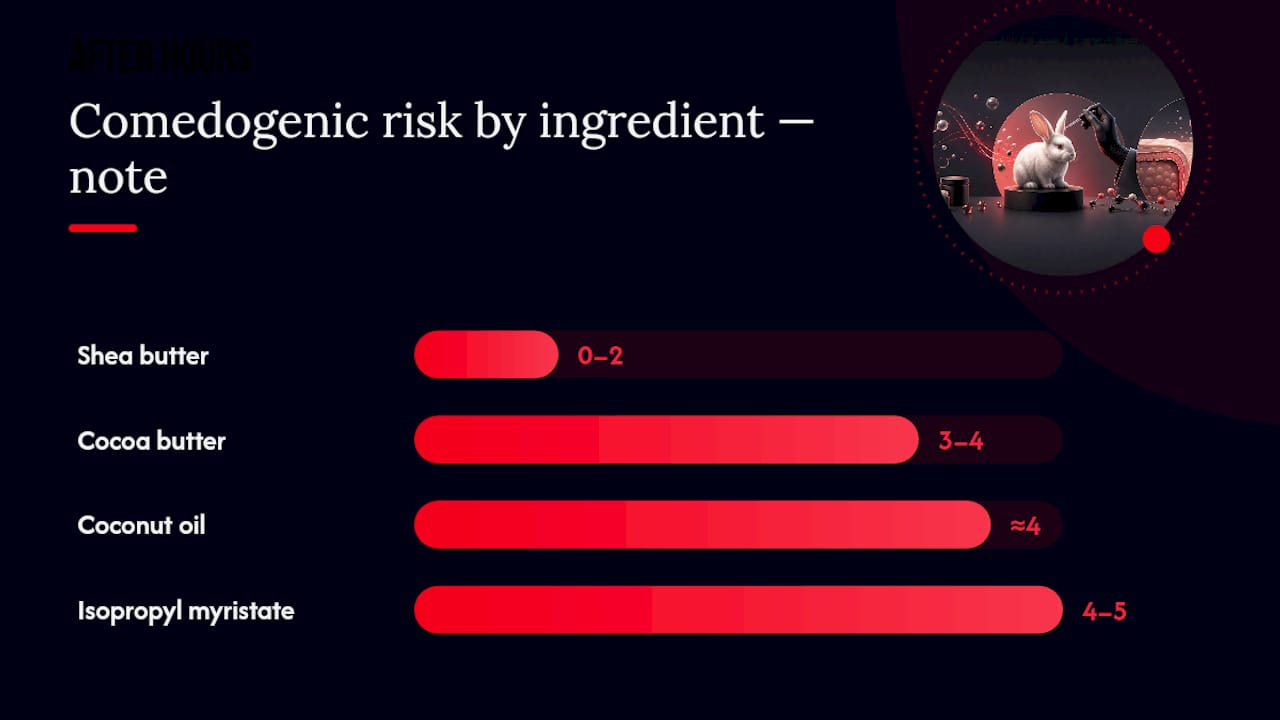
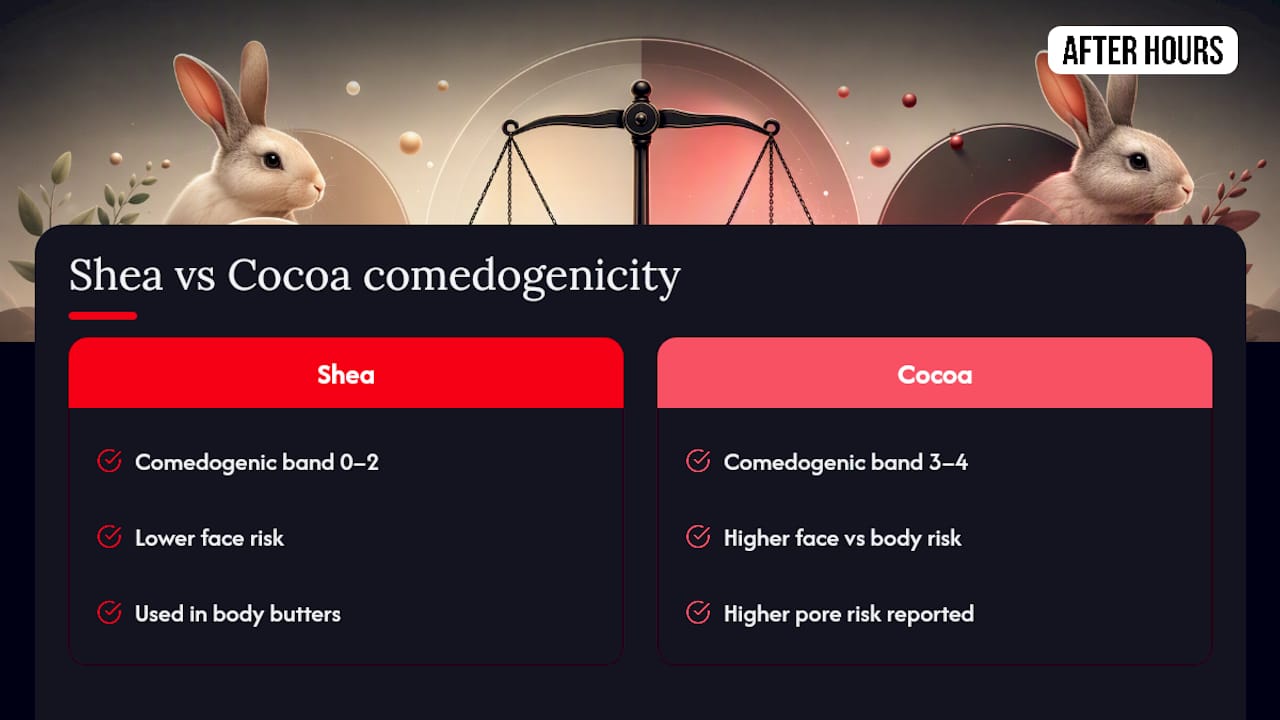
Shea butter typically scores between 0 and 2, making it one of the gentler botanical fats on the scale. Refined shea tends to sit at the lower end of that range because processing strips out some of the free fatty acids most associated with pore-clogging, while unrefined, raw shea can run slightly higher for sensitive or acne-prone skin.
Cocoa butter commonly lands at 3 to 4, a meaningfully higher risk band than shea. The nuance that matters most here is location: cocoa butter’s thicker, more occlusive texture tends to pose a greater risk on facial skin than on the body, where follicle density and oil production differ. Body use and face use are genuinely different propositions with the same ingredient.
Coconut oil is usually cited around 4 in its pure, unrefined form, one of the more consistently high-rated botanical oils across ingredient databases. Formulation still matters enormously; a trace amount deep in an ingredient list behaves differently from coconut oil as the primary carrier oil in a leave-on cream.
Isopropyl myristate and related synthetic esters routinely score 4 to 5, placing them among the highest-risk substances on most comedogenic charts. These esters appear frequently in the early rabbit ear studies that built the scale in the first place, which is part of why they’re cited so often in comedogenic ingredient databases today, including the Acne.
The lesson across all four: rating alone tells you little without knowing where the ingredient sits on the label and how concentrated it is. An ingredient buried seventh from the bottom is a very different risk to the same ingredient listed second.
How do you actually use the comedogenic scale when shopping?
A rating chart is only useful if you apply it methodically. Here’s a sequence that works whether you’re troubleshooting a current breakout or vetting something new before you buy it.
- Judge the finished product, not the raw ingredient. A high-rated oil diluted at 1 to 2% behaves nothing like the same oil at full concentration, a formulation effect Lab Muffin’s review of comedogenicity ratings explains in detail.
- Check ingredient position on the label. Ingredients are listed by concentration, so a 4-rated ingredient in the top seven matters far more than one buried near the preservatives.
- Note leave-on versus rinse-off. A moisturiser sits on skin for hours; a cleanser rinses off in seconds. The same ingredient poses very different risk in each format.
- Patch test for 7 to 14 days. Apply the product to a small area, such as behind the jaw or on the inner arm, and watch daily for small bumps, clogged-looking pores, or texture change.
- Track the timeline honestly. Comedones take days to weeks to form, so judging a product after 48 hours tells you almost nothing useful.
- Stop and reassess if you see new bumps, persistent redness, or texture changes that don’t settle within the test window. If breakouts continue after switching several products, it’s worth speaking to a dermatologist about a proper patch test series rather than guessing further.
Pro Tip: If you’re testing a body butter for facial use, apply it only to a small dry patch first rather than your full face. This matches how many people successfully use richer body formulations on drier areas without risking a full breakout across their T-zone.
What After Hours has learned from real skin, not just lab data
Darnell has spent time cross-referencing comedogenic literature against the ingredients that actually turn up in body butter formulations, and the gap between lab rating and lived experience is where most confusion starts. Afterhoursbodybutter’s own product notes on shea butter’s comedogenic profile and cocoa butter’s face versus body risk reflect the same 0 to 2 and 3 to 4 bands covered above. Customer feedback patterns reported to the brand tend to echo the wider dermatological view: people with reactive or acne-prone skin generally report calmer skin when they choose formulations that account for comedogenic risk rather than reach for the richest butter on the shelf. That’s a pattern, not a clinical guarantee, but it lines up with what the research actually shows.
When the comedogenic scale helps, and when it misleads you
The comedogenic scale earns its keep as a triage tool. When your skin is breaking out and you’re trying to work out why, a high rating on an ingredient near the top of your moisturiser’s label is exactly the kind of clue worth chasing down first.
Where it falls apart is when people use it as a permanent ban list. Cocoa butter isn’t universally bad; isopropyl myristate isn’t universally catastrophic. Concentration, position on the label, and your own skin’s tolerance all matter more than a single number carried over from a decades-old rabbit study. If you’re acne-prone, the sensible move is watching for products stacking several 4 to 5 rated ingredients near the top of the list, not avoiding every oil that ever scored above a 2.
— Darnell
Formulated with comedogenic risk in mind
This brand builds its vegan, cruelty-free body butters around concerns about pore-clogging risk, ingredient position, and concentration effects on skin. Products are made and packaged in the UK from chemical-free ingredients, chosen with sensitive and acne-prone skin in mind rather than added purely for texture or scent.

If you’ve read this far because a product has been breaking you out, that’s a good reason to look more closely at what’s actually in your routine. Afterhoursbodybutter’s product range lays out full ingredient details for exactly this kind of comparison, so you can check formulation before you buy rather than after a breakout forces the question. Have a look at the range and see which formulation fits your skin’s actual tolerance, not just its rating on a chart.
Sources
Key references used throughout this article include Lab Muffin Beauty Science’s guide to comedogenicity ratings, a dermatology review on ScienceDirect covering testing standardisation gaps, a PubMed entry on comedogenicity testing methods, expert commentary via Byrdie, and the acne.org comedogenic ingredient list.
- How to use comedogenicity ratings | Lab Muffin Beauty Science
- Review: comedogenicity testing and non‑comedogenic labelling (ScienceDirect)
- Comedogenic and non‑comedogenic: What experts say | Byrdie
- Acne
- Clinical overview of comedone formation (PMC article)
FAQ
What oil scores 0 on the comedogenic scale?
Very few natural oils score a true 0; most low-risk options like mineral oil, sunflower oil, and certain silicones sit at 0 to 1 depending on the specific study cited.
What does a comedogenic rating of 1 mean?
A rating of 1 means minimal evidence of pore-clogging in test conditions, low risk for most skin types, though individual reactions can still vary.
What is the comedogenic rating of shea butter?
Shea butter typically scores between 0 and 2, with refined shea generally sitting at the lower end of that range compared with unrefined, raw shea.
Which skincare products are more likely to be comedogenic?
Rich, occlusive leave-on products such as heavy face creams and body butters carry more risk when they contain high concentrations of 4 to 5 rated ingredients like isopropyl myristate near the top of the ingredient list, though rinse-off products like cleansers pose far less risk regardless of ingredients.
Can a high-rated ingredient still be safe to use?
Often yes, since concentration and position on the ingredient label change how an ingredient behaves; a 4-rated oil used sparingly and low on the list may cause no issues, which is why patch testing the finished product matters more than the raw ingredient score.