

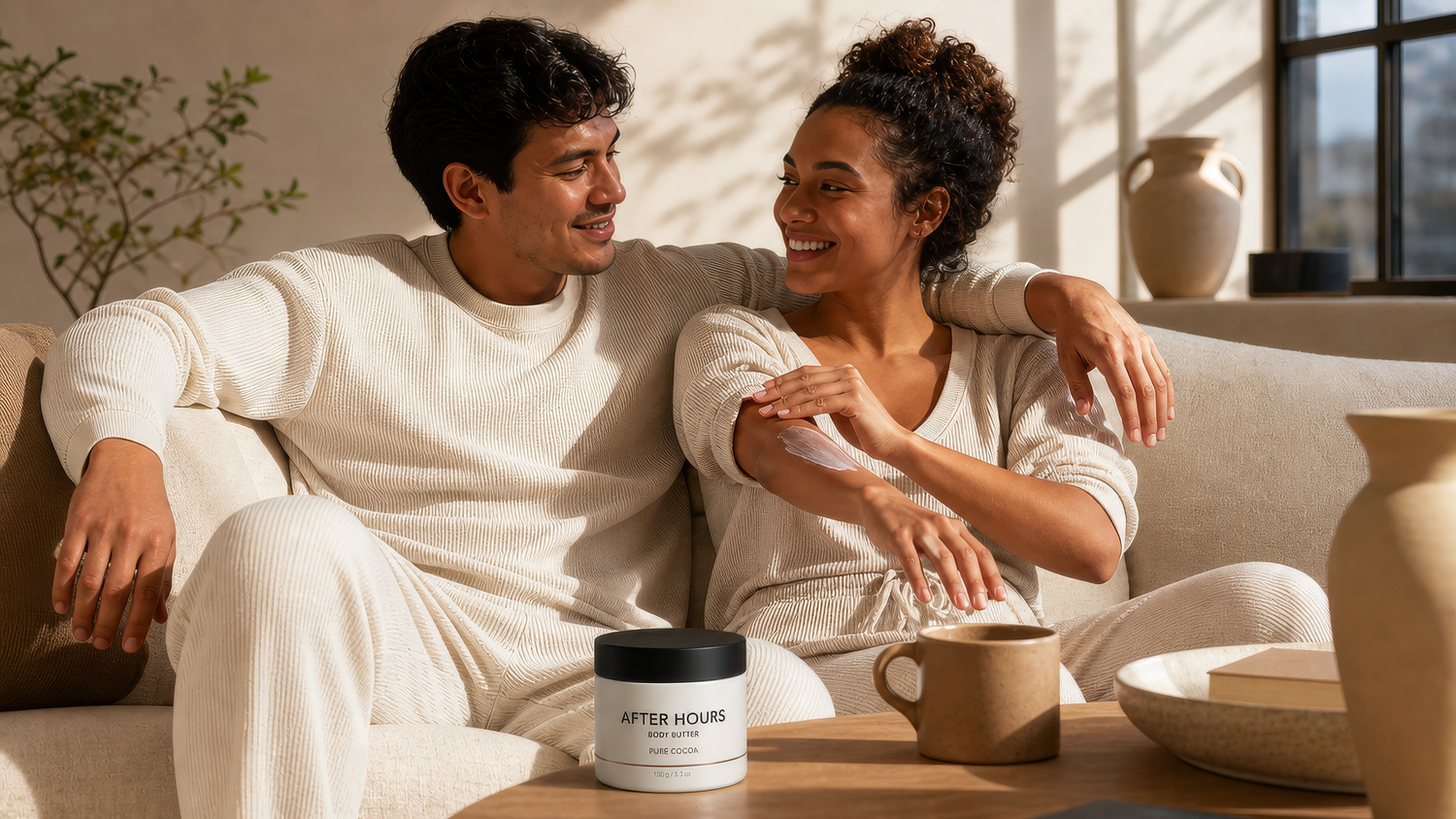

‘Cruelty-free’ is a claim about testing. ‘Vegan’ is a claim about ingredients. A product can be one without the other, and many are. To shop with confidence, run three quick checks: look for a recognised certifier logo (Leaping Bunny, Vegan Trademark, or PETA-Approved Vegan), scan the INCI ingredient list for common animal-derived names, and confirm whether the brand sells in markets that legally require animal testing. To be both cruelty-free and vegan, you need both assurances: a clear no-testing policy or certification, plus verified ingredient sourcing.
- Check the logo. Recognised certifier marks are more reliable than packaging text alone.
- Read the INCI list. Ingredients such as cera alba (beeswax), lanolin, and carmine signal animal-derived content.
- Check sales markets. Brands selling in jurisdictions with mandatory post-market testing may not qualify as fully cruelty-free regardless of what the label says.
Key takeaways
Cruelty-free and vegan are separate claims: a product needs both a verified no-testing policy and confirmed animal-free ingredients to satisfy both standards.
| Point | Details |
|---|---|
| Different claims, different checks | Cruelty-free covers testing; vegan covers ingredients. Verify each separately. |
| Certifier logos beat packaging text | Vegan Trademark and Leaping Bunny use independent audits; PETA lists rely on self-declaration. |
| Sales markets affect cruelty-free status | Brands selling in markets that require animal testing may not qualify as fully cruelty-free. |
| Vegan does not mean hypoallergenic | Vegan products can suit sensitive skin but still contain plant-based allergens; patch test first. |
| Afterhoursbodybutter | Formulated without animal ingredients and without animal testing, made sustainably in the UK. |
Table of Contents
- What ‘cruelty-free’ actually means in cosmetics
- What ‘vegan’ means for cosmetics and personal care
- Why cruelty-free is not the same as vegan
- How the main labels compare and what each actually guarantees
- How to verify claims when shopping in the UK
- Are vegan products better for sensitive skin?
- Why Afterhoursbodybutter prioritises both vegan and cruelty-free
- Vegan and cruelty-free bodycare from Afterhoursbodybutter
- Sources
What ‘cruelty-free’ actually means in cosmetics
Cruelty-free means a product, and ideally its ingredients, were not tested on animals at any stage of development. That covers the finished formula, but depending on the certifier, it may also extend to ingredient suppliers and the brand’s entire product range at company level.
The phrase has no legally regulated definition in the UK. Any brand can print ‘not tested on animals’ on packaging without independent verification. That is where third-party certifiers become the practical safeguard. Cruelty Free International’s Leaping Bunny programme certifies products free from animal testing across all stages of development and uses independent audits and a searchable registry to verify compliance. PETA’s Beauty Without Bunnies list is a self-declaration programme: brands sign a statement of assurance rather than submitting to an independent audit, which makes it a lower bar.
Common loopholes to watch for:
- Fixed cut-off dates. Some brands claim cruelty-free status based on a date after which they stopped testing, but ingredients sourced before that date may have been tested.
- Supplier testing. A brand may not test its finished product but may use ingredient suppliers who do.
- Post-market testing. Selling in markets that require animal testing after a product reaches shelves can compromise a brand’s cruelty-free status, even if the brand itself never commissions a test.
- Ambiguous wording. Phrases like ‘not tested on animals by us’ or ‘we don’t test on animals’ leave room for third-party testing on the brand’s behalf.
Pro Tip: Rather than relying on packaging alone, search the brand directly on the Leaping Bunny shopping guide or PETA’s database. If the brand does not appear, that absence is itself informative.
What ‘vegan’ means for cosmetics and personal care
Vegan cosmetics contain no animal-derived ingredients or by-products, and certified vegan products typically include supply-chain checks to verify that sourcing. The vegan skincare meaning goes beyond swapping out obvious animal products: it covers derivatives and processing aids that appear under non-obvious INCI names.
Common animal-derived ingredients to watch for:
- Cera alba (beeswax) — used in balms, lip products, and some body butters
- Lanolin — a wax derived from sheep’s wool, common in moisturisers
- Carmine (CI 75470) — a red pigment from crushed cochineal insects, used in lip and cheek products
- Collagen and elastin — often sourced from bovine or marine animals
- Gelatin — derived from animal bones and skin, sometimes used in nail products
- Silk (serica) — from silkworm cocoons, used in hair and skin products
- Albumen — egg white, occasionally used as a film-forming agent
PETA maintains a full animal ingredients list that decodes INCI names, which is a practical reference when reading labels.
What vegan certification actually checks:
- The Vegan Society’s Vegan Trademark requires no animal ingredients or by-products and verifies that neither the product nor its ingredients were tested on animals by the company or on its behalf. Crucially, it checks supply-chain details and does not permit fixed cut-off dates.
- The V-Label and Certified Vegan programmes operate on similar principles, verifying ingredient sourcing and sometimes packaging materials.
- PETA’s PETA-Approved Vegan badge confirms no animal ingredients but relies on brand self-declaration rather than independent audit.
One point worth stating plainly: vegan does not mean natural, organic, or hypoallergenic. A product can be entirely plant-based and still contain synthetic preservatives, fragrances, or allergens. Certification confirms ingredient sourcing, not skin compatibility.
Why cruelty-free is not the same as vegan
The two claims address entirely different parts of the supply chain. A product can be vegan in its formula yet still be animal-tested. A product can be cruelty-free yet still contain beeswax or lanolin. Neither claim implies the other.
Two concrete examples make this clear:
- A vegan foundation contains no animal-derived pigments or waxes, but the brand sells in a market that requires post-market animal testing. The formula is vegan; the product is not cruelty-free.
- A cruelty-free body lotion carries a Leaping Bunny mark confirming no animal testing at any stage, but the formula includes lanolin as an emollient. The testing record is clean; the product is not vegan.
Supply-chain nuance adds another layer. Even when a brand does not commission animal testing on its finished product, ingredient suppliers further up the chain may have tested raw materials on animals. Certifiers that check supplier declarations (as the Vegan Trademark does) close this gap; self-declared cruelty-free claims typically do not.
Geography matters too. Cruelty-free claims are geographically dependent: selling in markets with mandatory testing requirements can compromise a brand’s cruelty-free status unless the certifier and the company explicitly exclude that market from their distribution. This is why a brand’s sales geography is a relevant check, not just its packaging text.
How the main labels compare and what each actually guarantees
Different vegan and cruelty-free labels vary in what they guarantee and whether they include audits, packaging checks, or foreign-market testing coverage. The table below covers the labels UK shoppers encounter most often.
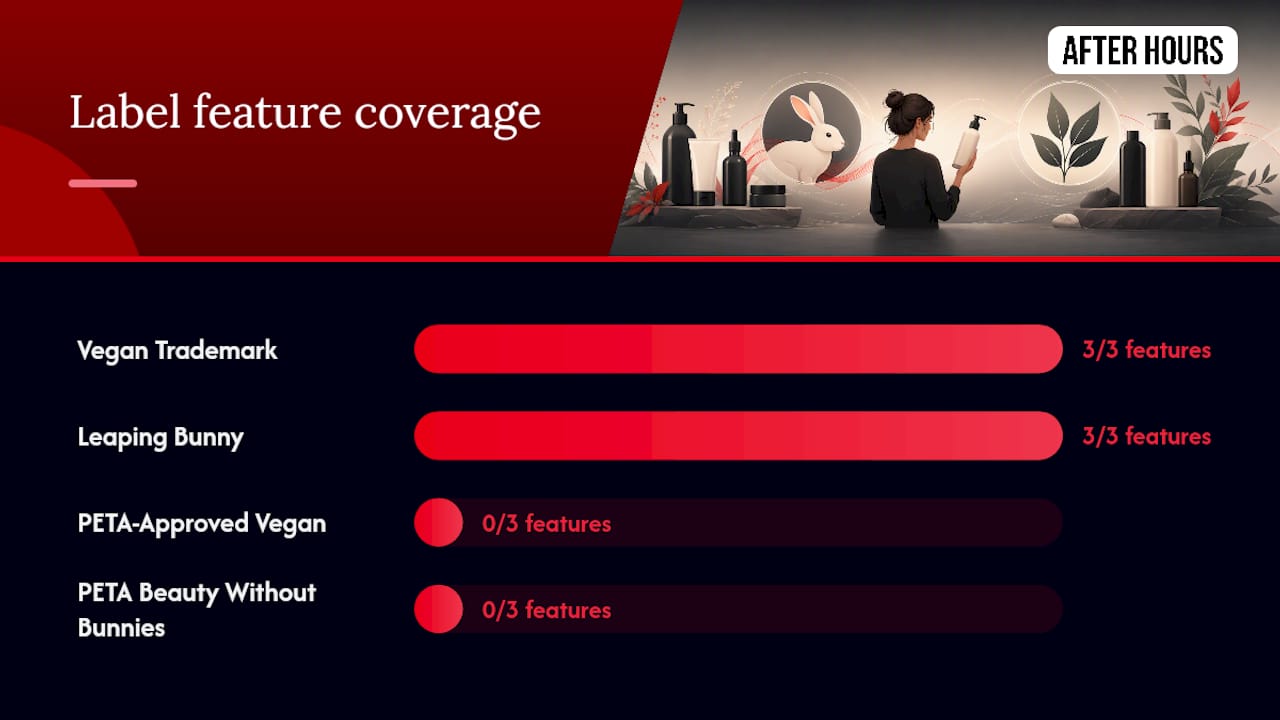
| Label | What it guarantees | Scope | Verification level | Foreign-market testing covered | Packaging/ingredients checked | Also guarantees vegan ingredients? |
|---|---|---|---|---|---|---|
| Vegan Society Vegan Trademark | No animal ingredients; no animal testing in product or supply chain | Company and product level | Independent ingredient and supply-chain verification; no fixed cut-off dates | Yes | Yes (ingredients and supply chain) | Yes |
| Leaping Bunny (Cruelty Free International) | No animal testing at any stage of development | Company-wide policy required | Independent control audits; searchable registry | Yes, if brand excludes those markets | Ingredients checked for testing history | No |
| PETA-Approved Vegan | No animal ingredients; no animal testing | Product level | Brand self-declaration; no independent audit | Not independently verified | Ingredients declared by brand | Yes |
| PETA Beauty Without Bunnies | No animal testing | Product or company level | Brand self-declaration | Not independently verified | Not specifically | No |
A few practical notes on credibility:
- The Vegan Trademark is a registered trademark of the Vegan Society, which gives it legal weight and makes misuse actionable.
- Leaping Bunny’s independent audits and searchable registry make it the most verifiable cruelty-free standard for UK shoppers.
- PETA’s lists are useful as a starting point but rely on brand self-declaration, so they carry less independent assurance.
When you want both cruelty-free and vegan, the Vegan Trademark is the single mark that covers both in one certification. If a product carries the Vegan Trademark, you do not need to separately verify the testing claim.
How to verify claims when shopping in the UK
The UK banned animal testing for finished cosmetics in 1998 and for cosmetic ingredients in 1998 as well, so most products sold here are not tested on animals domestically. That does not mean every product on UK shelves is cruelty-free: brands that also sell in markets requiring post-market testing may still be implicated. Here is a repeatable checklist.
- Look for a recognised certifier logo. Vegan Trademark, Leaping Bunny, or PETA-Approved Vegan on the packaging is your first filter. Then verify the brand appears on the certifier’s own searchable registry.
- Read the INCI ingredient list. Check for cera alba, lanolin, carmine, collagen, gelatin, silk (serica), and albumen. PETA’s animal ingredients list is a free reference for less obvious names.
- Read the brand’s policy page. Look for a company-wide statement that covers all products, all suppliers, and all markets. Vague language (‘we do not conduct animal testing’ without specifying suppliers or markets) is a red flag.
- Check where the product is sold. If a brand distributes in markets that legally require animal testing, its cruelty-free claim may not hold for those products, even if UK-sold stock is unaffected.
- Contact the brand if in doubt. Ask specifically: “Does your cruelty-free policy cover ingredient suppliers? Do you sell in markets that require animal testing?” A brand confident in its credentials will answer directly.
Red flags to watch for:
- ‘Not tested on animals by us’ — leaves room for third-party testing
- ‘We don’t believe in animal testing’ — a belief statement, not a policy
- Marketplace listings that describe a product as cruelty-free without linking to a certifier
- No certifier logo despite prominent cruelty-free or vegan claims
Pro Tip: The Leaping Bunny shopping guide lets you search by brand name and filter by product category. Bookmark it on your phone for in-store checks.
Note that in the EU (and by extension, UK-aligned practice), the widespread ban on animal testing means some brands do not prominently display ‘cruelty-free’ on packaging because the claim is considered standard. Absence of the phrase does not automatically mean a product was tested on animals; absence of a certifier logo is the more meaningful signal.
Are vegan products better for sensitive skin?
Vegan products can be a good fit for some people with sensitive skin, but they are not automatically gentler. The distinction matters.
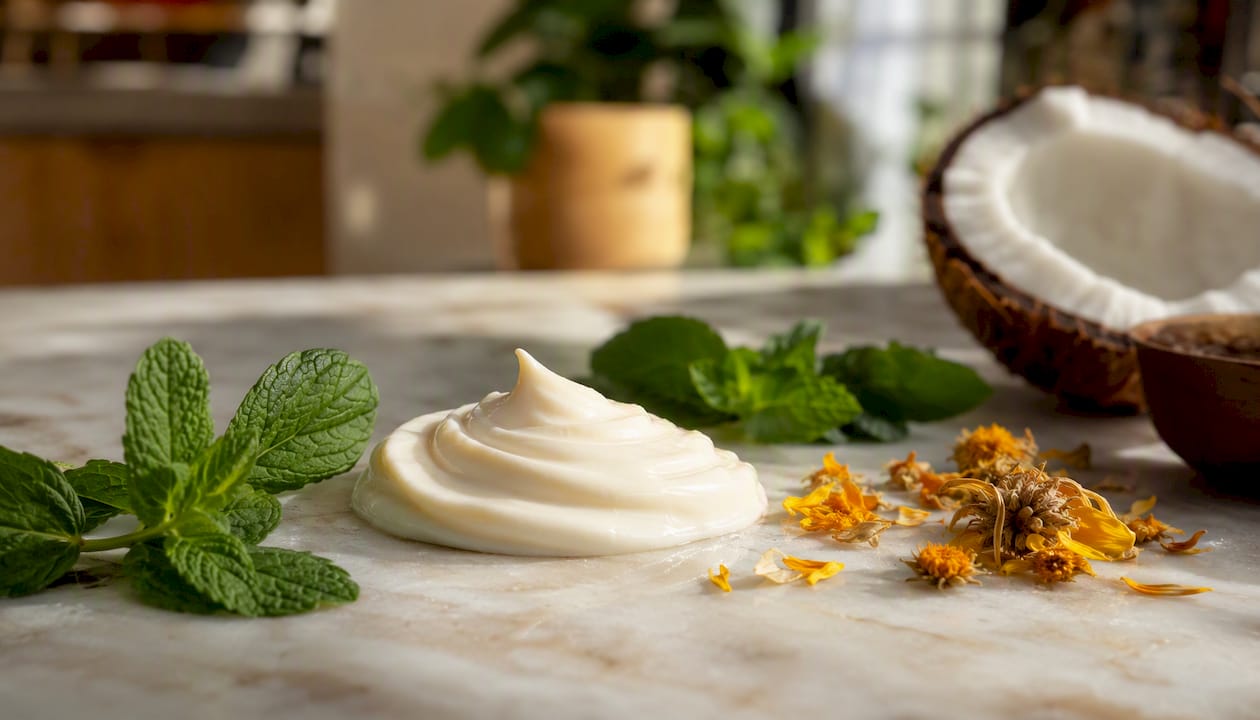
Vegan formulations often use simpler ingredient lists with fewer complex animal-derived actives. For some people, removing ingredients like lanolin (a common sensitiser) or carmine reduces the risk of a reaction. Dermatologists note that vegan products can be advantageous for some people with sensitive skin because plant-based ingredient lists tend to be shorter, but they are not universally gentler. A product can be entirely vegan and still contain fragrance, essential oils, or preservatives that trigger reactions in sensitive skin.
Certification reduces uncertainty about sourcing but does not replace individual patch testing. For a body care routine for sensitive skin, patch testing a new product on the inner arm for 24 hours before full application remains the most reliable personal check, regardless of what the label says.
Pro Tip: If you have a known allergy to wool or wool alcohols, lanolin is a specific ingredient to avoid. It appears on INCI lists as ‘lanolin’, ‘lanolin alcohol’, or ‘adeps lanae’. A vegan-certified product will not contain it.
Why Afterhoursbodybutter prioritises both vegan and cruelty-free
At Afterhoursbodybutter, both standards are built into the formulation process from the start. Products are made without animal-derived ingredients and without any animal testing at any stage, which means you get the ingredient assurance of a vegan product and the testing assurance of a cruelty-free one in a single purchase. For customers with sensitive skin or acne-prone skin, that combination matters: no lanolin, no carmine, no complex animal-derived actives that can trigger reactions.
All products are manufactured and packaged sustainably in the UK. For more on ingredient transparency and sourcing, the sustainable body care guide covers how sourcing decisions affect both ethics and skin outcomes.
Vegan and cruelty-free bodycare from Afterhoursbodybutter
Knowing the difference between cruelty-free and vegan is one thing. Finding a product that genuinely meets both standards is another.
Afterhoursbodybutter’s body butters are formulated without animal-derived ingredients and produced without animal testing, addressing both the ingredient and the testing question at once. Formulations are built around fat-soluble vitamins and natural plant-based nutrients, specifically chosen for sensitive and acne-prone skin. No synthetic fillers, no animal by-products, no ambiguity on the label.
Free UK delivery on orders over £30. Shop the full range at Afterhoursbodybutter and check each product page for the full INCI list.
Sources
Direct links to the certifier registries and resources referenced in this article: