


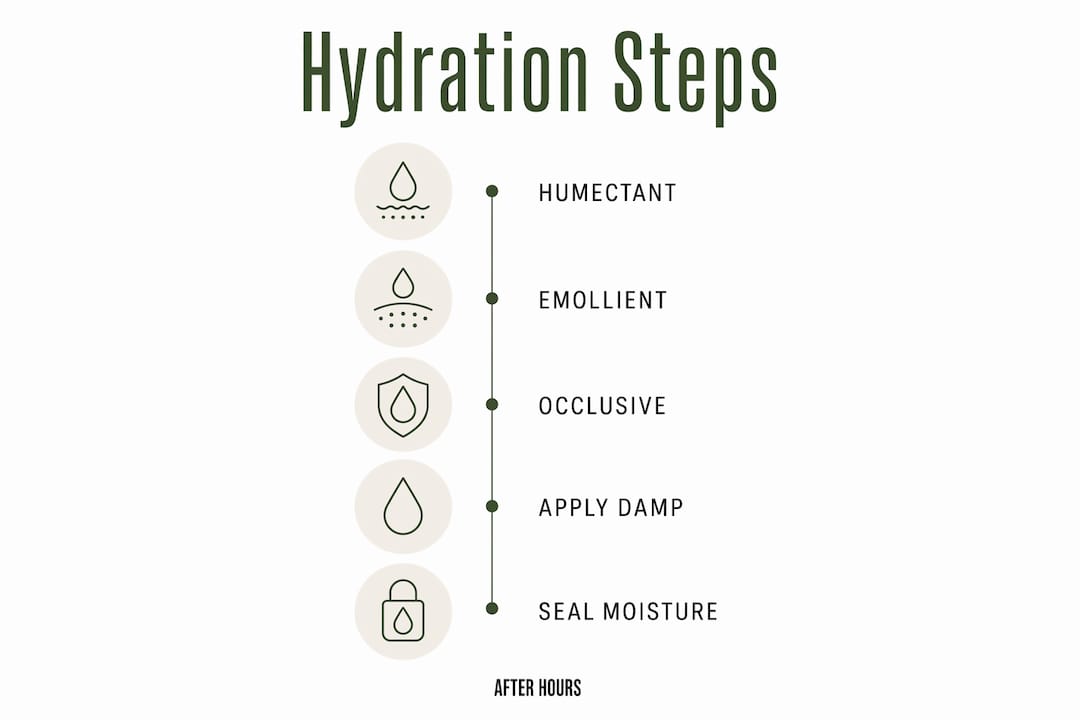
The most effective way to achieve long-lasting skin hydration is to apply a humectant to damp skin, follow with an emollient, then seal with an occlusive. This three-step sequence, applied shortly after washing, traps surface water before it evaporates and gives each ingredient class the conditions it needs to work. Multi-class formulations consistently outperform single-active products in clinical reviews.
Start here — do this in the next two minutes:
- Pat skin until just slightly damp after washing (not dripping, not bone-dry).
- Apply a humectant serum or toner (glycerin, hyaluronic acid) while damp.
- Layer an emollient moisturiser on top (ceramides, shea butter, squalane).
- Finish with a thin occlusive layer at night if skin is very dry (petrolatum, dimethicone). Repeat morning and evening, consistently, for several weeks.
Pro Tip: Apply hyaluronic acid only to damp skin. On dry skin in a low-humidity room, it pulls water from deeper epidermal layers and can worsen dehydration rather than relieve it.
Table of Contents
- Why does skin lose moisture so quickly?
- The three ingredient classes that actually keep skin hydrated
- How to build a simple daily routine for long-lasting hydration
- Which daily habits actually support lasting skin hydration?
- Special concerns: sensitive, acne-prone, ageing and very dry skin
- How to read UK product labels and choose the right texture
- When will you see results, and what if it is not working?
- Key takeaways
- The part most guides skip
- Afterhoursbodybutter body butter: natural ingredients, real hydration
- Useful sources and further reading
Why does skin lose moisture so quickly?
Skin loses water continuously through a process called transepidermal water loss (TEWL). The outermost layer, the stratum corneum, acts as the primary barrier: a lattice of dead skin cells embedded in lipids (ceramides, fatty acids, cholesterol) that slows water from escaping. When that barrier is intact, TEWL stays low. When it is compromised by harsh cleansers, hot water, or environmental stress, water escapes faster than the skin can replenish it.
The stratum corneum also contains natural moisturising factor (NMF), a mix of amino acids, urea, and lactic acid that draws water into skin cells and holds it there. Repeated washing, low humidity, and ageing all deplete NMF. The result is the cycle most people recognise: skin feels tight, looks dull, and absorbs moisturiser quickly without staying soft for long.
Understanding skin barrier physiology makes it clear why timing and ingredient choice matter so much. A well-structured routine does not just add water; it rebuilds the conditions that keep water in. Surface softness can appear within days of starting a consistent routine, but meaningful barrier repair takes several weeks of daily application.
The three ingredient classes that actually keep skin hydrated

Clinical reviews confirm that moisturisers combining all three classes deliver more durable hydration than products built around a single active. Here is what each class does and which ingredients to look for on UK labels.
| Class | What it does | Key ingredients | Typical form | UK availability |
|---|---|---|---|---|
| Humectant | Draws water into the stratum corneum from the environment or deeper layers | Glycerin, hyaluronic acid, urea, aloe vera | Serum, toner, essence | Widely available — most pharmacies and supermarkets |
| Emollient | Fills gaps between skin cells, smooths texture, softens | Ceramides, shea butter, squalane, jojoba oil | Cream, lotion, balm | Available in pharmacies, health stores, online |
| Occlusive | Forms a physical film over skin to slow TEWL | Petrolatum, dimethicone, lanolin, beeswax | Ointment, balm, thick cream | Petrolatum widely available; dimethicone in many creams |
Humectants attract water but need a seal. Without an emollient or occlusive on top, they draw moisture to the skin surface where it evaporates quickly, especially in the dry UK winter. Emollients smooth and repair, but they do not stop water leaving. Occlusives do the sealing, reducing TEWL substantially when applied as the final step.
Pro Tip: Hyaluronic acid comes in different molecular weights. High-molecular-weight HA stays on the skin surface and plumps immediately; low-molecular-weight HA penetrates more deeply. Products combining both tend to give more sustained results. Check the natural humectants guide for plant-derived alternatives.
How to build a simple daily routine for long-lasting hydration
A consistent, minimal routine outperforms a complex one because it allows the barrier to repair without excessive layering or irritation. Apply shortly after washing — that window is when damp skin absorbs humectants most effectively.
Morning routine
- Cleanse with a gentle, fragrance-free cleanser. Rinse with warm (not hot) water.
- Pat skin until just damp. Apply humectant serum or a glycerin-based toner immediately.
- Apply emollient moisturiser. Massage in gently.
- Finish with SPF 30 or higher (broad-spectrum). UV exposure degrades the barrier and accelerates moisture loss.
Evening routine
- Double-cleanse if wearing SPF or makeup; otherwise, one gentle cleanse is enough.
- Apply humectant to damp skin.
- Apply emollient moisturiser or a richer cream than your morning product.
- On very dry nights, apply a thin layer of occlusive (petrolatum, dimethicone-based balm) over the top. This is sometimes called “slugging” and is particularly useful two to three nights per week in winter.
Skin-type variants
Oily or combination skin: Use a lightweight lotion rather than a cream. Skip the occlusive step on oily zones. A gel-based humectant (hyaluronic acid gel) works well.
Sensitive skin: Fragrance-free, minimal-ingredient formulas only. Introduce one new product at a time. Patch test on the inner arm for 24 hours before applying to the face.
Very dry or mature skin: Creams and ointments consistently outperform lotions for genuinely dry skin. A richer emollient applied twice daily, with nightly occlusion, accelerates barrier recovery.
Acne-prone skin: Choose non-comedogenic occlusives (dimethicone rather than petrolatum). Avoid heavy slugging on breakout-prone areas.
Which daily habits actually support lasting skin hydration?
Products do most of the work, but a few simple habits make a measurable difference. The biggest gains come from changing how you bathe and what you do immediately afterwards.
Shower length and temperature. Limit showers to 5–10 minutes and use warm rather than hot water. Hot water strips the oily layer that slows TEWL. Closing the bathroom door while showering raises ambient humidity and reduces moisture loss from exposed skin.
Moisturise immediately after bathing. Apply your moisturiser while skin is still slightly damp. Waiting until skin is fully dry means the surface water has already evaporated and the humectant has less to work with.
Indoor humidity. A humidifier in the bedroom reduces the environmental moisture gradient that pulls water from skin overnight. Place it near the bed and run it while you sleep. Clean it weekly to prevent mould.
| Habit | Effect on skin moisture | Practical action |
|---|---|---|
| Hot showers | Strips lipid barrier, raises TEWL | Switch to warm water, limit to 5–10 min |
| Low indoor humidity | Increases TEWL, worsens dryness | Use a bedroom humidifier in autumn/winter |
| Harsh cleansers (SLS) | Disrupts NMF and barrier lipids | Switch to fragrance-free cleansers |
| Tight synthetic clothing | Friction strips barrier on body skin | Wear loose cotton; silk underlayer for rough fabrics |
| Frequent hand washing | Depletes hand barrier rapidly | Apply hand cream after every wash |
Diet and hydration. Drinking adequate water supports skin hydration from within. The Mayo Clinic notes that a diet rich in fruits, vegetables, and lean proteins may help prevent early skin ageing, while diets high in refined carbohydrates can accelerate it. Omega-3 fatty acids (oily fish, flaxseed) support lipid production in the stratum corneum.
Pro Tip: After a long-haul flight, cabin air humidity drops very low. Apply a humectant serum before boarding, reapply mid-flight, and seal with a balm or ointment on landing. Skip the face wipes — they strip NMF.
Special concerns: sensitive, acne-prone, ageing and very dry skin
When to see a clinician
Self-care works for most mild to moderate dryness. See a GP or dermatologist if you notice persistent cracking or bleeding, severe itch that disrupts sleep, a spreading rash, or no improvement after six weeks of consistent routine. These can indicate atopic dermatitis, psoriasis, or an underlying condition that requires prescription treatment.
Sensitive and reactive skin
Use fragrance-free, alcohol-free, minimal-ingredient products throughout. Avoid AHAs (lactic acid, glycolic acid) until the barrier has recovered — they accelerate cell turnover but increase TEWL temporarily. Patch test every new product. The skin barrier repair guide covers targeted steps for reactive skin.
Acne-prone skin
Hydration and acne management are not mutually exclusive. Dehydrated skin often overproduces sebum, worsening breakouts. Choose non-comedogenic emollients (squalane, jojoba) and lightweight occlusives (dimethicone). Avoid heavy petrolatum on acne-prone zones.
Ageing skin
Ceramide production slows with age, reducing barrier integrity. Peptide-containing moisturisers support collagen synthesis alongside hydration. If using a retinoid, apply it between two layers of moisturiser (the “sandwich method”) to reduce irritation and barrier disruption.
Severe xerosis (very dry skin)
The NHS recommends emollients as the first-line treatment for very dry skin conditions. In UK winters, switching to higher-lipid creams or ointments and using targeted occlusion two to three nights per week produces faster barrier recovery than adding more serums. Apply emollient to the body within minutes of bathing.
How to read UK product labels and choose the right texture
What to look for
- Ceramides (ceramide NP, AP, EOP): barrier repair; look for them in the first five INCI ingredients.
- Glycerin: the most evidence-backed humectant; inexpensive and effective.
- Hyaluronic acid (sodium hyaluronate): effective humectant; check molecular weight if listed.
- Petrolatum or dimethicone: reliable occlusives; petrolatum is the most studied.
- Shea butter or squalane: emollients with good tolerability for sensitive skin.
What to avoid
- Fragrance (parfum) and essential oils in high concentrations — common sensitisers.
- Sodium lauryl sulphate (SLS) in cleansers — strips the barrier.
- High-concentration alcohol (denatured alcohol, alcohol denat.) in moisturisers — increases TEWL.
- “Unscented” does not mean fragrance-free; it may contain masking chemicals that irritate dry skin.
Texture by skin type and season
Lotions contain more water and fewer lipids than creams or ointments. For genuinely dry skin, creams and ointments are more effective. In summer, a lighter lotion or gel may be comfortable on the face; switch to a cream or ointment in autumn and winter, particularly in the UK where central heating drops indoor humidity significantly.
Packaging and hygiene
Pump dispensers are preferable to open jars — they reduce contamination and oxidation of active ingredients. If you use a jar, apply with a clean spatula. Check the period-after-opening (PAO) symbol (the open-lid icon with a number) and discard products past that date.
Cost
Glycerin and petrolatum are among the most cost-effective moisturising ingredients available. A basic pharmacy-brand cream containing ceramides, glycerin, and dimethicone often outperforms an expensive single-active product. Spend more on SPF and actives (retinoids, vitamin C) if budget is limited; the moisturiser itself does not need to be expensive to be effective.
When will you see results, and what if it is not working?
Surface softness and reduced tightness typically appear within a few days of starting a consistent, well-structured routine. Meaningful barrier rebuilding takes several weeks, as the stratum corneum renews itself over that period. Do not judge a routine in under four weeks.
Troubleshooting checklist
- Applying humectant to dry skin? Switch to damp application immediately. This is the single most common reason a routine underperforms.
- Using a foaming or sulphate-based cleanser? Replace it with a gentle, fragrance-free alternative. Harsh cleansers undo moisturiser benefits within hours.
- Wrong texture for your skin type? If you have genuinely dry skin and are using a lotion, upgrade to a cream or ointment.
- Skipping the occlusive step in winter? Add a thin layer of petrolatum or dimethicone-based balm at night, a few times per week.
- Applying moisturiser too infrequently? Apply at least twice daily. For very dry or cracked skin, apply after every hand wash and whenever skin feels tight.
- Introducing too many new products at once? Simplify to three steps (humectant, emollient, occlusive) and reintroduce actives one at a time after four weeks.
Red flags — see a clinician
Cracking that bleeds, severe itch that disrupts sleep, a rash that spreads beyond the original dry area, or no improvement after six weeks of consistent routine all warrant a GP or dermatologist appointment. These may indicate atopic dermatitis, psoriasis, contact dermatitis, or another condition requiring prescription treatment.
Tracking progress
Photograph the same area in the same lighting weekly. Keep a brief product diary noting what you applied and when. Objective tracking prevents the common mistake of abandoning a routine that is working slowly.
Key takeaways
Consistent application of a humectant, emollient, and occlusive to damp skin is the most effective approach to long-lasting hydration, with visible surface improvement in days and barrier repair over four to six weeks.
| Point | Details |
|---|---|
| Apply in order on damp skin | Humectant first, emollient second, occlusive last — within 5–10 minutes of washing. |
| Choose multi-class moisturisers | Combined formulations outperform single-active products for sustained hydration. |
| Adjust texture seasonally | Switch to creams or ointments in UK autumn and winter; lighter lotions in summer. |
| Barrier repair takes time | Surface softness appears in days; meaningful barrier rebuilding takes several weeks. |
| Afterhoursbodybutter | Vegan, natural-ingredient formulations designed to address dryness using the humectant-emollient-occlusive triad. |
The part most guides skip
Most long-lasting moisture skin guides focus on what to buy. The more useful question is why the routine breaks down, and the answer is almost always timing and texture mismatch, not ingredient quality.
Applying a hyaluronic acid serum to dry skin in a centrally heated UK flat in January is not just ineffective; it actively pulls water from deeper skin layers and leaves skin drier than before. The research on this is clear, yet the instruction “apply to damp skin” appears in small print on packaging, if at all. The same applies to texture: a light lotion on genuinely xerotic skin is like putting a thin coat of paint on a cracked wall. It looks fine briefly, then the cracks show through.
The other underappreciated point is that barrier repair is cumulative. Skin does not respond to a single good routine night the way it responds to four consistent weeks. People abandon working routines at week two because they expect faster results. The four-to-six-week window is not a marketing claim; it reflects the actual renewal cycle of the stratum corneum.
What actually works is simpler than most product ranges suggest: three steps, consistent timing, the right texture for the season, and patience. The complexity is in understanding why each step matters, not in the number of products.
Afterhoursbodybutter body butter: natural ingredients, real hydration
Dry skin that does not respond to standard moisturisers often needs a formulation that works across all three classes at once. Afterhoursbodybutter body butters are built around natural humectants, barrier-repairing emollients, and plant-based occlusives, designed specifically for very dry, sensitive, and acne-prone skin.
The range is fully vegan, cruelty-free, and free from synthetic fragrances and harsh chemicals. Fat-soluble vitamins and nutrients are included to support barrier function alongside hydration. If you prefer a natural, minimal-ingredient approach to long-lasting hydration, Afterhoursbodybutter is a practical fit for the routine described in this guide.
Free UK delivery on orders over £30. Shop now at afterhoursbodybutter.co.uk and find the right product for your skin type.
Useful sources and further reading
Clinical and UK-specific references used in this guide:
- Moisturizers — StatPearls, NCBI Bookshelf: core clinical evidence on ingredient classes, multi-class formulations, and TEWL mechanisms.
- American Academy of Dermatology — how to pick a moisturiser: practical guidance on texture selection, application timing, and ingredient lists.
- AAD — dermatologists’ tips for relieving dry skin: bathing habits, cleanser choice, and when to see a clinician.
- Harvard Health — how to moisturise your skin: humidifier guidance, diet, and lifestyle factors.
- NHS — emollients: UK patient guidance on emollient use for dry skin conditions, including application frequency and product types.
- The Skin Formulary — skincare routine for dry skin: routine structure, slugging, and realistic timelines for barrier repair.
- Mayo Clinic — skin care tips: diet, sun protection, and gentle cleansing guidance.