


Skin dehydration is the state where the skin lacks adequate water content in its outermost layer, impairing its function and appearance. The condition sits in the stratum corneum, the skin’s outermost layer, and differs fundamentally from dry skin, which is an oil deficiency. Understanding what causes skin dehydration matters because the triggers are largely environmental and behavioural, meaning most people can address them directly. The skin’s hydration level affects elasticity, barrier function, and how skin looks and feels day to day. Both internal factors, such as water intake, and external ones, such as weather and skincare habits, play a role.
How does the skin normally hold onto water?
The skin’s ability to retain water depends on two things working together: the stratum corneum’s water content and the lipid barrier that stops water from escaping. Healthy skin maintains approximately 10–20% water in the stratum corneum and 70–75% water across the wider epidermis. When either figure drops, skin loses its suppleness and barrier integrity follows.
The lipid matrix sits between skin cells and acts as a physical seal. It is made up of ceramides, cholesterol, and fatty acids, and its job is to prevent transepidermal water loss (TEWL). TEWL is the rate at which water passively evaporates through the skin. A damaged lipid matrix means faster water loss, regardless of how much water you drink.
Natural Moisturising Factor, or NMF, is a collection of water-soluble compounds found inside skin cells. These include amino acids, urocanic acid, and pyrrolidone carboxylic acid. NMF draws water from the environment and holds it within the stratum corneum, keeping the outer layer pliable. Without sufficient NMF, the skin cannot regulate its own moisture effectively.
Skin hydration is not simply about drinking water. It depends on the stratum corneum’s water content and a functioning lipid barrier working in tandem. Damage either component and dehydration follows, regardless of lifestyle.
Fibroblast activity in the deeper dermis also contributes. Fibroblasts produce hyaluronic acid and collagen, both of which support the skin’s water-holding capacity from within. Age-related decline in hyaluronic acid and lipid biosynthesis is a primary reason skin becomes more prone to dehydration over time.
What causes skin dehydration: external and lifestyle factors
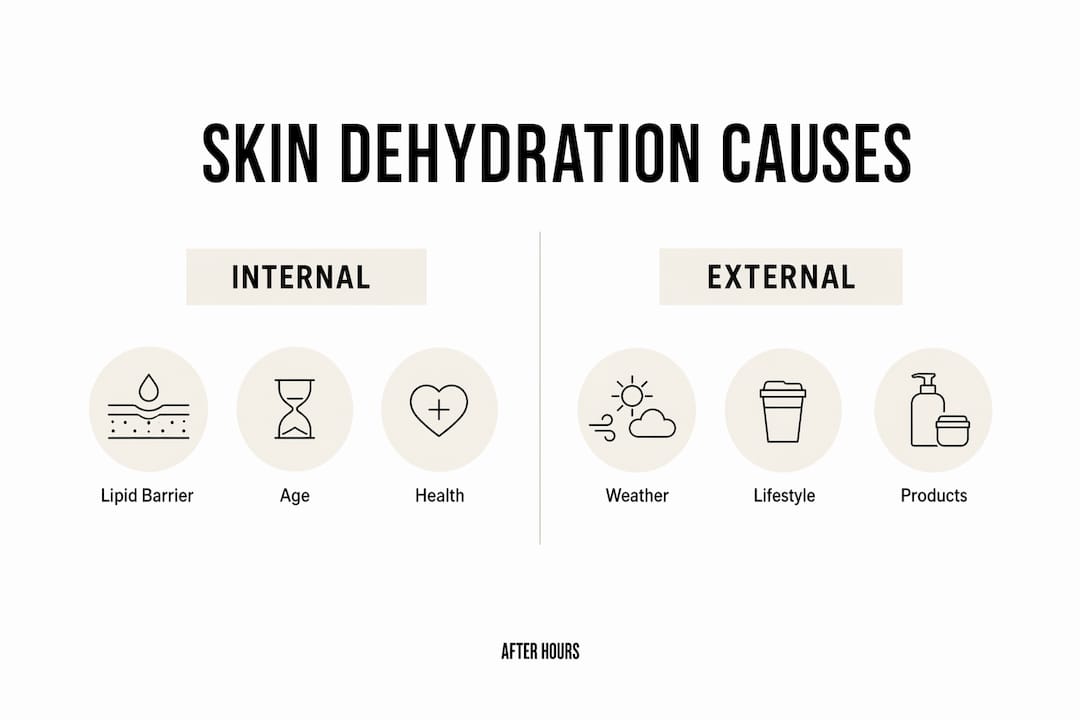
External factors are the most common triggers of skin dehydration, and many are avoidable. The following are the main culprits:
-
Low humidity and heating systems. Central heating and air conditioning strip moisture from indoor air. UV rays, pollution, and heating systems all disrupt barrier lipids and raise TEWL. Cold weather and wind compound this by physically stressing the lipid matrix.
-
Hot showers and over-bathing. Bathing for more than 10 minutes with hot water increases TEWL and strips the skin’s natural oils. The damage is cumulative. Shorter showers with warm, not hot, water reduce the risk significantly.
-
Harsh cleansers and over-exfoliation. Surfactant-heavy soaps and frequent exfoliation remove the hydrolipidic film, the skin’s primary defence against water loss. Over-cleansing and over-exfoliating disrupt the lipid barrier, increasing water loss and worsening dehydration.
-
UV radiation and pollution. Oxidative stress from UV exposure and airborne pollutants degrades ceramides and other lipid components. This accelerates moisture loss even when the skin looks otherwise healthy.
-
Insufficient water intake and systemic factors. Insufficient systemic water intake contributes to skin dehydration, though topical care and lifestyle factors are equally critical for visible improvement. Illness, fever, and heavy sweating also deplete the body’s water reserves quickly.
-
Stress, poor sleep, alcohol, and smoking. Chronic stress raises cortisol, which impairs barrier repair. Poor sleep reduces the skin’s overnight recovery. Alcohol and smoking both accelerate water loss and reduce the skin’s capacity to retain moisture.
Pro Tip: Apply a moisturiser within two minutes of stepping out of the shower. This window, while the skin is still slightly damp, is when occlusives are most effective at sealing in water.
Is dehydrated skin the same as dry skin?
Dehydrated skin and dry skin are not the same condition. Dry skin involves oil deficiency, whereas dehydrated skin involves water deficiency. The distinction matters because the treatments differ entirely.
| Feature | Dry skin | Dehydrated skin |
|---|---|---|
| Root cause | Lack of oil (sebum) | Lack of water |
| Skin type affected | Dry skin type only | Any skin type, including oily |
| Key symptoms | Flaking, rough texture, tightness | Dullness, fine lines, tightness |
| Primary treatment | Oil-rich barrier creams | Humectants and occlusives |
| Permanent condition? | Yes, a skin type | No, a temporary condition |
Oily skin can be dehydrated. This surprises many people, but it is one of the most common misconceptions in skincare. When the lipid barrier is compromised, the skin loses water rapidly even if sebaceous glands are producing plenty of oil. The result is skin that feels greasy on the surface but tight and dull underneath.
Applying heavy, oil-based moisturisers to dehydrated but oily skin does not solve the problem. It can block pores and trigger breakouts without addressing the water deficit at all. People frequently misinterpret dehydration symptoms and reach for oil-rich products that cause additional issues such as clogged pores or acne.
Hyaluronic acid is widely recommended for dehydration, but it carries a risk most people do not know about. Applying hyaluronic acid in a dry environment without an occlusive can paradoxically dehydrate skin by drawing water from deeper layers rather than from the air. Always follow it with an occlusive to lock the moisture in.
Pro Tip: If your skin feels tight after cleansing but looks shiny by midday, dehydration is the more likely cause. Try a humectant serum under your usual moisturiser for two weeks and assess the change.
How to prevent skin dehydration and restore moisture
Restoring hydration requires two steps: drawing water into the skin and then sealing it there. Humectants handle the first step. Occlusives handle the second. Using one without the other produces limited results.
- Choose a gentle cleanser. A non-stripping, pH-balanced cleanser preserves the hydrolipidic film. Limit shower time to under 10 minutes with warm water, not hot.
- Apply humectants to damp skin. Hyaluronic acid and glycerin attract water. Apply them while the skin is still slightly damp to maximise absorption.
- Seal with an occlusive immediately. Strong occlusive products can reduce TEWL by up to 98% when applied correctly. Natural butters, ceramides, and similar ingredients form a physical barrier that holds moisture in. The role of natural butters in skincare is specifically to provide this occlusive function while also delivering fat-soluble nutrients.
- Support collagen and fibroblast function. Retinoids stimulate fibroblast activity, which supports natural skin hydration from within. Antioxidants protect existing lipid structures from oxidative damage.
- Adjust lifestyle habits. Drink adequate water, manage stress, and prioritise sleep. Avoid excessive alcohol and do not smoke.
- Pause aggressive exfoliation during barrier repair. Acids and physical scrubs slow recovery when the barrier is already compromised. A less-is-more approach using gentle, non-stripping cleansers and limited exfoliation supports recovery of the hydrolipidic film.
Skin hydration depends on both the water content within the stratum corneum and the lipid barrier preventing evaporation, which is why routines that combine humectants and occlusives consistently outperform single-product approaches.
Key takeaways
Skin dehydration is a water deficit in the stratum corneum caused by a damaged lipid barrier, environmental stressors, and lifestyle habits, and it requires humectants plus occlusives to resolve.
| Point | Details |
|---|---|
| Dehydration vs dry skin | Dehydrated skin lacks water; dry skin lacks oil. They need different treatments. |
| Barrier function is central | A damaged lipid matrix raises TEWL and causes moisture loss regardless of water intake. |
| Environment is a major trigger | Heating, cold weather, UV, and pollution all disrupt barrier lipids and accelerate water loss. |
| Humectants need occlusives | Hyaluronic acid without an occlusive can worsen dehydration in dry conditions. |
| Lifestyle matters | Short warm showers, gentle cleansing, and limited exfoliation support barrier recovery. |
What I have learned about skin dehydration after years of watching people get it wrong
Most people treat dehydrated skin with the wrong product. They feel tightness, see dullness, and reach for a thick cream. If that cream is oil-heavy but lacks humectants, it does nothing for the water deficit. The skin stays dehydrated under a greasy surface layer.
The distinction between oil and water in skin is not academic. It changes everything about how you shop and what you apply. I have seen people with oily, acne-prone skin who were chronically dehydrated because they avoided all moisturisers out of fear of breakouts. Their barrier was compromised, their skin was losing water rapidly, and the dryness was actually making their oil production worse as the skin tried to compensate.
The environmental triggers are underestimated too. Sitting in a centrally heated office all day, then coming home to a hot shower, then applying a product that contains alcohol. Each step is a small insult to the lipid barrier. Individually they seem minor. Together they create a cycle that is genuinely hard to break without changing the routine.
My honest view is that simplicity wins. A gentle cleanser, a humectant serum on damp skin, and a good occlusive applied immediately after. That sequence, done consistently, outperforms any complicated ten-step routine that strips and rebuilds the barrier daily. Patience is required. Barrier repair takes weeks, not days. But the results are durable when the routine is consistent.
— Darnell
Afterhoursbodybutter body butters for lasting skin hydration
Sealing moisture into the skin is where most routines fall short. Afterhoursbodybutter formulates its scented body butters using natural, vegan ingredients that provide the occlusive layer your skin needs after applying a humectant. The butters are free from harsh chemicals and designed specifically to support barrier function without clogging pores.
The Black Summit body butter is the flagship product, built to lock in moisture and deliver fat-soluble vitamins directly to the skin. It works best applied to slightly damp skin immediately after cleansing, exactly as the science recommends. If you are working to restore hydration and protect your barrier, Afterhoursbodybutter offers a practical, cruelty-free solution that fits directly into the routine described above.
FAQ
What are the main symptoms of dehydrated skin?
Dehydrated skin typically presents as dullness, tightness, and the appearance of fine lines that improve when the skin is moisturised. Unlike dry skin, it can occur on any skin type, including oily skin.
Can oily skin be dehydrated?
Yes. Oily skin can be dehydrated when the lipid barrier is compromised, causing rapid water loss even while sebaceous glands produce normal or excess oil. Using a humectant serum followed by a light occlusive addresses this without triggering breakouts.
Does drinking more water fix skin dehydration?
Systemic water intake contributes to skin hydration, but topical care is equally critical for visible improvement. Drinking water alone does not repair a damaged lipid barrier or replace lost NMF components.
How long does it take to rehydrate skin?
Barrier repair typically takes several weeks of consistent, gentle routine. Visible improvement in hydration and texture can appear within one to two weeks when humectants and occlusives are used correctly and barrier-disrupting habits are reduced.
Is hyaluronic acid always good for dehydrated skin?
Hyaluronic acid is effective when applied to damp skin and sealed with an occlusive. Applied to dry skin in a low-humidity environment without an occlusive, it can draw water from deeper skin layers and worsen dehydration.