


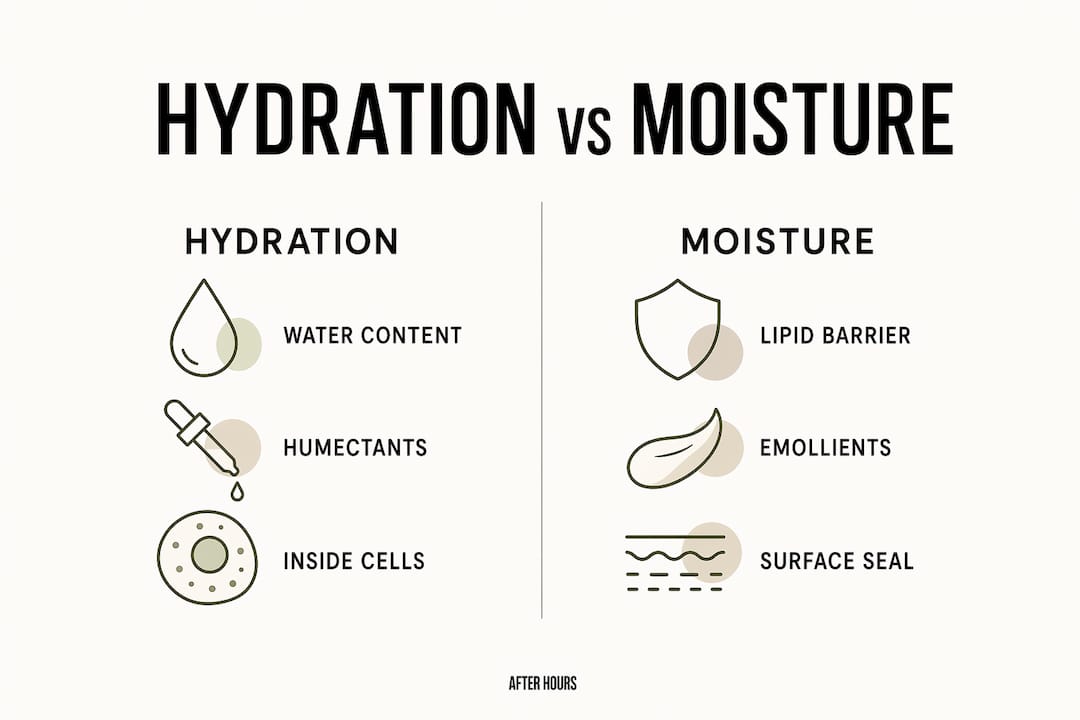
Hydration puts water into your skin cells. Moisturisation seals it in. Both matter, and most routines need both. The order is simple: apply a humectant first (a serum or gel containing hyaluronic acid or glycerin), then follow with a moisturiser that contains emollients or occlusives to stop that water escaping.
Quick check: what does your skin need right now?
- Tightness and dullness, fine lines that look deeper mid-day — your skin is likely dehydrated (water deficit)
- Flaking, rough patches, persistent dry areas — your skin is likely dry (lipid deficit)
- Both at once — common in winter or after travel; you need a hydrator and a moisturiser
Pro Tip: Apply your hydrating serum to slightly damp skin. Humectants draw water from the environment and from the surface of your skin, so a little moisture on the skin gives them more to work with before you seal everything in.
Table of Contents
- What is skin hydration vs moisture: the core difference
- How moisturisation protects your skin barrier
- How do you know if your skin needs hydration or moisture?
- How to layer hydrators and moisturisers in your routine
- Which ingredients hydrate and which ones moisturise?
- What does the research say about hydration and skin health?
- Key takeaways
- Afterhoursbodybutter: barrier support for dry and dehydrated skin
What is skin hydration vs moisture: the core difference
Hydration refers specifically to the water content inside your skin cells, particularly in the epidermis. Humectants are the ingredients that deliver it. They work by attracting water molecules and holding them in the upper layers of skin, either drawing moisture up from deeper tissue or pulling it from the air around you. The result is skin that looks plumper, feels softer, and shows fewer fine lines.
Common humectants to look for on labels include hyaluronic acid, glycerin, urea, panthenol, and aloe vera. You will find them most often in serums and gels, which are lightweight enough to absorb quickly and deliver actives close to the skin surface. Urea is worth a specific mention: at low concentrations (around 5–10%), it both attracts water and gently softens the stratum corneum, making it useful for rough or thickened skin.
Visible signs of good hydration include a natural bounce when you press the skin, reduced appearance of surface fine lines, and a healthy glow rather than a flat or grey tone. Topical humectants do most of the work, but internal hydration also plays a measurable role, particularly if your daily water intake is low. For natural humectant options including plant-sourced alternatives, there is useful guidance available.
How moisturisation protects your skin barrier
Moisturisation is about lipids, not water. The job of a moisturiser is to reduce transepidermal water loss (TEWL) by reinforcing the skin’s outer barrier, the stratum corneum, with oils, fatty acids, and occlusive agents that slow evaporation. Without this step, water you have just added to the skin can simply evaporate off.
Ingredient categories break down into three types:
- Emollients (squalane, fatty acids, jojoba oil) fill gaps between skin cells, smoothing texture and improving flexibility
- Occlusives (petrolatum, beeswax, lanolin) sit on top of the skin and physically block water from leaving
- Barrier-repair lipids (ceramides) mimic the skin’s own lipid matrix and support long-term structural repair
Product textures reflect these functions. Lightweight lotions suit oily or combination skin that needs a little barrier support without heaviness. Richer creams and balms deliver more occlusive coverage, making them better for dry or mature skin, or for evening routines when the skin is in repair mode. What makes a moisturiser effective depends on how these three ingredient types are balanced in the formula.
Pro Tip: For long-term barrier improvement, look for ceramides in your moisturiser rather than relying solely on occlusives. Ceramides actively rebuild the lipid matrix; occlusives only slow water loss while the barrier repairs itself.
How do you know if your skin needs hydration or moisture?
The two conditions feel different, but they are easy to confuse. Dehydrated skin has a water deficit. Dry skin has a lipid deficit. Oily skin can be dehydrated, which surprises many people: excess oil production is sometimes the skin’s response to a compromised barrier or low cellular water levels, not a sign that moisture is adequate.
Signs of dehydrated skin: dull tone, tight sensation (especially after cleansing), fine lines that look more pronounced in the afternoon, skin that feels thin or papery.
Signs of dry skin: persistent flaking, rough or scaly patches, visible dry areas that do not resolve with water alone, a feeling of tightness that does not ease after drinking more water.
Two quick at-home checks
- The skin-press test. Press two fingers gently against your cheek and hold for three seconds. Release and watch. Dehydrated skin shows a faint crease or takes a moment to spring back. Well-hydrated skin bounces back immediately.
- The tissue test. Press a clean tissue to your T-zone one hour after cleansing (no products applied). If the tissue picks up oil but your cheeks still feel tight and look dull, your skin is oily and dehydrated simultaneously.
Environmental and lifestyle factors accelerate both conditions. Low indoor humidity (common in UK winters with central heating), hot baths, alcohol, and certain medications all increase TEWL or reduce cellular water. If you have persistent scaling, severe irritation, or symptoms that do not respond to routine changes within two to three weeks, a GP or dermatologist referral is worth considering. For a fuller picture of what drives dehydration, the causes of skin dehydration are covered in detail elsewhere.
How to layer hydrators and moisturisers in your routine
Order matters because of physics. Water-based products need to reach the skin before any oil-based layer is applied; oils repel water, so applying a serum over a cream means the humectant cannot penetrate. The correct sequence: cleanse, apply hydrating serum or gel, follow with an emulsion or cream, and finish with a balm or occlusive if your skin still feels tight — this layering is clearly explained in how it works for maximum serum delivery and skin benefit.
Dermatologists consistently advise applying hydrating serums first and following with a moisturiser containing occlusive or emollient ingredients to lock in the benefit.
AM routine by skin type
| Skin type | Hydration step | Moisture step |
|---|---|---|
| Oily | Glycerin or hyaluronic acid gel | Lightweight lotion with niacinamide |
| Combination | Hyaluronic acid serum | Light cream on dry zones, gel on T-zone |
| Dry | Hyaluronic acid + panthenol serum | Rich cream with ceramides and squalane |
| Sensitive | Aloe or panthenol gel | Fragrance-free cream with ceramides |
PM routine notes
Evening is when the skin barrier does most of its repair work. A slightly richer moisturiser at night is appropriate for most skin types. Dry skin benefits from finishing with a plant butter or balm as the final occlusive layer. If you use retinoids or vitamin C, apply them after your hydrating serum and before your moisturiser. Buffering a retinoid by applying it over a thin layer of moisturiser reduces irritation without significantly reducing efficacy.
Reassess your routine every season. UK winters with low humidity and central heating increase TEWL noticeably; you will likely need a richer moisturiser from October through to March. Skin also produces less natural oil with age, so a routine that worked at 25 may need more emollient support by 40.
Which ingredients hydrate and which ones moisturise?
Moisturisers commonly combine humectants, emollients, and occlusives in a single formula, which is why product labels can be confusing. A cream labelled “hydrating” may contain all three categories.
| Humectants | Emollients | Occlusives |
|---|---|---|
| Hyaluronic acid | Squalane | Petrolatum |
| Glycerin | Shea butter | Beeswax |
| Urea | Jojoba oil | Lanolin |
| Panthenol | Fatty acids (e.g. linoleic) | Cocoa butter |
| Aloe vera | Ceramides | Mineral oil |
Many modern moisturisers are hybrid formulas that include humectants alongside occlusives, which can make a separate hydrating serum unnecessary for some skin types. Reading the ingredient list tells you whether a product genuinely covers both functions or relies on one category alone.
Common pitfalls to avoid:
- Applying oils or balms to dehydrated skin without a humectant underneath. Oils seal the surface but cannot add water to cells; you end up with a locked-in deficit.
- Using humectants alone in very low-humidity environments. Without an occlusive to follow, humectants can draw water from deeper skin layers and increase surface dryness.
- Over-exfoliating. Removing too much of the stratum corneum disrupts the lipid matrix and raises TEWL, undoing the work of your moisturiser.
- For acne-prone skin, choose non-comedogenic emollients (squalane, linoleic-rich oils) and lightweight occlusives. Heavy petrolatum-based products can block pores for some skin types, though individual response varies.
What does the research say about hydration and skin health?
A controlled clinical study on dietary water and skin hydration found that increasing daily water intake over 30 days improved both superficial and deep skin hydration in participants with lower baseline consumption. A clinical study measured epidermal hydration at multiple timepoints during the water intake increase. The improvement was most pronounced in those who started with lower fluid intake. For people already drinking adequate amounts, the topical effect was less significant, which confirms that topical routines remain necessary for localised, visible improvement regardless of diet.
| Evidence source | Key finding | Practical implication |
|---|---|---|
| PMC dietary water study | Increased water intake improved epidermal hydration in low-intake group | Drinking more water helps if your baseline is low; topical products still needed |
| StatPearls / NCBI | Moisturisers combine humectants, emollients and occlusives | Check labels for all three categories, not just one |
| Medical News Today | Humectants draw water in; emollients smooth; occlusives lock water in | Use products in this functional order for best results |
Dermatological consensus frames hydration and moisturisation as complementary. Most effective routines use both, and treating dehydrated skin with oils alone can mask symptoms without restoring cellular water levels. A practical two-week test: add a humectant serum to your current routine and note changes in skin tone, fine-line depth, and tightness. Track morning and evening observations. Most people see a visible difference within 10–14 days if dehydration was the primary issue.
Key takeaways
Hydration adds water to skin cells; moisturisation seals it in with lipids. Both steps are needed for a routine that actually works.
| Point | Details |
|---|---|
| Hydration vs moisture | Hydration = water in skin cells (humectants); moisturisation = lipids that prevent water loss (emollients, occlusives). |
| Correct layering order | Apply water-based hydrating serum first, then follow with a cream or balm to seal it in. |
| Diagnose before you treat | Dehydrated skin looks dull and shows fine lines; dry skin flakes and feels rough. Use the skin-press test to check. |
| Dietary water helps | Increasing water intake improved skin hydration in people with low baseline consumption, per the PMC study. |
| Afterhoursbodybutter | Vegan plant-butter formulas support barrier repair and moisturisation, suited to dry skin and heavier PM routines. |
A note on keeping it simple
The biggest mistake most people make is buying more products rather than using the right ones in the right order. Two products, a humectant serum and a good moisturiser, cover most skin needs. Start there, give it two weeks, and only add something new once you know what your baseline looks like. Seasonal changes and ageing both shift what your skin needs, so revisiting your routine every few months is worth the five minutes it takes.
Afterhoursbodybutter: barrier support for dry and dehydrated skin
Dry skin and dehydrated skin both need the right finish. Afterhoursbodybutter’s vegan body butters are formulated with plant-based emollients and barrier-supporting lipids, making them a practical occlusive step for dry patches, rough areas, and heavier PM routines.
The formulas are free from harsh chemicals and cruelty-free, with a focus on fat-soluble vitamins and natural plant butters that complement the moisturisation steps covered in this guide. They suit dry and sensitive skin types particularly well, and work as a finishing layer after a humectant serum to lock in hydration overnight. Check the ingredient list for plant butters and ceramide-supporting lipids when choosing a product.
Visit Afterhoursbodybutter to browse the full range and find the right barrier-support product for your routine.
Useful sources
- Dietary water affects human skin hydration and biomechanics (PMC) — The primary clinical study cited in this guide. Covers the effect of increased water intake on epidermal hydration in 49 healthy females.
- Moisturizers — StatPearls / NCBI Bookshelf — Authoritative clinical reference explaining how humectants, emollients, and occlusives function in modern moisturiser formulations.
- Hydration vs. moisture — Medical News Today — Consumer-facing explainer covering the core difference and practical ingredient guidance; useful for cross-referencing symptom descriptions.
- Hydration vs. Moisturization — Jane Yoo MD — Practising dermatologist’s guidance on layering order and product formats; supports the routine advice in this guide.
- Mayo Clinic — healthy lifestyle — Broad reference for lifestyle factors affecting skin health, including hydration and barrier function.