


If your moisturiser stings, your skin is usually signalling a compromised barrier or an ingredient triggering your sensory nerves. Stop any actives immediately, rinse with lukewarm water, and switch to a bare-minimum, fragrance-free routine. If the sting comes with swelling, blistering, or spreading redness, stop the product entirely and get medical advice rather than waiting it out.
TL;DR:
- Using rich occlusives like petroleum jelly or plant butters can help protect and repair the skin barrier during irritation.
- Refrain from active ingredients and harsh behaviors such as exfoliation, hot showers, or shaving until the skin recovers.
- Ingredients like fragrance, alcohol, high-strength acids, retinoids, and propylene glycol are common triggers for stinging and should be avoided on sensitive skin.
- Stinging lasting under 30 seconds and fading without redness typically indicates a transient sensory response rather than real irritation or allergy.
- A gradual reintroduction of actives over several weeks, starting with patch tests, minimizes risk of recurring sensitivity after barrier repair.
Table of Contents
- Minute-by-minute actions to stop the sting right now
- What actually makes a moisturiser sting: barrier damage, ingredients and behaviour
- Ingredients that commonly trigger stinging and why
- How to triage the reaction: transient sting, irritation, or allergy
- Safe short-term routine and products to reduce stinging
- A stepwise 2 to 4 week barrier repair plan
- How to choose a moisturiser that won’t sting next time
- Notes from After Hours on formulation and sensitive skin
- Where a barrier-supportive body butter fits into recovery
- Sources
Minute-by-minute actions to stop the sting right now
The first few minutes matter more than most people think. What you do immediately after the sting starts determines whether skin calms down in an hour or stays inflamed for days.
Start here:
- Rinse the area with lukewarm water. Not hot, not cold. Hot water strips more lipids and makes stinging worse.
- Do not scrub or use a flannel. Pat the skin dry with a clean towel.
- Apply a fragrance-free occlusive, such as petroleum jelly or a thick plant butter, if the skin isn’t broken or blistered.
- Pause every active ingredient: retinol, AHAs, BHAs, vitamin C serums, and anything labelled “brightening” or “resurfacing”.
- Stay out of direct sun and avoid hot showers, saunas, or steam rooms for at least 24 hours.
If the moisturiser is still on the skin and the sting is mild and fading, you can usually leave a thin layer in place rather than washing it off again, which risks re-irritating the area. If the sting is sharp, persistent, or paired with heat and swelling, remove the product with lukewarm water straight away.
Pro Tip: Keep a small pot of plain petroleum jelly or an unscented balm in the bathroom cabinet specifically for reaction days. Digging through a full skincare shelf while your face is stinging is the last thing you want to do.
What actually makes a moisturiser sting: barrier damage, ingredients and behaviour
Stinging almost always comes down to one of two things: your skin barrier is compromised, or an ingredient is irritating nerve endings that would otherwise be protected.
The outermost layer of skin, the stratum corneum, works like roof tiles held together by lipids, ceramides, cholesterol, and fatty acids. When that layer is intact, it keeps water in and irritants out. Strip those lipids through over-cleansing, harsh exfoliation, or excessive active use, and nerve endings sit closer to the surface with less protection. At that point, even a normally mild moisturiser reaches nerve fibres it never used to touch, and transepidermal water loss climbs, which dries skin out faster and compounds the sensitivity. This is the mechanism behind most stinging, and it’s backed by research on skin barrier function and repair.
There’s a meaningful difference between sensory irritation and allergic contact dermatitis. Irritation is a direct chemical or physical effect on the skin, often dose-dependent and reversible. Allergy is an immune response that can develop after repeated exposure to a specific ingredient, sometimes one you’ve used without issue for years.
A few other common causes worth knowing:
- pH mismatch: Healthy skin sits around pH 4.5 to 5.5. Acidic actives or poorly formulated products can throw that balance off, and a damaged barrier feels this far more acutely.
- Active overload: Layering retinol, an acid toner, and a vitamin C serum in the same routine adds up. Each ingredient alone might be fine; stacked together, they overwhelm the skin’s tolerance.
- Behavioural triggers: Hot showers, over-cleansing, and shaving immediately before moisturising all strip lipids and set skin up to sting at the next application.
If soap or a harsh cleanser started the problem, these steps for stripped skin walk through recovery in more detail.
Ingredients that commonly trigger stinging and why
Certain ingredients show up again and again in stinging complaints, and knowing which ones to watch for saves a lot of trial and error.
- Fragrance and essential oils. These remain the most common cause of both irritant and allergic reactions in skincare, even in products marketed as natural.
- Alcohol denat. Found in many gel moisturisers and toners, it strips surface lipids quickly, which explains the sharp sting on application.
- AHAs, BHAs, and concentrated niacinamide. Glycolic acid, salicylic acid, and niacinamide above around 10% can sting on skin that’s already compromised, even though niacinamide is usually well tolerated at lower strengths.
- Retinoids. Effective for texture and ageing, but notorious for stinging during the adjustment period, particularly on thin or already sensitised skin.
- Propylene glycol. A common penetration enhancer that helps other ingredients absorb faster, which sounds useful until it’s dragging fragrance or acids deeper into irritated skin.
A product labelled “suitable for sensitive skin” can still contain several of these, according to aggregated ingredient research. Marketing claims aren’t regulated the way active ingredient percentages are, so the label alone tells you very little.
How to triage the reaction: transient sting, irritation, or allergy
Not every sting means stop and panic. Clinicians commonly use a simple duration-based rule to sort a normal sensory response from something that needs action.
If the sting lasts under 30 seconds and fades without redness, it’s usually a transient sensory response. Skin with a few surface micro-tears or recent exfoliation reacts this way to almost anything, including plain water, and it settles on its own.
Longer or recurring stinging, especially paired with visible redness that builds rather than fades, points to an irritant reaction. That’s your skin telling you the product itself is the problem, not just your nerve endings being oversensitive that day.
Genuine allergy looks different again: itching rather than pure stinging, swelling, widespread redness beyond the application area, or a rash that develops hours or days later. That pattern warrants stopping the product completely and, if it doesn’t resolve within a few days, getting it looked at by a dermatologist or GP.
Safe short-term routine and products to reduce stinging
While skin recovers, less really is more. The goal is to stop adding irritants while giving the barrier time and material to rebuild.
Keep cleansing gentle and infrequent. A non-foaming, fragrance-free cleanser used with lukewarm water is enough. Skip physical scrubs, muslin cloths, and cleansing brushes entirely until the sting has settled.
For moisturising, look for ingredients that rebuild rather than just hydrate:
- Ceramides, cholesterol, and fatty acids replace the lipids your barrier has lost, which structured barrier repair research shows works better than humectants alone on damaged skin.
- Glycerin and panthenol draw in moisture and calm surface inflammation without the sting risk of acids or retinoids.
- Colloidal oatmeal has a long track record for soothing itch and irritation in over-the-counter emollients.
- Occlusives, such as petroleum jelly or rich plant butters, seal moisture in overnight and cut transepidermal water loss while lipids rebuild.
Even humectants like hyaluronic acid can sting on a damaged barrier if they aren’t paired with something to lock moisture in, which is why pairing a humectant with an occlusive matters more than reaching for either alone, as consumer-clinic guidance notes.
Sun protection still matters, but switch to a mineral sunscreen (zinc oxide or titanium dioxide) while skin is irritated. Chemical filters can sting compromised skin in exactly the same way other actives do.
Pro Tip: Apply your barrier-repair moisturiser to slightly damp skin straight after rinsing. It locks in more moisture than applying to fully dry skin and tends to feel noticeably less sharp on sensitised areas.
A stepwise 2 to 4 week barrier repair plan
Recovery has a rhythm to it, and knowing the rough timeline stops you from panicking or reaching for actives again too soon.
- Days 0 to 7: Strip back completely. Gentle cleanser, one barrier-repair moisturiser, mineral sunscreen by day. Apply an occlusive at night. No actives, no hot water, minimal sun exposure.
- Weeks 1 to 2: Watch for early signs of calm. Redness starts to fade, stinging on application becomes less frequent, and skin feels less tight after cleansing. Keep the routine unchanged.
- Weeks 2 to 4: Reintroduce one active at a time. Once skin tolerates the barrier-repair moisturiser with zero sting for at least a week, patch-test a single active, ideally a low-strength one, on a small area for several days before applying it broadly.
- Beyond 4 weeks: Rebuild gradually. Add back one product every one to two weeks, watching for recurrence. Skin that’s been mildly irritated typically stabilises within this window, while more significant barrier damage or dermatitis-type reactions can take longer and may need a dermatologist involved.
This mirrors the simplification protocols used in dermatology practices, where reintroducing actives one at a time is standard advice rather than a shortcut. For more detail on rebuilding long-term resilience once the acute phase passes, this guide to strengthening your skin barrier covers the maintenance phase.
How to choose a moisturiser that won’t sting next time
Once skin has calmed down, the real work is choosing products that don’t put you back at square one. A few label-reading habits make a bigger difference than any single ingredient claim.
- Choose fragrance-free, not “unscented.” Unscented products often still contain masking fragrance to cover raw material smells.
- Check for ceramides, glycerin, squalane, or panthenol near the top of the ingredient list rather than buried at the bottom.
- Avoid daily moisturisers that stack multiple actives (acids, high-strength niacinamide, retinol) into one product. Actives belong in a targeted step you control, not baked into your everyday hydrator.
- Patch-test anything new on the inner forearm for three to five days before applying it to your face, particularly with niacinamide-containing products, which can destabilise and irritate more when stored in heat or direct light.
- Be wary of marketing language like “intense resurfacing moisturiser” or “activated exfoliating cream.” These terms usually mean actives are present even when the packaging leans on soothing imagery.
Pharmacy-style emollients remain one of the safest starting points while you rebuild trust with your skin, and a practical guide to aqueous cream options is worth a look if you want a bland, barrier-friendly base. For a broader look at building a full sensitive-skin routine once the reaction has settled, this guide to body care for sensitive skin covers the next steps.
Notes from After Hours on formulation and sensitive skin
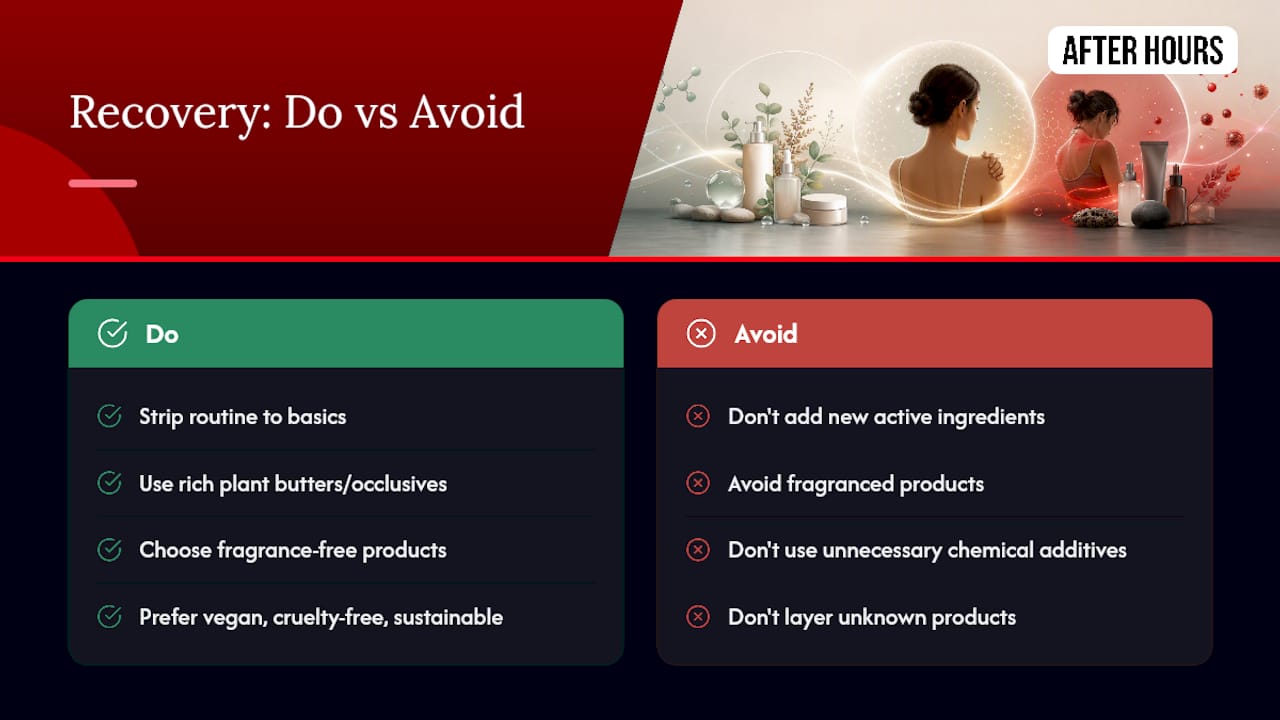
Customers come to us most often after a run of actives has left their skin raw and unpredictable. The pattern repeats: strip the routine back to almost nothing, and the sting usually fades within days rather than weeks. It’s rarely the moisturiser doing damage on its own. It’s what came before it.
Rich plant butters and occlusive-style balms earn their place specifically in that recovery window, when skin needs a physical seal more than it needs another active ingredient doing work. This approach involves formulating without fragrance or unnecessary chemical additives, and using vegan, cruelty-free ingredients, with attention to sustainable manufacturing and packaging practices.
— Darnell
Where a barrier-supportive body butter fits into recovery
A body butter formulated specifically for skin that’s already reactive uses vegan, chemical-free ingredients with fat-soluble vitamins and nutrients rather than fragrance or filler actives. That matters most during the exact recovery window this article covers: when your skin needs a rich occlusive layer, not another ingredient to tolerate.
A thick plant butter applied at night does the same job as petroleum jelly in a barrier-repair routine, sealing moisture in while ceramides and fatty acids rebuild underneath, but without synthetic additives that can undo the calming work you’ve just done. If your skin has been stinging through a run of actives or a harsh cleanser, easing it back with a formulation built around nourishing rather than resurfacing is a reasonable next step. Visit the After Hours Body Butter storefront to see the full range and find the product that fits your current skin, not the one you were using before it started stinging.
Sources
For readers who want to go straight to the clinical sources: the NHS guidance on emollients covers barrier-supporting products for irritated skin, the peer-reviewed review on skin barrier repair explains the underlying science, and the London Dermatology Centre’s clinic guidance outlines when persistent stinging needs a professional opinion.
This article is general information, not a substitute for advice from a qualified doctor. Consult a qualified healthcare professional about your own circumstances before acting on anything here.
- Skin barrier function and repair
- Why does my face sting when I apply moisturizer? — SkinDetekt
- Why Does My Moisturizer Burn? — Skin Deep Diaries
- Why does my skin burn after applying hydrating products? — Elora Clinic