


Three routes replace palm oil in skincare formulas: plant butters and oils (shea, cocoa, coconut, jojoba, mango, babassu), structured or hydrogenated vegetable fats, and fermentation-derived lipids grown from yeast or CO2. Each trades off differently between availability, functional match, and sustainability. What follows covers the formulation checks and sourcing steps that make the swap actually work.
TL;DR:
- Shea butter closely mimics palm stearin’s structure and functionality, but varying refinement grades can affect setting time and feel.
- Fermentation-derived lipids are emerging as sustainable, palm-like alternatives with consistent performance but still face regulatory and supply hurdles.
- Proper testing, including small-batch trials and accelerated oxidation tests, is essential to ensure palm-free ingredients match the texture and stability of original formulations.
- Sourcing verification through certifications like RSPO and detailed supplier assessment remains critical to ensure true sustainability claims.
- Using traceable, low-land-use lipids empowers buyers to influence the market and accelerate the shift away from conventional palm oil cultivation.
Table of Contents
- Practical palm oil free moisturiser ingredients that work now
- Matching palm oil’s technical functions without losing texture
- Checking sourcing, sustainability and regulatory status
- Biotech and fermentation-derived lipids: the next wave.
- What formulators should prioritise now
- How Afterhoursbodybutter puts palm-free formulation into practice
- Sources
- FAQ
Practical palm oil free moisturiser ingredients that work now
Shea butter is the closest like-for-like swap for palm oil in most body butters and balms, and that’s largely down to its fatty acid profile. It’s rich in oleic and stearic acids, giving it a firm structure at room temperature that softens on contact with skin, which is exactly the behaviour palm stearin provides in mass-market creams. It suits dry, mature, or barrier-compromised skin well, though its comedogenic rating sits in the middle range, so acne-prone users should patch test first.
Cocoa butter brings a harder, more brittle structure than shea, with a melting point close to body temperature (around 34 to 38°C). That makes it excellent for solid balms and lip products where you want a clean snap and a controlled melt, but it can feel heavy on oilier skin types and carries a stronger natural scent that some formulations need to mask.
Coconut oil is fully liquid to semi-solid depending on climate, high in lauric acid, and genuinely antimicrobial. It’s a poor choice for facial products aimed at breakout-prone skin because of its comedogenic profile, but it performs well in body-only formulas where pore-clogging risk matters less.
Jojoba oil isn’t technically an oil at all. It’s a liquid wax ester, structurally closer to human sebum than almost anything else in the plant kingdom. That structural similarity is why it sits near the bottom of comedogenicity scales and why it’s become the default non-comedogenic oil for face formulations targeting sensitive or acne-prone skin. It also has excellent oxidative stability, meaning products formulated with it resist rancidity for longer without needing heavy antioxidant loads.
Mango butter and babassu oil are the two most underused palm substitutes among smaller, sustainability-focused brands. Mango butter has a firmer texture than shea with lower fatty acid oxidation, useful where shelf stability is a concern. Babassu oil, extracted from a Brazilian palm relative but grown without the same deforestation footprint associated with oil palm, melts at body temperature and absorbs faster than coconut oil, making it a strong choice for lighter lotions.
Avocado oil and sunflower or olive oil round out the liquid-oil side of the equation. Avocado oil is heavier and richer in oleic acid, suited to very dry or damaged skin. Sunflower oil, particularly high-oleic variants, offers a lighter, faster-absorbing alternative with a good linoleic acid content that supports barrier function. Olive oil works similarly but oxidises faster, so it needs careful antioxidant support in a finished product.
For structure without any tropical-oil sourcing question at all, hydrogenated vegetable fats (typically derived from sunflower or rapeseed) can mimic palm stearin’s hardening function directly. These are processed to raise melting point and crystallinity, giving formulators a palm-free route to the same waxy structure without relying on plant butters that carry their own scent or colour.
Two barrier-focused oils deserve a mention even though they’re not structural replacements. Chia seed oil is exceptionally high in omega-3 fatty acids and supports the skin barrier in ways most tropical oils don’t match. Rosehip oil, rich in vitamin A precursors and essential fatty acids, is a favourite for scar and pigmentation concerns and layers well under heavier butters.
Which oils and butters to reach for, by function:
- Structure and hardness: cocoa butter, mango butter, hydrogenated vegetable fats
- Emollience without heaviness: jojoba oil, babassu oil, high-oleic sunflower oil
- Barrier support: chia seed oil, rosehip oil, avocado oil
- Sensitive or acne-prone skin: jojoba oil, babassu oil, rosehip oil
- Body-only, richer finish: shea butter, cocoa butter, coconut oil
Pro Tip: Always check the INCI name and supplier certificate of analysis before substituting one fat for another. “Shea butter” on a label can mean several different refinement grades with genuinely different melting points, and the wrong grade will throw off a formula’s set time and feel even when the ingredient name looks identical.
If you want a deeper comparison of how these butters perform against each other in real formulations, mango butter versus shea covers the trade-off in more technical detail, and the NHS guidance on emollients is a useful baseline reference for which oil types genuinely suit dry or reactive skin.
Matching palm oil’s technical functions without losing texture
Palm oil earns its place in formulations through four measurable properties: melting point and crystallinity, hardness, oxidative stability, and emulsification behaviour. Swap it out without checking all four, and a body butter that looked identical on paper can turn grainy, greasy, or unstable within weeks.
Run a short test sequence before committing to any substitution:
- Small-batch trial blends. Mix your candidate fat or fermentation lipid at 100g scale first, varying the ratio of semi-solid to liquid oil until the set texture matches your benchmark.
- Hardness and rheology checks. Use a simple penetrometer or even a consistent thumb-pressure test at controlled room temperature to compare firmness against your palm-based control.
- Oxidation testing. Store samples at accelerated conditions (typically 40°C) for several weeks and check for rancid odour or colour shift, since many palm-free liquid oils oxidise faster than palm fractions.
- Consumer feel panels. Even a handful of testers applying both versions blind will catch absorption speed and greasiness differences that lab data misses.
Processing matters as much as ingredient choice. Hydrogenated vegetable fats need tempering, similar to chocolate, to achieve a stable crystal structure rather than a soft, waxy one. Fermentation-derived lipids with engineered semi-solid profiles reduce this burden considerably, because their melting behaviour is closer to a pre-blended structure rather than requiring you to combine a hard butter with a liquid oil to hit the right set point. Whichever route you take, add tocopherols or a chelator to guard against oxidation, and revisit your emulsifier ratio, since palm-derived emulsifiers and their replacements rarely behave identically at the same percentage.
Pro Tip: Keep one small batch of your original palm-based formula in cold storage as a permanent benchmark. Memory of “how it used to feel” fades fast, and side-by-side comparison months later is the only reliable way to judge whether a substitution has genuinely matched the original.
Checking sourcing, sustainability and regulatory status
Palm cultivation’s environmental cost is well documented: expansion into tropical forest and peatland drives both deforestation and outsized greenhouse gas emissions, since drained peatland continues releasing carbon for decades after clearing. That lifecycle impact is why sustainability claims need checking rather than taking at face value, whether you’re sourcing palm or a substitute.
A short list of registries and certifications worth consulting:
- RSPO certification confirms a supplier follows recognised standards for sustainable palm management, and it’s worth understanding what the certification actually covers before assuming it applies to your specific batch.
- COSING, the EU’s cosmetics ingredient database, confirms INCI names and regulatory status for any ingredient sold into the European market.
- EUDR (the EU Deforestation Regulation) increasingly requires traceability documentation for palm-derived commodities entering the EU, which will affect supplier paperwork regardless of certification status.
Before signing off on any supplier, ask three direct questions: is this mass balance or segregated sourcing (mass balance mixes certified and uncertified material in the supply chain, segregated keeps them apart), can they provide a lifecycle assessment, and can they trace the batch back to a specific mill or farm. Vague answers to any of these three are a signal to keep looking.
Biotech and fermentation-derived lipids: the next wave.
Precision fermentation has moved from lab curiosity to formulation-ready ingredient faster than most palm oil alternatives skincare guides acknowledge. Yeast strains engineered to produce palm-like fatty acid profiles can now hit close functional parity with palm oil for texture, emollience, and melting behaviour, without needing a single hectare of tropical land.
Some fermentation-derived lipids report a high degree of functional parity with palm oil across texture, emollience, and melting profile, a level that makes small-batch reformulation genuinely viable rather than a compromise.
Fraunhofer IGB and Mibelle’s pilot project offers the clearest sign of where this is heading: their route converts captured CO2 into a palm-like fat blend, and moved to kilogram-scale production after laboratory validation in 2025. Commercial ingredients such as ZymaLipid Complex already deliver a semi-solid profile at room temperature with better oxidation stability than many traditional oils, and Torula-derived ranges are expanding the toolkit further. Expect availability to widen and cost to fall gradually over the coming years, but regulatory clearance and consistent supply still lag behind the plant-based swaps covered above.
What formulators should prioritise now
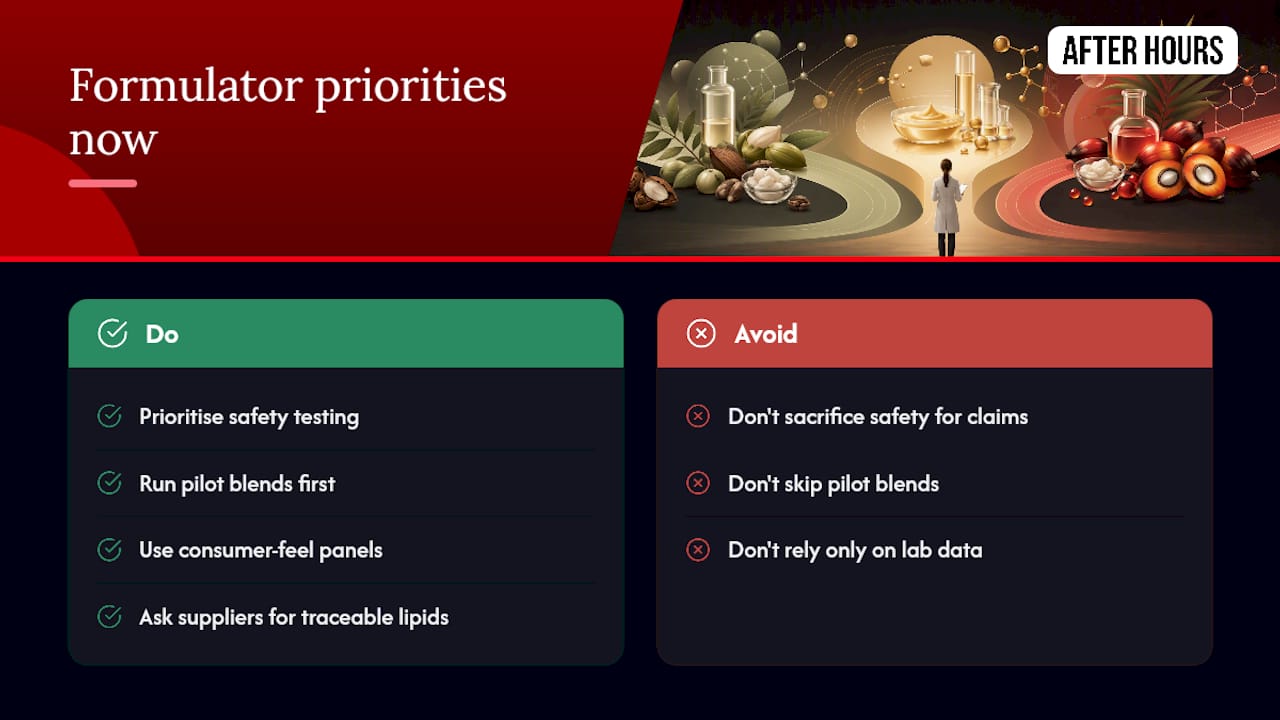
Sustainability claims mean nothing if the reformulated product breaks out sensitive skin or separates on the shelf. Prioritise safety and performance testing alongside any environmental pitch, and run pilot blends before committing to a full substitution across a product line. A simple consumer-feel panel of a dozen testers catches problems that oxidation charts and melting-point data never will.
The bigger opportunity is buyer leverage. Every formulator asking suppliers for traceable, low-land-use lipids nudges the market a little further away from commodity palm, faster than any single reformulation ever could.
— Darnell
How Afterhoursbodybutter puts palm-free formulation into practice
This brand offers palm-free body care products made without fillers or silicones, intended to address dryness, irritation, and acne-prone skin using fat-soluble vitamins and natural ingredients.
Formulators researching palm-free texture solutions are welcome to get in touch about formulation notes or sample packs, since seeing how a shea and jojoba blend actually performs on skin tells you more than any spec sheet. If you’re a consumer looking for a ready-made palm-free body butter rather than a DIY project, the full product range sits on the Afterhoursbodybutter site, packaged sustainably in the UK. Have a look through the range and see which formula matches your skin’s needs.
Sources
For deeper supplier checks, consult RSPO’s certification overview for sourcing verification, COSING for INCI and regulatory status, and the University of Bath’s yeast-derived lipid project for a closer look at fermentation science. For business context on why brands are making this switch, this guide on building a skincare brand is worth a read.
- Precision fermentation of bioidentical palm oil alternatives — Cosmetics & Toiletries
- Palm oil and global warming — Union of Concerned Scientists
- RSPO certification overview — RSPO
FAQ
What is a good replacement for palm oil in skincare?
Shea butter, cocoa butter, and babassu oil are the most direct replacements for structure and hardness, while jojoba oil and mango butter cover emollience without heaviness. For high-performance formulas, fermentation-derived lipids like ZymaLipid offer a closer functional match than most plant oils alone.
Is it better to avoid palm oil in skincare products?
Avoiding conventional palm oil reduces exposure to the deforestation and peatland emissions linked to its cultivation, though RSPO-certified sourcing can mitigate some of that impact if a full switch isn’t feasible. Palm oil free products from brands like Afterhoursbodybutter sidestep the question entirely by formulating without it from the start.
Which brands don’t use palm oil in their skincare products?
Afterhoursbodybutter formulates its full range of vegan body butters without palm oil, relying instead on plant butters and oils chosen for skin compatibility. Beyond that, checking a brand’s INCI list against the COSING database is the most reliable way to confirm any product’s palm-free status.
What are the disadvantages of palm oil on skin?
Palm oil itself isn’t inherently irritating for most skin types, but refined palm fractions can sit at a moderate comedogenic level, which makes them a poor fit for acne-prone or very sensitive skin. The bigger disadvantage for eco-conscious buyers is environmental rather than dermatological, tied to the land-use and emissions impact of conventional cultivation.