

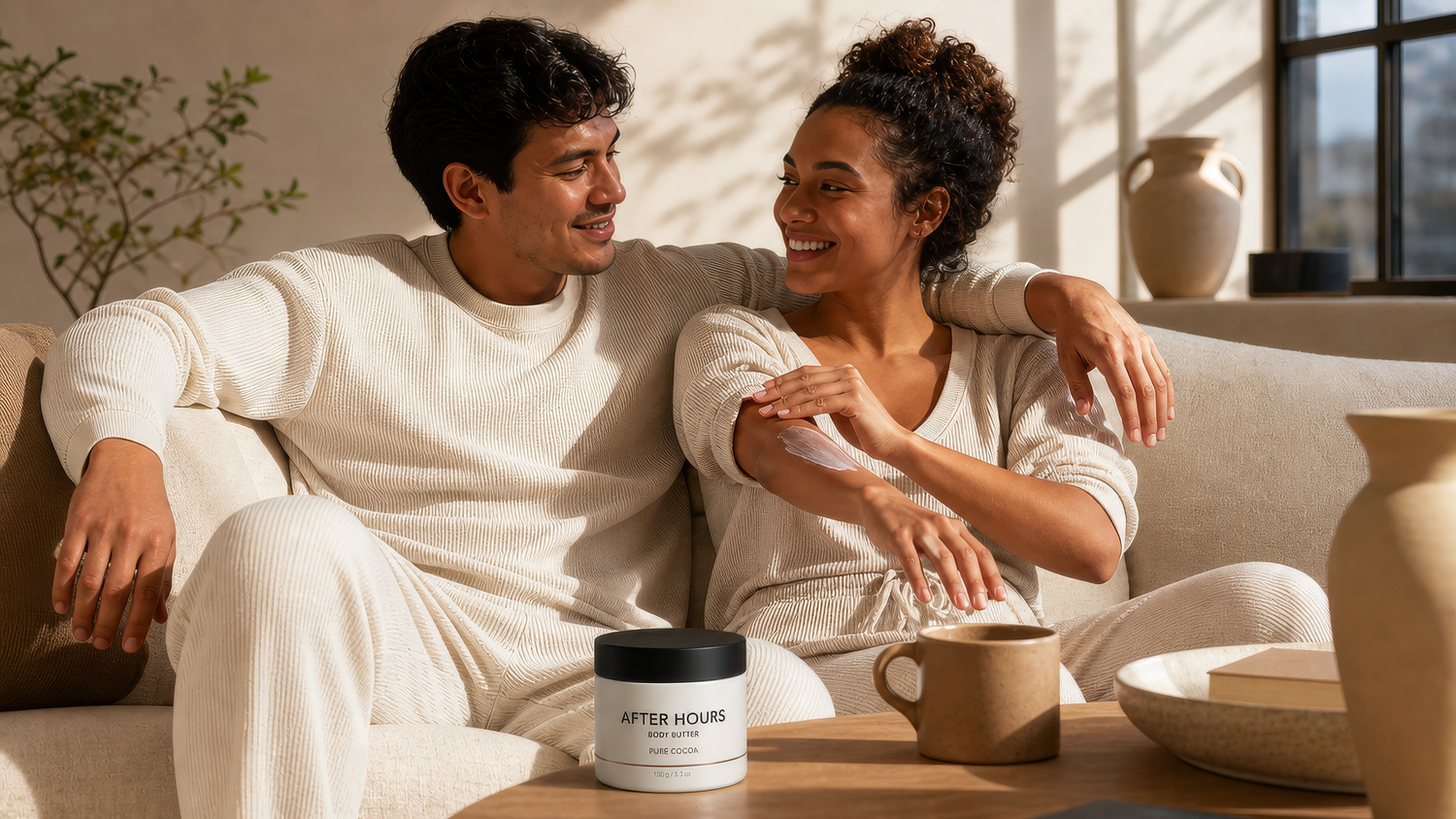

The most effective fix for swimmer dry skin is a two-part routine: rinse with fresh water before you get in, then rebuild your barrier straight after with a quick lukewarm shower, a gentle cleanser, pat dry, and a lipid-rich moisturiser applied while skin is still damp. Swimming measurably raises transepidermal water loss, so timing matters as much as the products you use. A dense, oil-based body butter locks in that moisture far better than a light lotion.
TL;DR:
- Rinsing with fresh water before swimming reduces chlorinated water absorption and minimizes transepidermal water loss during sessions.
- Applying a dense, oil-based moisturizer immediately after swimming effectively seals in water and rebuilds the skin barrier.
- Daily or high-volume swimmers often experience persistent dryness that requires consistent, twice-daily moisturizing and additional hydration efforts.
- Indoor pools cause more skin dryness due to low humidity and higher chlorine levels, while outdoor pools demand sun protection and salt residue rinsing.
- Sensitive or acne-prone skin benefits from fragrance-free, simple formulations with ceramides, fatty acids, and occlusives like shea or cocoa butter for optimal recovery.
Table of Contents
- Why swimming causes dry, irritated skin
- Do pre-swim habits actually reduce irritation?
- What should your post-swim skincare routine look like?
- Which ingredients actually help swimmer skin recover?
- When does dry skin need a dermatologist?
- Impact of indoor vs. outdoor pools on skin dryness
- Effects of swimming frequency and duration on skin health
- Diet and hydration tips that support skin barrier repair for swimmers
- Why a body butter, not a lotion, makes sense after swimming
- Quick note: try After Hours Body Butter as your post-swim occlusive
- Sources
Why swimming causes dry, irritated skin
Chlorinated water strips sebum from the skin faster than most people realise. A peer-reviewed study in the International Journal of Environmental Research and Public Health found that a two-hour swimming session significantly increased transepidermal water loss (TEWL) on the forearm, elbow crease, and back of the hand, with differences between swimmers and non-water athletes reaching statistical significance. That’s your skin’s barrier losing water faster than it can replace it, measured in real time.
Pool chemistry compounds the problem. Chlorine and its disinfection by-products break down surface lipids, while most pools run slightly alkaline, which pushes skin pH away from its naturally acidic state. A separate review of pool exposure and barrier function links this combination directly to what dermatologists call swimmer’s xerosis.
Several everyday habits make it worse:
- Long, hot showers after training strip whatever oil is left
- Washing daily with harsh, foaming soap disrupts the acid mantle further
- Low indoor air humidity draws moisture out of already-compromised skin
- Poor fluid intake reduces how much water your body has to spare for skin repair
None of these causes act alone. They stack, session after session, which is why swimmers often notice dryness creeping in gradually rather than after one swim.
Do pre-swim habits actually reduce irritation?
Pre-wetting your skin with fresh water before you get in the pool genuinely helps. Skin that’s already hydrated absorbs less chlorinated water on contact, a mechanism confirmed in sports dermatology guidance on aquatic sports. It costs nothing and takes ten seconds under a poolside shower.
Barrier creams marketed as pre-swim protection are a different story. Immersion tends to wash them off within minutes, so relying on a thick cream applied before you swim gives a false sense of security. Dermatologists interviewed for Triathlete’s coverage of post-swim dryness are consistent on this point: the real protection happens after you get out, not before you get in.
A short pre-swim checklist that actually earns its place:
- Rinse under fresh water for at least ten seconds before entering the pool
- Tie back long hair to reduce product and chlorine contact with your scalp and neck
- Fit goggles properly to avoid rubbing and irritation around the eyes
- Apply reef-safe sunscreen at least fifteen minutes before open-water swims
- Skip exfoliation on training days. It thins the barrier you’re about to expose to chlorine
Pro Tip: Keep a small bottle of fresh water in your kit bag for a quick splash-rinse before you even reach the poolside shower. It takes seconds and does more than any pre-swim lotion.
What should your post-swim skincare routine look like?
The window right after you leave the pool matters more than anything you do beforehand. Chlorine keeps working on your skin until you rinse it off, and the longer it sits, the more lipid loss you get.
Follow this sequence within a few minutes of finishing your swim:
- Rinse with lukewarm, not hot, water. Heat feels good but strips residual oils further
- Cleanse with a mild, oil-friendly wash rather than a foaming antibacterial soap
- Pat skin dry with a towel. Rubbing aggravates already-irritated skin
- Apply a humectant while skin is still damp, so it traps water at the surface
- Follow with a ceramide-rich moisturiser to rebuild the lipid layer
- Seal it in with an occlusive layer, such as a plant-based body butter or petrolatum balm
This layering order, humectant then barrier lipid then occlusive, is standard advice in sports dermatology literature on swimmers, and it works because each layer does a different job. Skip the occlusive step and the moisture you just applied evaporates within the hour.
A few practical notes worth flagging:
- Hands and feet crack first for most swimmers, since they get the most direct water exposure. Give them a second pass with a thicker balm.
- Winter training makes everything worse. Indoor heating dries the air further, so most swimmers need a heavier moisturiser from October through March.
- Daily swimmers should moisturise twice: once post-swim, once before bed, rather than relying on a single heavy application.
Which ingredients actually help swimmer skin recover?
Three ingredient categories do the real work, and understanding what each does stops you buying products on marketing language alone.
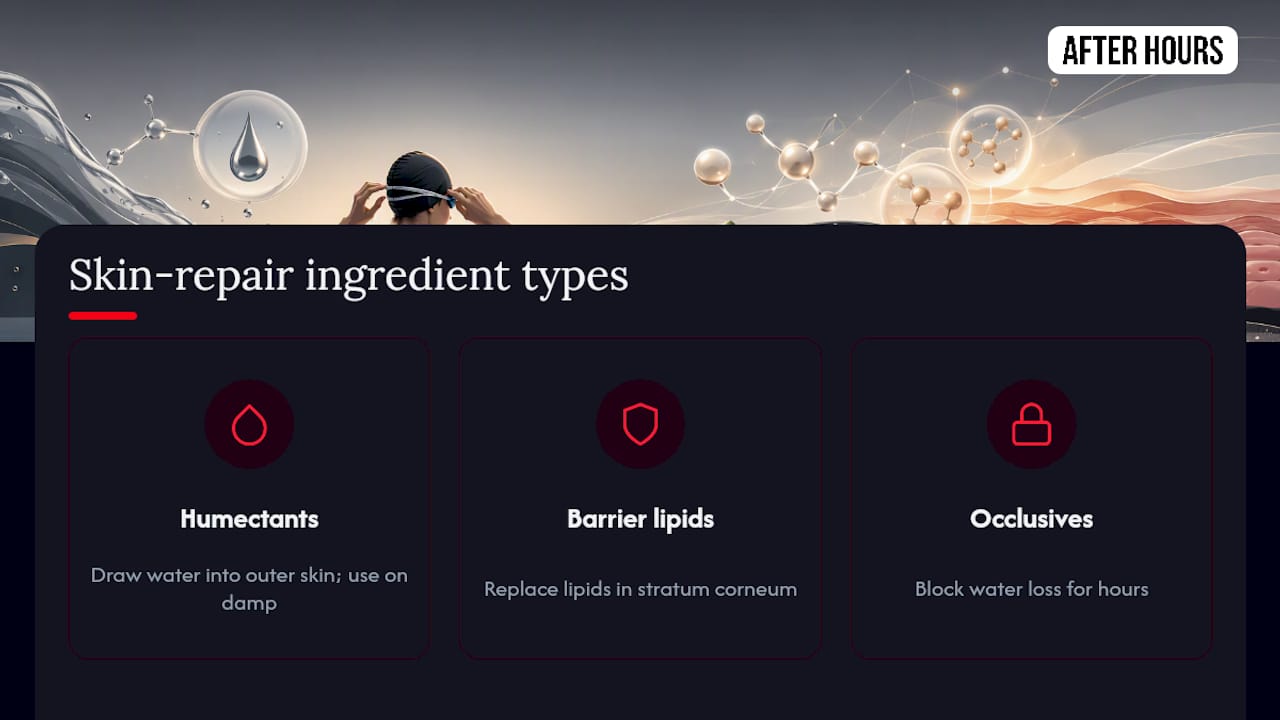
Humectants such as glycerin and hyaluronic acid pull water into the skin’s outer layer. They work best applied to damp skin, not dry, because they need water nearby to draw from.
Barrier lipids, mainly ceramides and fatty acids, replace what chlorine strips out of the stratum corneum. This is the layer that’s actually been measured as disrupted in the MDPI swimmer TEWL study, so it’s the one ingredient class swimmers can’t really skip.
Occlusives, including petrolatum, shea butter, cocoa butter, and squalane, sit on top and physically block water loss. Clinical guidance on managing swimmer’s xerosis consistently favours oil-based emollients over lighter formulas for exactly this reason. A dense body butter holds moisture in for hours; a watery lotion evaporates its own water content within thirty minutes, taking some of yours with it.
If you have sensitive or acne-prone skin, look for fragrance-free formulas with a short ingredient list. Minimal actives means less chance of the product itself triggering the irritation you’re trying to fix. Reading up on what causes skin dehydration in the first place helps explain why lightweight products alone rarely solve chronic swimmer dryness.
When does dry skin need a dermatologist?
Most swimmer dryness responds to routine changes within one to two weeks. If it doesn’t, or if you notice any of the following, book an appointment rather than adjusting your moisturiser again:
- Itching that disrupts sleep or doesn’t ease after moisturising
- Oozing, weeping, or crusting patches
- Blisters or a rash that spreads beyond the areas exposed to water
- Redness that gets worse rather than better over several days
These symptoms can point to contact dermatitis (a reaction to chlorine or pool additives), a flare of underlying eczema, or a more stubborn case of swimmer’s xerosis that needs prescription-strength emollients. Dermatology guidance from the AAD recommends professional assessment for anything persistent or atypical rather than guessing at causes.
Before your appointment, jot down how many hours a week you swim, which pools (chlorine, salt, or open water), and every product you’ve used on the affected area in the last month. That timeline speeds up diagnosis considerably.
Impact of indoor vs. outdoor pools on skin dryness
Indoor pools tend to be harder on skin than outdoor ones, and the reason isn’t the water itself. It’s the air. Indoor facilities run mechanical dehumidification and heating systems that keep ambient humidity low, which pulls moisture out of skin between sessions, not just during them. Combine that with chlorine concentrations that are often higher indoors, since there’s no rain or sunlight breaking down disinfection by-products, and you get a double exposure most swimmers don’t account for.
Outdoor pools and open water bring their own issues. Saltwater swimming (sea or brackish) has a drying effect too, though through osmosis rather than chemical stripping, and sun exposure adds UV damage on top of barrier disruption. Chlorinated outdoor pools sit somewhere in between: lower ambient chlorine buildup than an enclosed indoor hall, but more sun and wind exposure.
The practical takeaway differs by setting. Indoor swimmers benefit most from a humidifier in their bedroom overnight and a heavier moisturiser through winter months. Outdoor and open-water swimmers need the same post-swim barrier routine, plus sun protection and closer attention to salt residue, which should be rinsed off just as promptly as chlorine. Neither setting is risk-free. Both call for the same rinse, cleanse, moisturise sequence, just with different emphasis depending on which environmental stressor is doing the most damage.
Effects of swimming frequency and duration on skin health
Skin barrier disruption is dose-dependent, and the research backs this up directly. The MDPI study on elite swimmers measured TEWL before, immediately after, and thirty minutes after a two-hour session, finding the changes were significant enough to distinguish swimmers from athletes training in non-water sports. Longer sessions mean more cumulative chlorine contact and more time for your skin’s surface lipids to wash away.
Frequency compounds duration. A swimmer training four or five times a week gives their skin barrier far less recovery time between exposures than someone swimming once or twice. If your post-swim routine only partially repairs the barrier each time, the deficit builds. This is why competitive swimmers often report chronic dryness that recreational swimmers, who might swim once a week, rarely experience to the same degree.
There’s a useful comparison here to overtraining in other contexts: the damage isn’t from any single session, it’s from insufficient recovery between them. Swimmers doing high-volume training should treat post-swim moisturising as non-negotiable, not optional, precisely because their skin gets less time to recover on its own. Tracking session length and frequency alongside how your skin responds can help you spot the pattern before it becomes chronic. Training apps like Swimbox, built specifically for swimmers logging laps and sessions, make it easier to correlate training load with skin flare-ups over time.
If you swim daily, consider whether every session needs to be a full workout. Even one lighter week a month gives your skin barrier a chance to fully rebuild rather than running a permanent deficit.
Diet and hydration tips that support skin barrier repair for swimmers
Topical care only gets you so far if your body doesn’t have the raw materials to rebuild its own barrier. Skin repair relies on fatty acids and adequate hydration reaching the skin from the inside, not just products applied to the surface.
Fluid intake matters more than most swimmers assume, partly because pool time doesn’t feel like it should trigger thirst the way running or cycling does. Editorial commentary on swim skin care from Outdoor Swimmer Magazine notes that internal hydration status directly affects how dry skin looks and feels, alongside whatever moisturiser you’re using. If you’re finishing sessions dehydrated, no amount of body butter fully compensates.
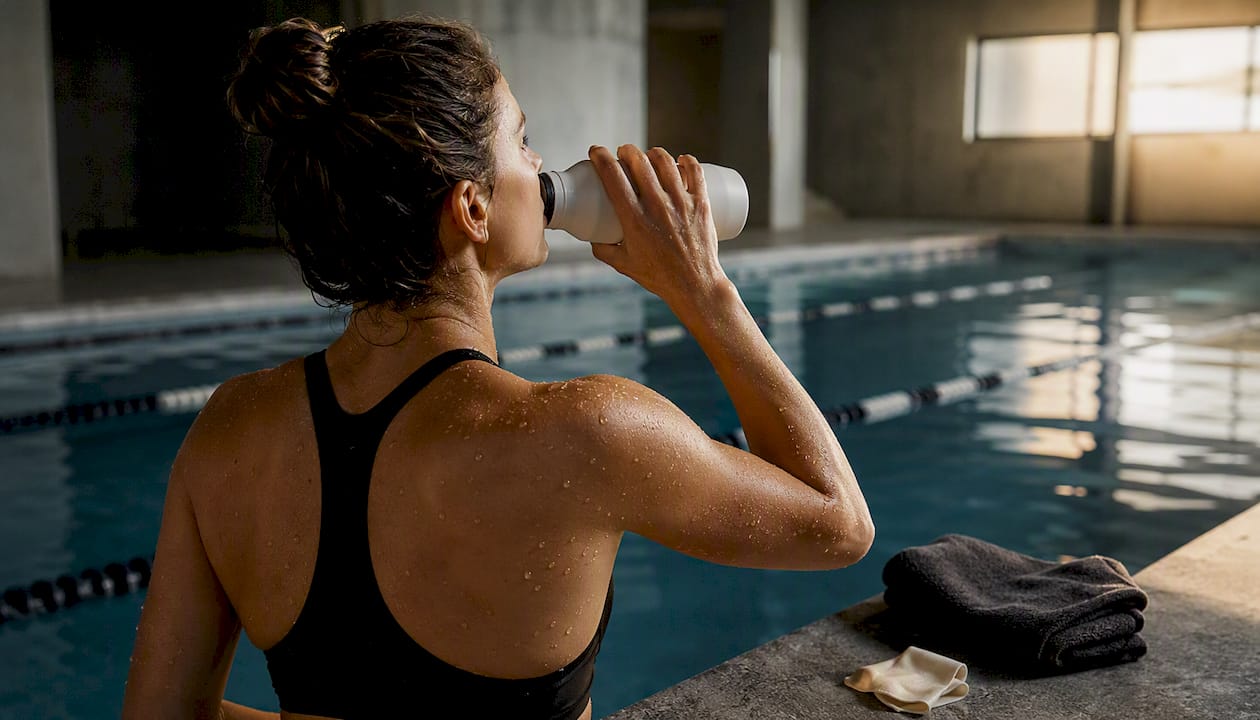
Diet-wise, omega-3 fatty acids (oily fish, walnuts, flaxseed) support the same lipid structures that ceramides work on topically. Vitamin E and vitamin A both play a role in skin repair and are worth getting from food rather than relying purely on supplements. None of this replaces a proper post-swim routine. It supports it. Swimmers who hydrate well and eat enough healthy fats tend to see their topical routine work faster and hold for longer between sessions.
Why a body butter, not a lotion, makes sense after swimming
Water alone won’t rebuild what chlorine strips out. That’s the gap Afterhoursbodybutter’s formulations are built around: plant-based butters carrying fat-soluble vitamins that sit in the barrier layer rather than evaporating off it within the hour, the way a thin lotion does.
Different swimmer scenarios call for different textures. Sensitive or acne-prone skin generally does better with a lighter, fragrance-free butter that won’t clog pores after chlorine exposure. Swimmers training daily, or through winter, tend to need a denser formulation that holds moisture through longer gaps between sessions. Neither replaces medical treatment for a genuine dermatitis flare, but for straightforward post-swim dryness, an occlusive layer built from natural fats does the job a watery moisturiser simply can’t.
— Darnell
Quick note: try After Hours Body Butter as your post-swim occlusive
Some body butters offer swimmers a genuinely occlusive, fat-rich formula made from vegan, chemical-free ingredients, avoiding layering fragrance and preservatives onto skin that chlorine has already irritated.

For many swimmers, a fragrance-free body butter applied to damp skin straight after a post-swim shower is a good starting point, with a smaller pot kept for hands and feet if they crack more than the rest of the skin. If you have particularly reactive or acne-prone skin, patch test on your inner forearm for 24 hours before applying it more widely. Topical care like this supports recovery between sessions, but it isn’t a substitute for medical treatment if you’re dealing with genuine dermatitis or eczema flares, those need a dermatologist, not a moisturiser. For everyday swimmer dryness, though, it’s a straightforward next step: browse the After Hours Body Butter range and pick a formula that matches your skin’s sensitivity and your training load.
Sources
- Effects of Exercise on the Skin Epithelial Barrier of Young Elite Athletes—Swimming Comparatively to Non-Water Sports Training Session
- Effects of exposure to pool environment on skin barrier function (study referenced earlier)
- Why Do I Get Dry Skin After Swimming?