


For therapeutic dryness and barrier repair, choose unrefined shea butter. For scent-sensitive or formulation-stable products, choose refined shea butter. That single choice comes down to what processing removes: unrefined shea keeps more of its vitamin A and E content and antioxidant load, while refined shea trades some of those bioactives for a neutral scent and a longer shelf life, a trade-off confirmed in laboratory analysis published in MDPI Foods.
The trade-offs break down like this:
- Nutrients vs uniformity: unrefined retains more tocopherols and sterols; refined offers batch-to-batch consistency.
- Scent vs neutrality: unrefined smells nutty and earthy; refined is close to odourless.
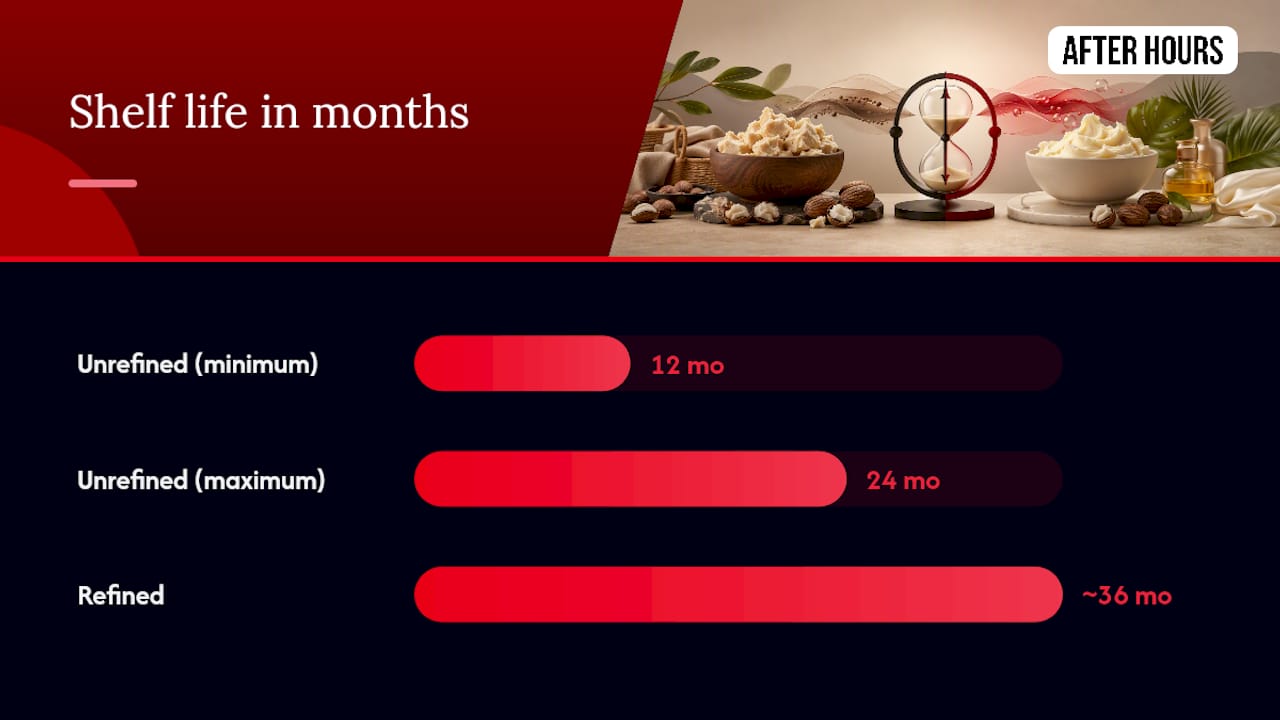
- Shelf life: unrefined lasts roughly 12 to 24 months; refined can hold up to around 36 months.
At Afterhoursbodybutter, that trade-off shapes every formulation decision, not just a shopping list.
Key Takeaways
Unrefined shea butter delivers more vitamins and antioxidants for therapeutic moisturising, while refined shea butter offers scent neutrality and a longer shelf life for cosmetic formulations.
| Point | Details |
|---|---|
| Choose by need, not habit | Unrefined suits therapeutic dryness and eczema; refined suits fragranced or pale-coloured products. |
| Nutrients drop with processing | Refining lowers tocopherols, sterols and antimicrobial activity compared with crude shea. |
| Shelf life favours refined | Unrefined lasts around 12 to 24 months; refined can reach roughly 36 months. |
| Check the label before buying | Look for cold-pressed or Grade A for raw shea, deodorised or cosmetic grade for refined. |
| Afterhoursbodybutter matches grade to purpose | Formulations lean on richer shea for dryness-focused products, staying vegan and chemical-free throughout. |
Table of Contents
- Unrefined vs refined shea butter: what raw shea actually is
- Refined shea butter: how processing changes what you get
- Which type suits your skin, and which to avoid
- How to use and store shea butter without wasting it
- How Afterhoursbodybutter chooses shea for its formulations
- Sources
Unrefined vs refined shea butter: what raw shea actually is
Unrefined shea butter is the closest thing to shea straight from the nut. Producers crush and roast shea kernels, grind them into a paste, then extract the fat through boiling water separation or manual kneading, a traditional method largely unchanged for generations. No chemical solvents, no bleaching, no deodorising. That matters because heat and chemical processing are exactly what strip out the compounds unrefined shea is prized for.
Laboratory comparisons show crude shea butter holds higher tocopherol, sterol and phenolic content than its refined counterpart, along with stronger radical-scavenging and antimicrobial activity, according to the MDPI Foods analysis. Those compounds, alongside vitamins A and E, are what give unrefined shea its reputation for genuine barrier repair rather than surface-level softness.
You will recognise it immediately by its senses, not just its label:
- Colour: ivory through to a distinct pale yellow, depending on the harvest and region.
- Scent: nutty, smoky, sometimes faintly earthy. It fades with skin contact but never disappears entirely.
- Texture: often slightly grainy straight from the tub, though it melts smoothly the moment it meets warm skin.
That grain is why unrefined shea earns its place in products aimed at eczema-prone or very dry skin, where deep, sustained moisture matters more than a polished sensory profile. The catch is variability. Colour and scent shift between batches, and because more of the natural fat structure survives, shelf life runs shorter than refined alternatives.
Pro Tip: If a tub of “unrefined” shea has almost no smell at all, ask what processing it went through. Genuine raw shea always carries some trace of its nutty aroma, even after months in storage.
Refined shea butter: how processing changes what you get
Refining shea butter is a multi-stage industrial process, and each stage removes something specific. De-gumming strips out phospholipids and gums that would otherwise cloud the fat. Neutralisation removes free fatty acids that cause rancidity. Bleaching lifts the natural yellow pigment. Deodorisation, usually done under steam and vacuum, pulls out the volatile compounds responsible for shea’s characteristic nutty smell. The result is a fat that is neutral in odour, paler in colour and notably smoother in texture.
That transformation gives refined shea a distinct set of practical advantages:
- A predictable melting point, which matters enormously for consistent manufacturing.
- A longer shelf life, often stretching toward 36 months under good storage conditions.
- No competing scent, which is why it turns up in facial creams, fragranced lotions and pale soap bars where a nutty undertone would clash with the intended fragrance.
- Uniform appearance batch to batch, useful for brands that need visual consistency across production runs.
Some refiners also fractionate shea into stearin and olein, two fractions with different melting points used to fine-tune texture for specific product types, from firmer balms to lighter lotions. The trade-off is measurable: refining and fractionation reduce peroxide value and free fatty acids but also lower antioxidant and antimicrobial activity compared with crude shea, per the same MDPI research. You gain stability. You lose some of the bioactive punch.
Which type suits your skin, and which to avoid
Nutrient density, scent, texture, shelf life and formulation ease pull in opposite directions depending on which butter you pick:
- Nutrient density: unrefined wins clearly, retaining more vitamins and antioxidants.
- Scent control: refined wins, offering a near-neutral base.
- Texture consistency: refined is smoother and more predictable batch to batch.
- Shelf life: refined typically outlasts unrefined by roughly a year.
- Formulation ease: refined blends more predictably into fragranced or pale-coloured products.
Match the type to the job rather than the marketing. Very dry skin, eczema-prone patches and cracked heels respond best to unrefined shea, where the richer bioactive profile does real work. Facial formulations, scented body lotions and soap bases lean refined, since scent neutrality avoids clashing with added fragrance. Hair masks can go either way, though unrefined tends to deliver more shine and scalp benefit. Soap makers generally prefer refined for its cleaner set and predictable trace.
At purchase, look for label signals rather than guessing. Cold-pressed or Grade A points to minimal processing and higher nutrient retention. “Deodorised” or “cosmetic grade” signals refining for stability and neutrality. If you have a tree nut allergy, treat shea with caution regardless of grade, since it comes from the shea tree nut and cross-reactivity is possible. Acne-prone skin can react to either type if applied too heavily, since shea is comedogenic for some people at high concentrations.
How to use and store shea butter without wasting it
Apply a small amount, roughly a pea-sized dab for the face and a coin-sized amount per limb for the body, and warm it between your palms before smoothing it on. Frequency depends on skin type: once daily for normal to dry skin, every other day if you are prone to breakouts.
- Patch test first. Apply a small amount to your inner forearm and wait 24 to 48 hours before using it elsewhere, particularly if you have nut sensitivities.
- Blend by melting point. Unrefined shea softens around body temperature; if a DIY recipe calls for refined and you only have unrefined, expect a slightly grainier finish.
- Store it cool and dry. Keep shea butter in an airtight container away from direct sunlight and away from bathroom humidity, which speeds up rancidity.
- Check freshness before use. A sour or plasticky smell replacing the usual nutty note means it has turned.
Pro Tip: Melt a small test amount in your palm before committing a whole batch to a DIY recipe. If it separates or smells off, don’t use it on your face.
For step-by-step application across body, face and hair, our guide to applying body butter covers amounts and timing in more depth.
How Afterhoursbodybutter chooses shea for its formulations
Afterhoursbodybutter formulates with vegan, cruelty-free and chemical-free ingredients as a baseline, not an add-on. That stance shapes which shea grade goes into which product. Therapeutic, deep-moisture formulas lean on shea closer to its unrefined state, chosen to carry more of the fat-soluble vitamins the brand’s skin-concern products are built around. Lighter, everyday formulas favour a gentler processed shea where consistency and a clean sensory finish matter more.
Customers with sensitive skin have reported visible improvements in texture and reduced irritation after switching to formulations built on richer, less-stripped natural fats, a pattern consistent with what unrefined shea’s bioactive profile would predict.
For deeper formulation context, see how natural butters function in skin care more broadly.
A simple rule, and one thing worth checking
If you want maximum natural benefit, choose unrefined. If you want a neutral scent and a longer shelf life, choose refined. Beyond that, ask where the shea was sourced. Fair-trade and cooperative-sourced shea tends to support better livelihoods for the women’s groups who traditionally process it by hand, and checking the label takes seconds. Always patch test before committing to daily use.
Afterhoursbodybutter’s shea-based formulations, and where to start
Afterhoursbodybutter’s body butters are built around the same principle this article has argued for: match the shea to the skin concern, not the marketing claim. Formulations aimed at dryness and irritation lean on richer, less-stripped shea to deliver the vitamin A and E content your skin barrier actually needs, while staying vegan, cruelty-free and free from chemical additives throughout.
If you have sensitive skin, acne-prone patches, or you simply want a body butter that does not rely on synthetic fillers to feel indulgent, that formulation stance is the whole point. Every product is made and packaged sustainably in the UK, so what you are choosing is not just a shea grade but a supply chain built around it. Visit the Afterhoursbodybutter shop to see which formulation matches your skin concern and place an order.
Sources
- Effect of refining and fractionation processes on minor components, fatty acids, antioxidant and antimicrobial activities of shea butter (MDPI Foods)
- Refined vs Unrefined Shea Butter: Choose the Right Type - Africa Imports
- Unveiling the difference: Refined vs Unrefined Shea Butter - Gombella