


Natural skincare is defined as products formulated primarily with plant-derived, mineral, or botanical ingredients designed to nourish and protect the skin with fewer synthetic chemicals. Understanding why natural skincare matters goes beyond marketing preference. It touches on skin barrier health, ingredient safety, and the environmental cost of what you put on your body every day. The challenge is that “natural” is not a regulated term, which means the label alone tells you very little. What actually matters is formulation quality, ingredient transparency, and evidence-backed selection.
Why natural skincare matters for your skin health
The core argument for natural skincare rests on what goes into the formula and how your skin responses. Botanicals like zinc oxide and colloidal oatmeal have strong dermatological backing for supporting the skin barrier. Zinc oxide sits at the heart of mineral sun protection and wound care, while colloidal oatmeal is clinically recognised for calming inflammatory conditions like eczema. These are not marketing claims. They are ingredients with decades of peer-reviewed evidence behind them.
That said, the naturalness bias is real and widespread. Between 66% and 84% of people favour products labelled natural even when synthetic alternatives perform similarly. That preference is understandable, but it can lead to poor choices if it overrides reading the actual ingredient list.
The risks in natural formulations are specific and worth knowing:
- Plant-derived fragrances are among the most common triggers for contact dermatitis. 37% of natural skincare formulations include these fragrance materials, which frequently provoke immune responses.
- Essential oils used for scent or preservation can irritate sensitive skin, particularly for people with eczema or rosacea. Allergy cases occur even in products labelled hypoallergenic.
- Complex botanical extracts contain many compounds simultaneously, making it difficult to identify which specific component caused a reaction.
- Natural preservatives are necessary to stabilise formulas, but some, including certain plant-based antimicrobials, can irritate reactive skin types.
The takeaway is not that natural ingredients are dangerous. It is that “natural” does not automatically mean gentle or safe. Formulation quality and ingredient selection determine the outcome, not the label.
Pro Tip: Always patch test a new product on the inside of your wrist for 24–48 hours before applying it to your face or body. Choose fragrance-free options if your skin is sensitive or reactive, regardless of whether the product is natural or synthetic.
Understanding how natural butters support skin function gives you a clearer picture of which ingredients deliver real barrier benefits versus those that simply smell pleasant.
How do natural and synthetic skincare products compare?
The practical differences between natural and synthetic skincare come down to four areas: ingredient origin, shelf life, clinical evidence, and environmental footprint.
Ingredient origin and formulation stability
Natural formulations draw from plant extracts, minerals, and animal-free botanicals. Synthetic formulations use laboratory-produced compounds, some of which replicate natural molecules and some of which have no natural equivalent. Neither origin guarantees safety or efficacy. What matters is how the ingredient behaves on skin and whether the formula is stable enough to deliver it effectively.
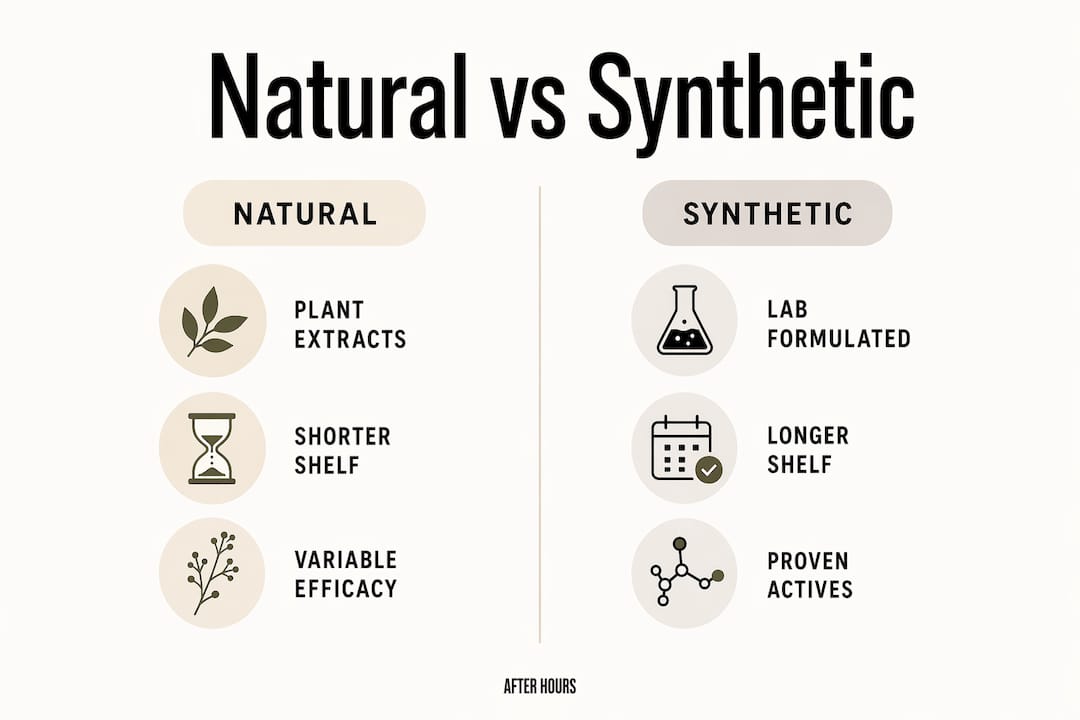
Shelf life and product longevity
| Feature | Natural skincare | Synthetic skincare |
|---|---|---|
| Typical shelf life | 6–12 months | 24+ months |
| Preservative type | Plant-based antimicrobials | Synthetic preservatives |
| Stability | Lower, more variable | Higher, more consistent |
| Allergen risk | Higher from botanicals | Lower, but not zero |
| Environmental footprint | Depends on sourcing | Depends on production method |
Natural products expire faster because plant-derived preservatives are less potent than synthetic ones. That shorter shelf life is not a flaw. It reflects a formula with fewer stabilising chemicals. The practical implication is that you need to use natural products within their recommended period and store them correctly.
Clinical evidence and efficacy
Synthetic actives like retinoids have decades of clinical trial data behind them. Botanical compounds like niacinamide (derived from vitamin B3) and bakuchiol (a plant-based retinol alternative) are building similar evidence bases. The most effective approach, according to dermatology literature, is combining botanical antioxidants with proven synthetic actives rather than treating the two categories as opposites.
Environmental considerations
True sustainability in skincare is complex. Plant-based sourcing can strain ecosystems through over-harvesting, high water use, and land pressure. Some biotechnology-derived synthetic ingredients actually carry a lower ecological footprint than their natural equivalents. The honest position is that neither category is automatically more sustainable. Sourcing practices, production methods, and third-party verification determine the real environmental cost.
How to read labels and spot greenwashing
The term “natural” carries no standardised legal definition in the UK or EU cosmetics market. Regulators confirm it functions primarily as a marketing tool rather than a safety or quality guarantee. That gap is where greenwashing enters.
Greenwashing is the practice of presenting a product as more natural, sustainable, or safe than it actually is. It shows up in vague claims like “botanical formula,” “earth-friendly,” or “clean beauty” with no certification to back them up.
Here is what to look for instead:
- COSMOS certification: Issued by a consortium of European certification bodies, COSMOS provides harmonised criteria for natural and organic cosmetics, covering ingredient sourcing, processing, and environmental impact.
- ECOCERT: A French certification body that audits both ingredient origin and manufacturing practices. Products bearing the ECOCERT mark have passed independent verification.
- Fair Trade certification: Confirms ethical sourcing and fair payment for agricultural ingredients, particularly relevant for shea butter, cocoa butter, and similar plant-derived materials.
- Full ingredient lists (INCI format): Every ingredient must appear by its International Nomenclature of Cosmetic Ingredients name. If a brand hides behind “fragrance” or “parfum” without disclosure, that is a signal to look elsewhere.
Pro Tip: Prioritise brands that publish their full ingredient lists and hold third-party certifications over those that rely on terms like “natural,” “clean,” or “green” without evidence. Ingredient transparency is a more reliable indicator of product quality than any marketing phrase.
The importance of natural ingredients is real, but only when those ingredients are properly sourced, verified, and formulated with care.
What is the environmental impact of natural skincare choices?
Sustainability in skincare is not determined by whether a product is labelled natural. It is determined by how ingredients are sourced, how the product is manufactured, and whether those claims are independently verified.
Plant-based sourcing carries genuine risks. Demand for ingredients like rosehip oil, argan oil, and shea butter has in some regions contributed to ecosystem strain, water depletion, and displacement of smallholder farmers. High consumer demand for “natural” products does not automatically translate into better environmental outcomes. It can accelerate the very pressures it claims to avoid.
Biotechnology offers a counterintuitive answer. Some synthetic ingredients produced through fermentation or biosynthesis, such as lab-grown squalane derived from sugarcane rather than shark liver, carry a significantly lower ecological footprint than their traditionally sourced natural equivalents. The ingredient origin matters less than the production method and its verified impact.
Third-party certification is the clearest signal of genuine sustainability. COSMOS, for example, assesses not just ingredient origin but also the environmental impact of processing and packaging. A product with COSMOS certification has passed scrutiny that a product with a “natural” label has not. Choosing certified products is the most direct way to align your skincare choices with genuine environmental values.
The practical step is straightforward. Check for certification marks before purchasing. Read the brand’s sourcing statements. If a company cannot explain where its key ingredients come from, that absence is informative. Transparency about daily skin moisture and ingredient sourcing together give you the full picture of what a product actually delivers.
Key takeaways
Natural skincare delivers real benefits for skin health and sustainability only when formulation quality, ingredient transparency, and third-party certification back up the label claims.
| Point | Details |
|---|---|
| “Natural” is unregulated | The term carries no legal definition; certifications like COSMOS are the reliable standard. |
| Botanical ingredients carry allergen risk | 37% of natural formulations contain plant-derived fragrances that commonly trigger contact dermatitis. |
| Shelf life is shorter | Natural products typically last 6–12 months versus 24+ months for synthetic formulas. |
| Blending works best | Combining botanical antioxidants with proven synthetic actives delivers better results than either alone. |
| Certification beats marketing | Third-party auditing from COSMOS or ECOCERT confirms genuine safety and sustainability claims. |
The honest truth about natural versus synthetic skincare
By Darnell
After years of reading formulation science and watching consumer trends, the thing that frustrates me most is the binary framing. People treat “natural” and “synthetic” as moral opposites, and that framing does real harm.
I have seen people with rosacea switch to “all-natural” products and end up with worse flare-ups because the formula was loaded with essential oils and botanical fragrances. I have also seen people dismiss plant-derived ingredients entirely because they assumed “synthetic equals science.” Both positions miss the point.
The skin does not care about the origin story of an ingredient. It responds to the molecule itself, the concentration, and the formulation context. Retinoids work because of their molecular structure, not because they are synthetic. Colloidal oatmeal works because of its specific compounds, not because it comes from a plant. The question to ask is always: what does the evidence say about this specific ingredient at this specific concentration for this skin type?
What I have found actually works is treating natural and synthetic as complementary rather than competing. A formula with shea butter and niacinamide outperforms one that is purely botanical or purely synthetic. The best brands understand this. They do not market purity. They market results, backed by transparent ingredient lists and third-party verification.
My honest advice: stop reading the front of the packaging and start reading the back. If the ingredient list is hidden, abbreviated, or buried in marketing language, that tells you everything you need to know about the brand’s priorities.
— Darnell
Afterhoursbodybutter: natural body butters with clear ingredients

Afterhoursbodybutter formulates its body butters with vegan, plant-derived ingredients and publishes full ingredient lists so you know exactly what you are applying. The range is cruelty-free and built around fat-soluble vitamins and botanical nutrients that support skin hydration and texture without synthetic fillers or hidden fragrances.
If you have sensitive skin or specific concerns like dryness or acne, the product range addresses those needs directly. Customers report visible improvements in skin texture and a reduction in irritation after consistent use. Browse the full natural body butter range to find a formula suited to your skin type, or try the Men’s Cocoa Body Butter for deep moisture using natural cocoa-derived ingredients.
FAQ
What does “natural skincare” actually mean?
Natural skincare refers to products formulated primarily with plant-derived, mineral, or botanical ingredients. The term has no standardised legal definition in the UK or EU, so certification marks like COSMOS are the most reliable indicator of genuine natural formulation.
Are natural skincare products always safer than synthetic ones?
No. 37% of natural formulations contain plant-derived fragrances that commonly trigger contact dermatitis. Safety depends on formulation quality and individual skin compatibility, not ingredient origin.
How long do natural skincare products last?
Natural skincare products typically have a shelf life of 6–12 months, compared to 24+ months for synthetic formulas. Store them away from heat and direct light to preserve stability.
What is greenwashing in skincare?
Greenwashing is the practice of presenting a product as more natural or sustainable than it is, using vague terms like “clean” or “botanical” without certification. Look for COSMOS, ECOCERT, or Fair Trade marks to verify genuine claims.
Is natural skincare better for the environment?
Not automatically. Plant-based sourcing can strain ecosystems through over-harvesting and high water use. Third-party certification from bodies like COSMOS is the most reliable way to confirm a product’s genuine environmental credentials.