


Moisturising is defined as the process of restoring water content to the skin’s outer layer, and it directly reduces acne severity by repairing the skin barrier and regulating oil production. When your skin loses moisture, it compensates by producing excess sebum, which clogs pores and triggers breakouts. Dry skin raises the odds of moderate acne tenfold, making hydration one of the most clinically significant factors in acne management. Understanding why moisturising helps acne means understanding how your skin barrier works, and what happens when it fails.
How does skin hydration affect acne severity?
Skin hydration directly controls how much oil your skin produces and how well it defends against bacteria. The skin barrier, technically called the stratum corneum, acts as a protective seal. When that seal breaks down through dryness, water escapes rapidly and bacteria enter more easily.
Research confirms the scale of this problem. Every 10% reduction in skin moisture raises the odds of moderate acne by 3.87 times. That figure shows that hydration is not a cosmetic concern. It is a clinical one.
The mechanism works like this. Dehydrated skin triggers the sebaceous glands to produce more oil as a compensatory response. That excess oil mixes with dead skin cells and blocks follicles. The result is the classic acne cycle: dryness leads to oiliness, oiliness leads to blockages, and blockages lead to inflammation.
Understanding skin dehydration causes is the first step to breaking that cycle. Once you restore hydration, the skin stops overproducing oil, the barrier repairs itself, and inflammation decreases measurably.
| Hydration level | Effect on skin | Acne risk |
|---|---|---|
| Well hydrated | Barrier intact, oil production balanced | Low |
| Mildly dehydrated | Minor barrier disruption, slight oil increase | Moderate |
| Severely dehydrated | Barrier compromised, high sebum output | High |
Why do acne treatments often require moisturising?
Most standard acne treatments work by increasing cell turnover or killing bacteria. Both processes strip moisture from the skin. Retinoids, benzoyl peroxide, and salicylic acid are effective, but they also damage the skin barrier as a side effect.
Adjunctive moisturising during retinoid treatment produced an acne severity reduction of 2.49 points compared to 1.41 points for those not using a moisturiser. That difference is clinically meaningful. It shows that moisturising does not just soothe irritation. It actively improves treatment outcomes.
Patients who skip moisturiser during treatment face a predictable problem. Without a moisturiser, skin loses up to ten times more water, which drives sebum overproduction and worsens the very condition the treatment targets. Dermatologists now classify moisturising as an essential adjunct to aggressive acne therapies, not an optional comfort measure.
The benefits of adding a moisturiser to your acne routine include:
- Reduced burning and peeling from retinoids and exfoliating acids
- Better treatment adherence, because skin feels tolerable rather than raw
- Lower inflammation, as a repaired barrier keeps irritants out
- Improved quality of life, with patients reporting scores rising from 14.24 to 17.87 in clinical trials
Pro Tip: If your skin feels tight or flaky at week two or three of a new acne treatment, that is a sign of barrier damage, not treatment failure. Adding a moisturiser at this stage can stabilise your skin and prevent you from abandoning a treatment that is actually working.
What types of moisturisers are best for acne-prone skin?
Not all moisturisers suit acne-prone skin equally. The wrong formula can trap bacteria, block pores, and worsen breakouts. The right formula hydrates without interfering with the skin’s natural processes.
Lightweight, water-based moisturisers containing humectants like hyaluronic acid and niacinamide are the preferred choice for acne-prone skin. Hyaluronic acid draws water into the skin from the environment. Niacinamide reduces redness and regulates sebum production. Glycerin works similarly to hyaluronic acid and is well tolerated by sensitive skin.
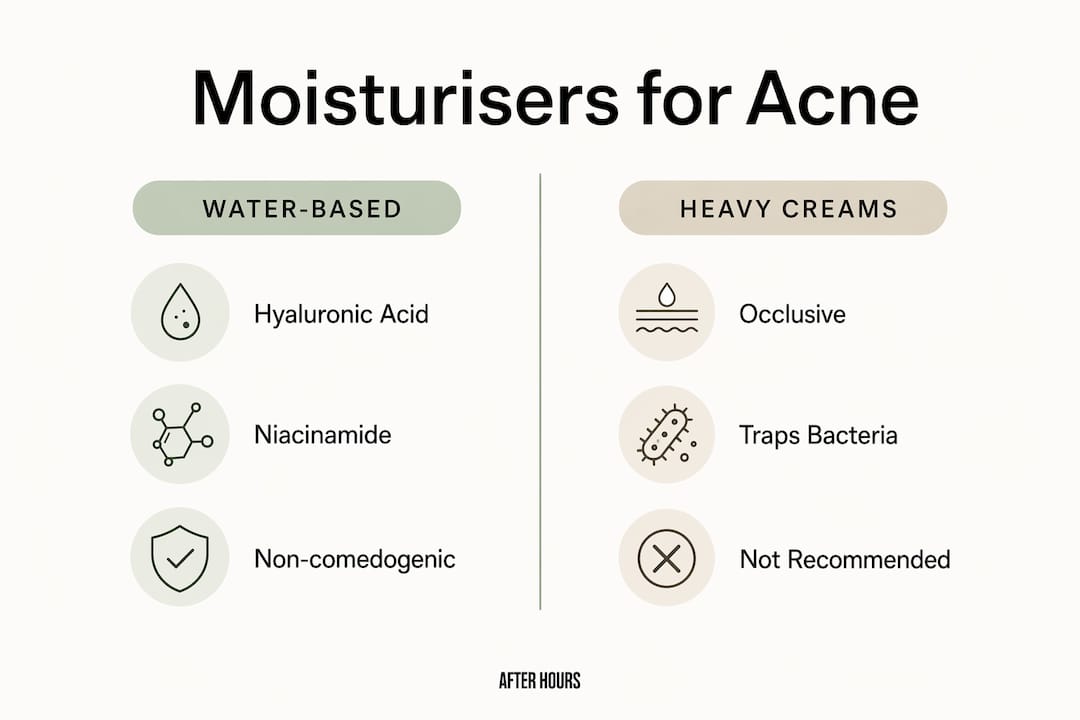
Heavy, occlusive creams present a different picture. They form a thick layer on the skin’s surface that can trap bacteria and dead cells inside follicles. For acne-prone skin, that is a direct route to new breakouts. A bioactive moisturiser has been shown to reduce dryness scores significantly (p=0.021) while maintaining acne treatment efficacy. That result confirms that effective hydration does not require a heavy product.
| Moisturiser type | Key ingredients | Suitable for acne-prone skin |
|---|---|---|
| Water-based gel | Hyaluronic acid, glycerin | Yes |
| Niacinamide serum | Niacinamide, panthenol | Yes |
| Lightweight lotion | Ceramides, aloe vera | Yes |
| Heavy cream | Petrolatum, lanolin | No |
| Oil-based balm | Mineral oil, beeswax | No |
Selecting the right product also means checking for the label “non-comedogenic,” which indicates the formula has been tested not to block pores. For guidance on nourishing skin butters that work for specific skin types, ingredient lists matter more than marketing claims.
Pro Tip: Apply your moisturiser to damp skin immediately after cleansing. Damp skin application locks in hydration far more effectively than applying to dry skin, and it reduces the amount of product you need.
How to properly integrate moisturising into an acne care routine?
The sequence of application matters as much as the products you choose. Applying moisturiser at the wrong stage can dilute your acne treatment or reduce its contact time with the skin.
Follow these steps for the most effective routine:
- Cleanse your face with a gentle, non-stripping cleanser. Avoid anything that leaves your skin feeling tight.
- Apply your acne treatment (retinoid, benzoyl peroxide, or salicylic acid) to clean, dry skin. Allow it to absorb fully before moving on.
- Wait for the treatment to dry completely. Applying moisturiser after the treatment dries does not reduce the treatment’s effectiveness. Applying it too soon can dilute the active ingredient.
- Apply your moisturiser to slightly damp skin in a thin, even layer. Focus on areas prone to dryness and flaking.
- Use SPF in the morning as a final step. Acne treatments increase photosensitivity, and sun damage worsens post-acne marks.
Common mistakes to avoid include mixing your moisturiser directly with your acne treatment in your palm, applying moisturiser before the treatment has dried, and using a heavy night cream when a lightweight gel would suffice. Consistency matters more than perfection. A simple routine you follow every day outperforms a complex one you abandon after a week. For a broader view of daily moisture needs, the frequency and timing of application both affect long-term skin health.
What are the common myths about moisturising and acne?
The most persistent myth is that moisturiser causes acne. This belief leads many people to skip hydration entirely, which makes their skin worse. The reality is that the wrong moisturiser can cause breakouts, but the right one actively reduces them.
Common misconceptions worth addressing:
- “Oily skin does not need moisturiser.” Oily skin is often dehydrated skin producing excess sebum to compensate. Hydrating it correctly reduces oil output over time.
- “Moisturiser will block my pores.” Non-comedogenic, water-based formulas are specifically designed not to block pores. The issue is product selection, not moisturising itself.
- “If my skin breaks out after using a moisturiser, I should stop moisturising.” The correct response is to switch products. Acne-prone skin in a dehydration cycle worsens without hydration support.
- “Natural ingredients are always safe for acne-prone skin.” Some natural oils are highly comedogenic. Coconut oil, for example, scores among the highest on the comedogenic scale and is unsuitable for most acne-prone skin types.
If a moisturiser causes new breakouts, look at the ingredient list before abandoning hydration altogether. Fragrance, certain alcohols, and heavy oils are the most common culprits. Switching to a fragrance-free, water-based formula usually resolves the issue.
Key takeaways
Moisturising reduces acne severity by repairing the skin barrier, cutting excess oil production, and improving tolerance to acne treatments, making it a clinical necessity rather than an optional step.
| Point | Details |
|---|---|
| Hydration and acne severity | Dry skin raises the odds of moderate acne tenfold; restoring moisture breaks the cycle. |
| Treatment outcomes improve | Moisturising alongside retinoids reduces acne severity by nearly twice as much as treatment alone. |
| Product choice is critical | Use lightweight, non-comedogenic, water-based formulas with hyaluronic acid or niacinamide. |
| Application sequence matters | Apply acne treatment first, let it dry fully, then apply moisturiser to damp skin. |
| Skipping moisturiser backfires | Without hydration, skin loses far more water, triggering the sebum overproduction that causes breakouts. |
Moisturising and acne: what I have learned from years of watching people get it wrong
People with acne are often told to keep their routine minimal. Strip it back. Use the treatment. Nothing else. I understand the logic, but I have watched that advice fail repeatedly.
The skin does not respond well to being treated as an enemy. Aggressive treatments without barrier support create a skin that is simultaneously inflamed, dehydrated, and overproducing oil. That is not a skin getting better. That is a skin in crisis.
What I find most telling is the week two or three drop-off. Someone starts a retinoid, their skin gets dry and irritated, and they assume the treatment is wrong for them. They stop. But in most cases, the treatment was working. The barrier just needed support to keep up. A simple moisturiser, applied correctly, would have kept them on track.
The other thing I notice is that people treat moisturising as a reward for good skin, not a tool for improving it. They wait until their acne clears before they start hydrating properly. That is backwards. Hydration is part of what gets you to clear skin, not a celebration of having arrived there.
Patience and consistency with barrier repair are what separate people who see results from those who cycle endlessly through treatments without progress. Moisturising is not glamorous. It is not the exciting part of a skincare routine. But it is the part that makes everything else work.
— Darnell
Afterhoursbodybutter: natural hydration for acne-prone skin
Afterhoursbodybutter formulates vegan, cruelty-free body care products using natural ingredients chosen specifically to nourish and hydrate without triggering breakouts.
Their products focus on fat-soluble vitamins and nutrients that support the skin barrier from within, using chemical-free formulations suited to sensitive and acne-prone skin. Customers report visible reductions in acne and skin irritation after consistent use, which aligns with the clinical evidence that proper hydration reduces breakout frequency and severity. If you are looking for a moisturiser that works with your skin rather than against it, browse the full range at Afterhoursbodybutter and find a formula built for your skin’s actual needs.
FAQ
Does moisturiser make acne worse?
Moisturiser does not cause acne when the formula is non-comedogenic and water-based. The wrong product, particularly heavy or oil-based creams, can block pores and worsen breakouts.
How does moisturising help with acne?
Moisturising repairs the skin barrier, reduces excess oil production, and lowers inflammation. Dry skin raises acne odds tenfold, so restoring hydration directly reduces breakout severity.
Should I moisturise if I use retinoids for acne?
Yes. Retinoid users who add a daily moisturiser show significantly greater acne severity reductions than those who do not. Moisturising also reduces burning and peeling, helping you stay on treatment longer.
What ingredients should I look for in a moisturiser for acne-prone skin?
Hyaluronic acid, glycerin, and niacinamide are the most effective and well-tolerated options. They hydrate without clogging pores or increasing sebum production.
How often should I moisturise if I have acne?
Moisturise twice daily, once in the morning and once at night, after cleansing and applying any acne treatments. Consistency matters more than frequency adjustments.