

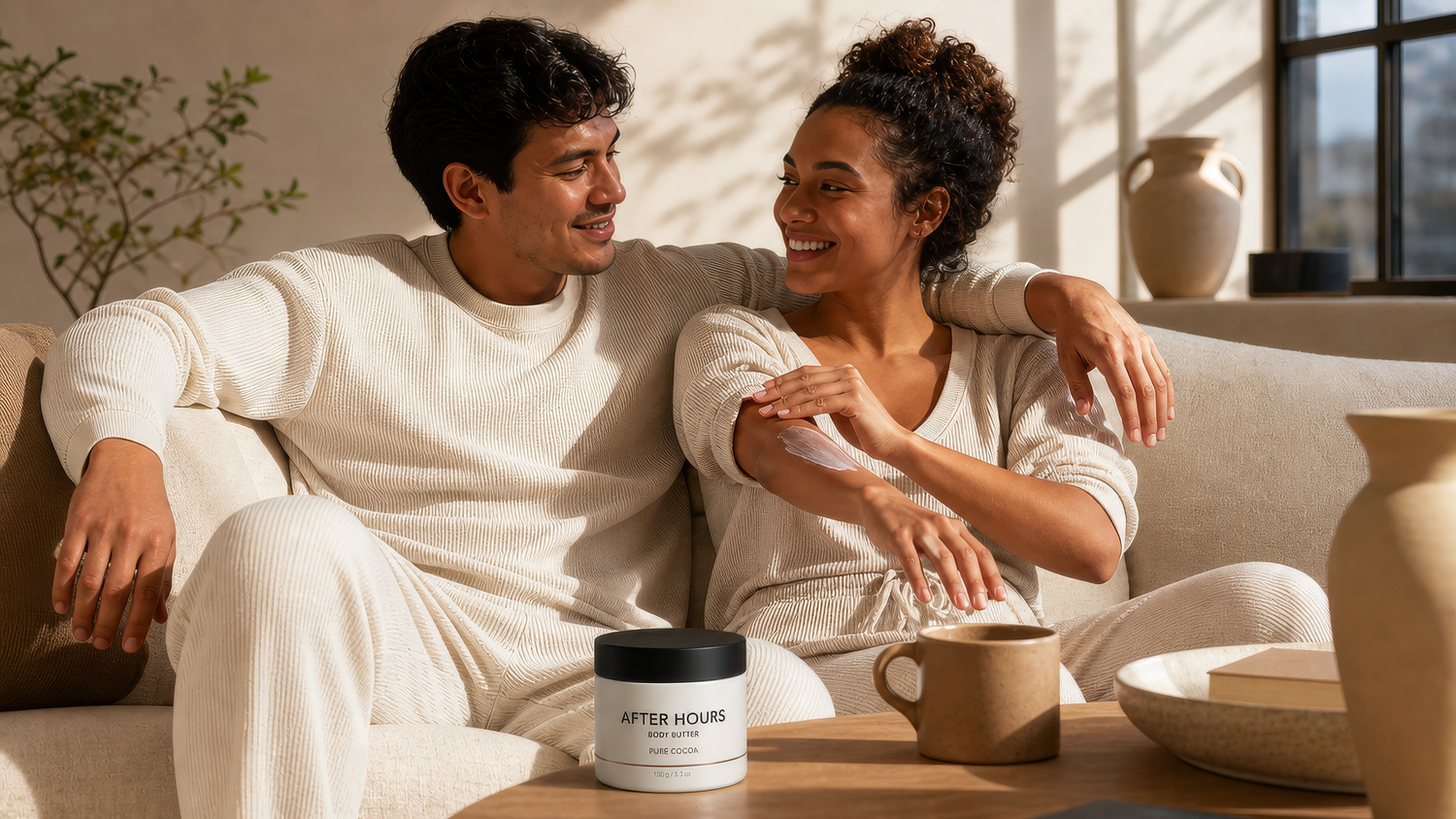

Hard water commonly contributes to dry, tight, and sometimes inflamed skin by leaving mineral residues on the surface and increasing transepidermal water loss (TEWL). Two things to do right now: swap your current bar soap for a soap-free syndet cleanser, and apply a ceramide-rich moisturiser to damp skin within three minutes of stepping out of the shower. Most people notice less tightness within a few days and measurable barrier improvement within one to four weeks.
- Swap your cleanser. Replace lye-based bar soaps with a syndet or soap-free body wash. This reduces the insoluble residue that hard water leaves on skin.
- Moisturise damp skin. Apply a ceramide-rich, fragrance-free moisturiser or body butter immediately after patting dry. Damp skin absorbs and seals moisture more effectively.
Table of Contents
- Can you tell if hard water is affecting your skin?
- Why does hard water dry and irritate your skin?
- How do you check whether your tap water is hard?
- What skincare routine changes actually reduce dryness?
- What plumbing options actually help with hard water?
- When should you expect to see improvement?
- When should you see a GP or dermatologist?
- What does the research actually show?
- How do environment and lifestyle make hard water effects worse?
- Does hard water affect psoriasis and acne too?
- Key takeaways
- The part most guides skip
- Afterhoursbodybutter fits the routine you already need
- Primary sources and further reading
Can you tell if hard water is affecting your skin?
The pattern is fairly specific. Your skin feels tight or itchy immediately after a shower, not hours later. Soap barely lathers. There is white scale on your taps, kettle, and shower glass. You apply moisturiser and it seems to absorb well, then your skin feels dry again within an hour.
Certain groups are more likely to notice these effects. Infants and young children are at higher risk: a meta-analysis of 385,901 participants found a statistically significant association between hard water exposure and atopic eczema in children. People with existing eczema or sensitive skin, older adults whose skin produces less natural oil, and anyone living in known hard-water areas of the UK (London, the South East, East Anglia, and the East Midlands) are all more susceptible.
A quick self-assessment checklist:
- White limescale on taps, kettle, or shower screen
- Soap or shampoo lathers poorly and rinses slowly
- Skin feels tight or itchy directly after washing
- Moisturiser absorbs quickly but dryness returns fast
- Hair feels stiff or dull after washing
Pro Tip: Try the travel test. If your skin noticeably improves after a few days in a hotel, a friend’s house, or anywhere with different water quality, that is a strong signal that your home water supply is a contributing factor.
Why does hard water dry and irritate your skin?
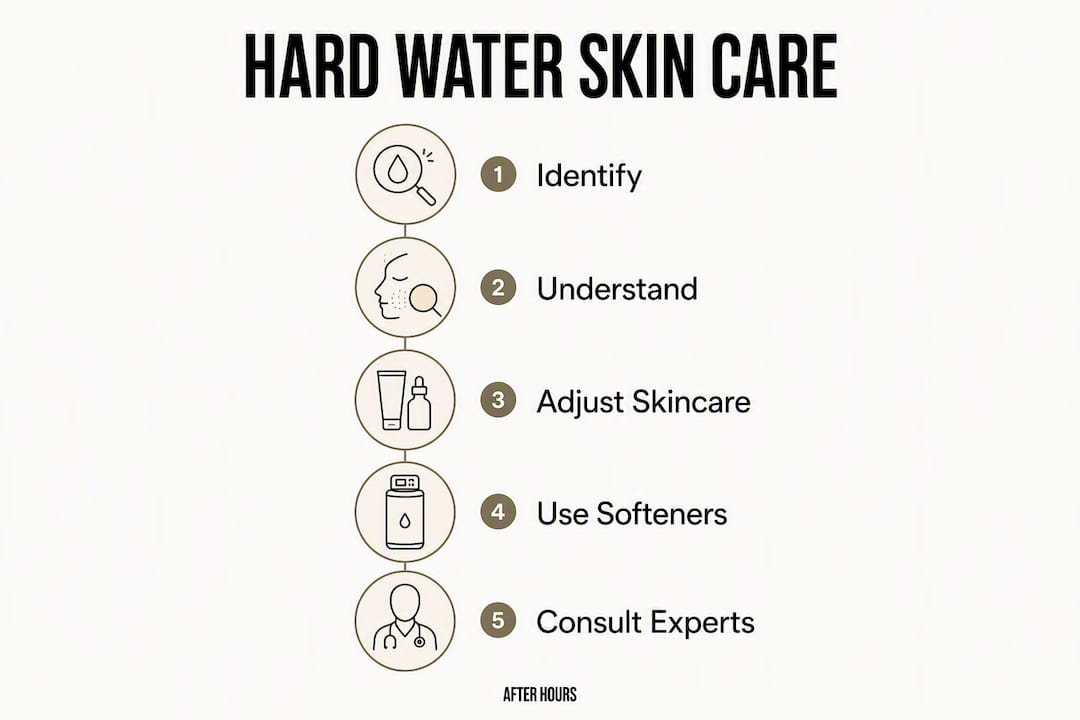
The mechanism starts with chemistry. Hard water contains dissolved calcium and magnesium ions. When these react with the surfactants in soap or body wash, they form insoluble precipitates — soap scum — that stick to the skin surface rather than rinsing away cleanly. Research by Danby et al. demonstrated measurably increased surfactant residue on skin after hard-water washing, and showed that these residues prolong contact with irritant surfactants. Simply rinsing for longer does not remove them.
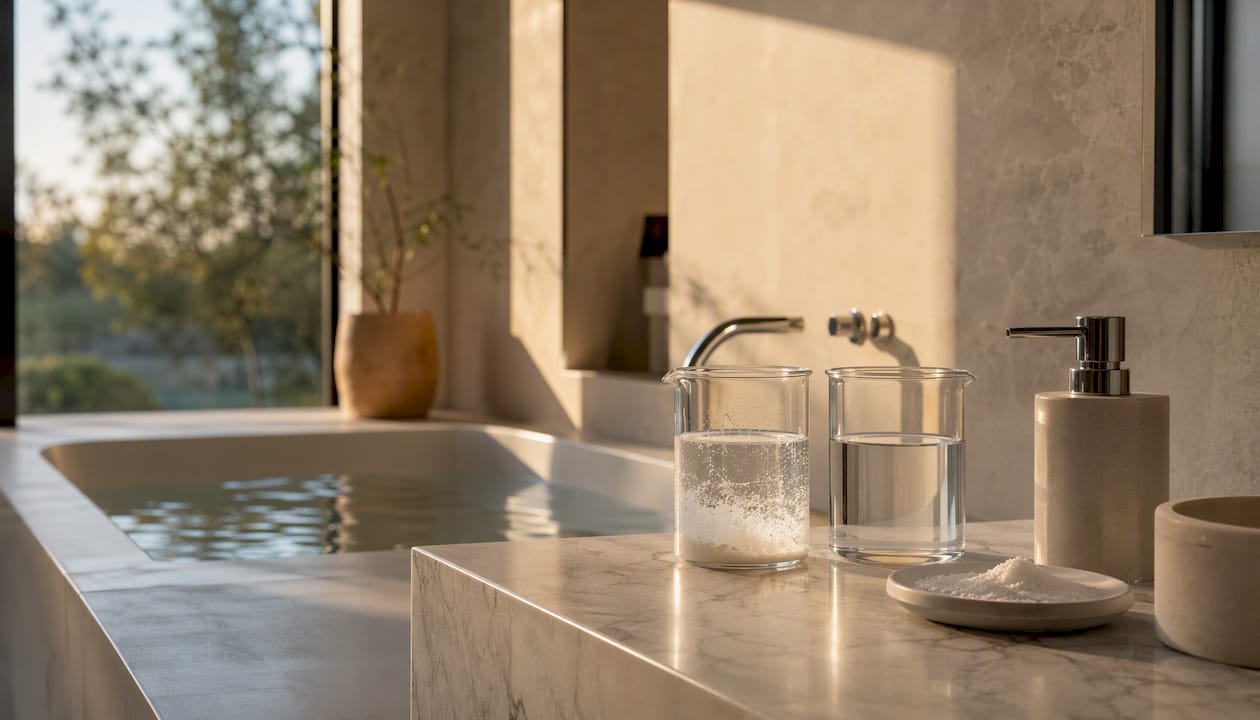
Beyond residue, the mineral deposits raise the skin’s surface pH. The stratum corneum (the outermost skin layer) functions best at a slightly acidic pH of around 4.5–5.5. Raising it disrupts the lipid organisation that holds skin cells together and keeps moisture in. The result is a measurably impaired skin barrier.
The clinical data backs this up. An experimental study published in the Journal of Investigative Dermatology measured TEWL in 80 participants after washing with hard water:
| Group | TEWL increase after hard-water washing |
|---|---|
| Healthy volunteers | +7.12 ± 0.84 g/m²/h |
| Atopic dermatitis + FLG mutation | +13.84 ± 1.68 g/m²/h |
“Washing with hard water significantly increased TEWL in both healthy volunteers and those with atopic dermatitis, with the greatest impairment seen in participants carrying a filaggrin gene mutation — the group already at highest risk of barrier dysfunction.” — Journal of Investigative Dermatology
People with a filaggrin (FLG) gene mutation, common in eczema sufferers, show nearly double the barrier impairment from the same water. Hard water does not affect everyone equally.
At the population level, the meta-analysis found an odds ratio of 1.28 (95% CI 1.09–1.50) for atopic eczema in children exposed to harder water, across studies covering hardness ranges of 76 to over 350 mg/L CaCO3.
How do you check whether your tap water is hard?
Start with what you can already see. Thick white scale inside your kettle, a chalky film on shower glass, and soap that barely lathers are reliable visual indicators. Consumer hardness guidance commonly uses PPM (parts per million) as a practical guide: below 60 PPM is unlikely to cause skin issues; above 180 PPM is commonly associated with noticeable dryness and irritation.
For a more precise reading, water hardness test strips are widely available from hardware shops, Amazon UK, and some pharmacies. Dip the strip in a glass of tap water, wait the specified time, and match the colour to the chart. Results are usually shown in PPM or mg/L CaCO3.
The fastest check is your water company’s website. All UK water suppliers are required to publish hardness data by postcode. Search “[your water company] water hardness” or visit their water quality page and enter your postcode. Thames Water, Anglian Water, and Southern Water all serve areas with consistently hard water above 200 mg/L CaCO3.
UK hardness bands (mg/L CaCO3): Soft: 0–50 | Moderately soft: 50–100 | Slightly hard: 100–150 | Moderately hard: 150–200 | Hard: 200–300 | Very hard: 300+
- Check your water company’s postcode hardness tool
- Use test strips for a quick home reading (available from hardware shops and online)
- Look for limescale in your kettle as a rough visual guide
- Contact your local water authority if you want a formal written hardness figure
What skincare routine changes actually reduce dryness?
The routine matters more than any single product. Follow these steps consistently and most people see improvement within days.
- Keep showers short and lukewarm. Aim for around 10 minutes. Hot water strips natural oils faster and opens the door for mineral residues to penetrate further.
- Use soap only where needed. Apply cleanser to odorous areas (armpits, groin, feet) rather than lathering your entire body. This limits surfactant-mineral contact on drier areas like legs and arms.
- Switch to a syndet cleanser. Soap-free syndets do not react with calcium and magnesium the same way lye-based soaps do, so they produce far less insoluble residue. Avoid sodium lauryl sulphate (SLS) in body washes.
- Pat dry, do not rub. Leave skin slightly damp.
- Apply moisturiser within three minutes. This is the three-minute rule: applying a ceramide-rich, occlusive product to damp skin reduces subsequent TEWL and gives better barrier recovery. A thick body butter outperforms a light lotion here because it provides an occlusive layer that holds moisture in.
- Repeat every day. Barrier repair is cumulative. One application will not undo weeks of hard-water exposure.
Ingredients to look for:
- Ceramides — restore the lipid structure of the stratum corneum
- Niacinamide — reduces redness and supports barrier function
- Hyaluronic acid — draws moisture into the skin
- Occlusives (shea butter, body butters) — seal moisture in, particularly useful at night
Ingredients to avoid: lye-based bar soaps, SLS, synthetic fragrances, and alcohol-heavy formulations.
Pro Tip: Layer in this order for maximum effect: treatment serum (if used) → humectant (hyaluronic acid) → emollient (ceramide lotion) → occlusive (body butter). Apply the occlusive last, ideally at night, to lock everything in while you sleep. This is where a science-backed moisture routine makes a real difference in hard-water areas.
What plumbing options actually help with hard water?
Understanding what each option does — and does not do — saves you money and disappointment.
Shower filters: limited for hardness
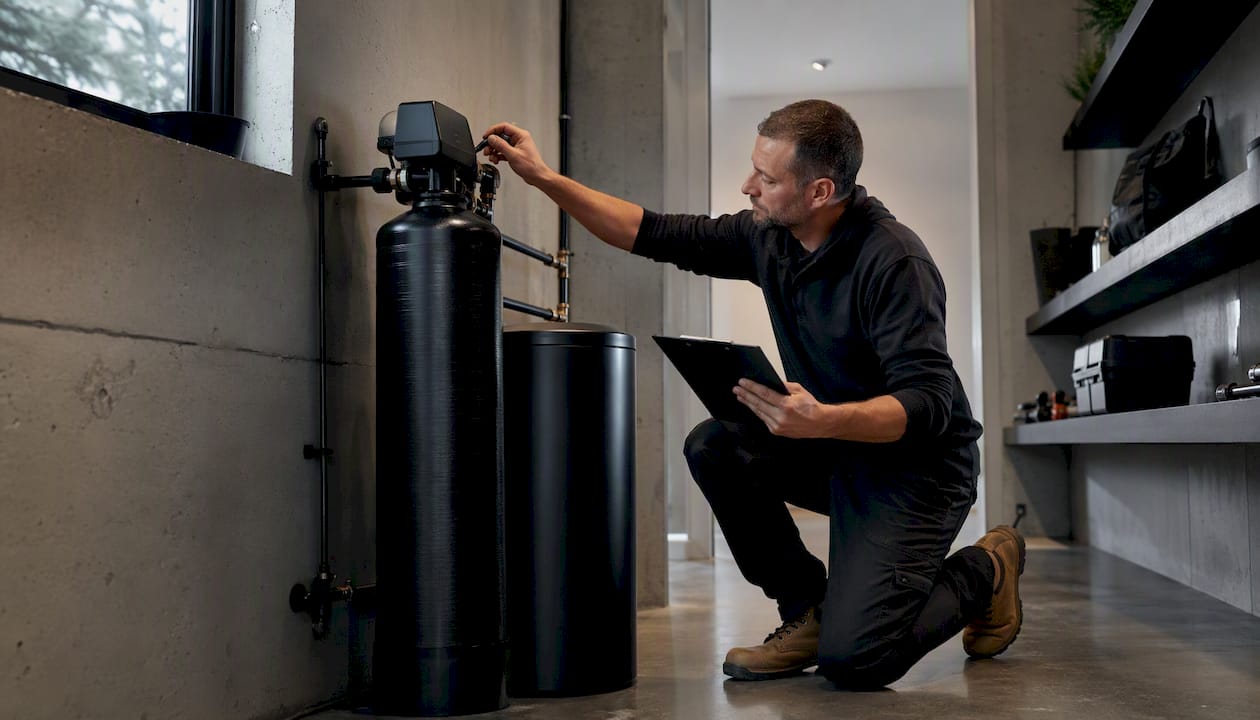
Most inexpensive shower filters use activated carbon or KDF media. These remove chlorine, chloramine, and some organic compounds effectively. They do not remove dissolved calcium and magnesium ions, because these are ionic minerals, not particulate contaminants. A shower filter may improve the smell and feel of water, but it will not meaningfully reduce the mineral load responsible for soap scum and barrier disruption.
“Common shower filters are not designed to remove dissolved hardness minerals. Ion-exchange technology is required to actually soften water at the point of use.” — ShowerSoft explainer on filter limitations
Point-of-use and whole-house softeners
Ion-exchange water softeners replace calcium and magnesium ions with sodium ions, genuinely reducing water hardness. These are the only widely available consumer systems that address the root cause.
| Option | What it removes | Approximate cost | Maintenance |
|---|---|---|---|
| Shower filter (carbon/KDF) | Chlorine, organics | — | Cartridge every 3–6 months |
| Point-of-use softener | Ca²⁺, Mg²⁺ (at one tap/shower) | — | Salt top-up, resin servicing |
| Whole-house ion-exchange softener | Ca²⁺, Mg²⁺ throughout | — | Salt top-up monthly, annual service |
| Salt-free conditioner | Alters mineral structure, does not remove | — | Low maintenance |
Salt-free conditioners change the physical form of minerals so they are less likely to form scale, but they do not remove hardness. Skin benefits are less well evidenced than with true ion-exchange systems.
Practical considerations before buying a whole-house softener:
- You need space near the mains supply for the unit (typically under-stairs or utility room)
- Softened water has slightly elevated sodium content — some people prefer an unsoftened drinking tap
- Budget for annual servicing and ongoing salt costs
- Trials of whole-house softeners have shown mixed results for eczema outcomes, so manage expectations accordingly
When should you expect to see improvement?
- Beyond 8 weeks: — If symptoms persist despite routine changes, consider water hardness testing and plumbing options, or seek clinical review.
Softening your water or changing your routine reduces environmental stress on the skin. It does not replace medical treatment for established dermatological disease. If you have diagnosed eczema or psoriasis, these steps complement but do not substitute for prescribed therapy.
When should you see a GP or dermatologist?
Some situations need professional assessment rather than a product swap.
- Broken, weeping, or infected skin
- A rash that spreads rapidly or appears in new areas
- Severe itching that disrupts sleep
- No improvement after four to six weeks of consistent routine changes
- Sudden new flares with no obvious trigger
A GP will take a history (when symptoms started, whether they improve with travel or water changes), examine the skin, and may prescribe emollients, topical corticosteroids, or non-steroidal alternatives such as tacrolimus. Persistent or complex cases are referred to dermatology.
To get the most from your appointment: note your local water hardness figure, take photographs of your skin before and after travel, and bring a list of every product you currently use on your skin.
This article provides general information, not medical advice. Confirm current treatment options with a GP or qualified dermatologist.
What does the research actually show?
The two most important studies for anyone making decisions about hard water and skin are a population-level meta-analysis and a controlled experimental study.
Meta-analysis (childhood eczema): A systematic review and meta-analysis published in Clinical and Experimental Allergy pooled data from seven observational studies covering 385,901 participants. Hard water exposure was associated with an odds ratio of 1.28 (95% CI 1.09–1.50) for atopic eczema in children. The hardness range across included studies was 76 to over 350 mg/L CaCO3.
Experimental TEWL study: The Journal of Investigative Dermatology study used 80 participants and measured TEWL directly after hard-water washing. Healthy volunteers showed a TEWL increase of +7.12 ± 0.84 g/m²/h; those with atopic dermatitis and a filaggrin gene mutation showed +13.84 ± 1.68 g/m²/h.
“These findings provide experimental evidence that hard water impairs the skin barrier, with the effect amplified in genetically susceptible individuals — supporting the case for routine changes in hard-water households.” — Journal of Investigative Dermatology
| Study | Key finding | Practical implication |
|---|---|---|
| Meta-analysis, 385,901 participants | OR 1.28 (95% CI 1.09–1.50) for childhood eczema | Hard water is a real environmental risk factor, not anecdotal |
| JID experimental study, 80 participants | TEWL +7.12 g/m²/h (healthy); +13.84 g/m²/h (AD + FLG) | Barrier disruption is measurable; FLG carriers need extra protection |
| Danish Blood Donor Study | Association between residential hard water and xerosis | Dry skin prevalence links to water hardness at population level |
How do environment and lifestyle make hard water effects worse?
Hard water rarely acts alone. Several factors compound its impact on skin.
Central heating and low indoor humidity are significant in UK winters. Heated indoor air drops relative humidity, which accelerates TEWL independently of water quality. When you add hard-water barrier disruption on top of dry indoor air, the combined effect on skin is noticeably worse than either factor alone.
Hot, long showers strip natural skin oils faster and increase the time mineral residues spend in contact with the skin. Cutting shower time to around 10 minutes and keeping the temperature lukewarm addresses both problems at once.
Frequent handwashing exposes the hands to repeated hard-water and surfactant contact throughout the day. People in healthcare, food service, or any role requiring regular washing often notice hand eczema or dryness that worsens in hard-water areas.
Seasonal changes matter too. Cold, windy weather in autumn and winter reduces the skin’s ability to retain moisture, making it more vulnerable to the barrier disruption hard water causes. A richer, more occlusive moisturiser in winter is a practical response. Understanding why skin needs daily moisture helps you adjust your routine as conditions change.
Clothing and detergents add another layer. Washing clothes in hard water can leave mineral and detergent residues in fabric, which then sit against the skin. Using a liquid detergent rather than powder, and an extra rinse cycle, reduces this.
Does hard water affect psoriasis and acne too?
Eczema gets most of the research attention, but hard water interacts with other skin conditions in ways worth knowing.
Psoriasis: The raised skin pH and barrier disruption from hard water can trigger or worsen psoriasis flares. Psoriatic skin already has a compromised barrier and heightened inflammatory response; the additional pH shift from mineral deposits adds environmental stress. There is no large-scale trial data equivalent to the eczema meta-analysis, but dermatologists commonly note that psoriasis patients in hard-water areas benefit from the same routine adjustments: syndet cleansers, short lukewarm showers, and consistent emollient use.
Acne: The relationship here is less straightforward. Hard water’s effect on skin pH can disrupt the acid mantle, which normally suppresses acne-causing bacteria. Soap scum residues can also clog pores. Some people with acne-prone skin find that switching to a soap-free cleanser and a non-comedogenic moisturiser reduces breakouts in hard-water areas. If you are managing both dryness and acne, a hydration approach suited to acne-prone skin avoids the trap of over-moisturising with heavy occlusives on the face while still repairing the body’s barrier.
Seborrhoeic dermatitis: Hard water’s pH disruption can alter the scalp environment in ways that favour the yeast Malassezia, which drives seborrhoeic dermatitis. Switching to a pH-balanced, syndet shampoo is the most direct response.
Key takeaways
Hard water dry skin is a measurable, addressable problem: switching to a syndet cleanser and applying a ceramide-rich moisturiser to damp skin within three minutes delivers the fastest, most cost-effective relief for most people in hard-water areas.
| Point | Details |
|---|---|
| Swap your cleanser first | Replace lye-based soap with a syndet or SLS-free body wash to cut mineral residue on skin. |
| Moisturise damp skin within 3 minutes | Apply a ceramide-rich or occlusive product immediately after patting dry to seal in moisture. |
| Check your local water hardness | Use your water company’s postcode tool or test strips; above 180 PPM is commonly linked to dryness. |
| Try skincare fixes before plumbing | Routine changes cost little and work quickly; consider a whole-house softener only if symptoms persist. |
| Afterhoursbodybutter for barrier repair | Afterhoursbodybutter’s vegan, chemical-free body butter fits the occlusive step in the recommended routine, suitable for sensitive skin. |
The part most guides skip
Hard water is a genuine, measurable skin stressor. The TEWL data and the eczema meta-analysis make that clear. But the framing most guides use — “hard water is ruining your skin, buy a softener” — skips the more useful point.
The skincare routine changes cost almost nothing and work within days. A whole-house softener costs hundreds of pounds, requires ongoing salt and servicing, and the clinical trials for eczema outcomes have been mixed. For most people, the barrier repair routine is the intervention that actually moves the needle. The plumbing option is a reasonable next step if symptoms persist after six to eight weeks of consistent routine changes, not the first move.
There is also a tendency to treat hard water as the sole cause when it is almost always one factor among several. Indoor heating, long hot showers, the wrong cleanser, and infrequent moisturising all compound the problem. Fix the routine first. Then reassess.
Afterhoursbodybutter fits the routine you already need
If you are in a hard-water area and your skin is dry, tight, or reactive, the occlusive step in your post-shower routine is where a quality body butter makes a direct difference. Afterhoursbodybutter’s vegan, chemical-free body butters are formulated with fat-soluble vitamins and natural nourishing ingredients, designed for sensitive skin and barrier repair. No synthetic fragrances, no harsh chemicals — just the ingredients your skin needs to hold moisture overnight.
Apply to damp skin within three minutes of showering, focusing on the driest areas. Use nightly for the first two weeks to give your barrier time to recover. The formula is cruelty-free, sustainably packaged in the UK, and free from the chemical irritants that compound hard-water damage. Free UK delivery on orders over £30.
Shop body butters for dry, sensitive skin and start the routine that actually works in hard-water areas.
Primary sources and further reading
The studies and resources below were used to build this article. Each is linked directly.
-
Journal of Investigative Dermatology — TEWL experimental study: Controlled study in 80 participants measuring barrier impairment after hard-water washing. The source for the TEWL figures (+7.12 and +13.84 g/m²/h) cited throughout.
-
Danby et al. — surfactant deposition mechanism: Detailed experimental report demonstrating how hard water increases insoluble surfactant residue on skin. Explains why rinsing longer does not solve the problem.
-
Systematic review and meta-analysis — water hardness and childhood eczema: Pooled data from seven studies, 385,901 participants. OR 1.28 (95% CI 1.09–1.50). The strongest population-level evidence linking hard water to atopic eczema.
-
Danish Blood Donor Study — water hardness and xerosis: Retrospective cohort study linking residential hard water exposure to self-reported dry skin in adults. Adds population-level evidence beyond the eczema literature.
-
WaterHardness.org — PPM guide and consumer explainer: Practical PPM-to-impact reference used for the hardness bands and consumer testing guidance.
-
The Well (Northwell) — hard water and skin health: Balanced clinical summary noting mixed trial evidence for whole-house softeners; used to temper expectations in the timeline section.
A note on sources: The two peer-reviewed studies (JID and the meta-analysis in Clinical and Experimental Allergy) carry the most evidential weight. The consumer-facing sources were used only for practical guidance and PPM reference ranges, not for clinical claims.