


Yes, microplastics are still present in some skincare products, including leave-on items such as creams and lotions. EU law is phasing them out on staggered dates, but products already on shelves can legally remain there until each deadline passes. Your move right now: check the ingredient list for polymer names and lean towards products with clear, verifiable formulations.
TL;DR:
- Microplastic particles in skincare vary in size, with microscopic polymers often blended invisibly into formulations and only visible microbeads phased out years ago.
- Leave-on products stay on skin for hours and are less studied than rinse-off formats, increasing the risk of prolonged skin contact and transfer to water systems.
- A 2026 study found that some creams can release tens of thousands of microplastic particles per application, but high counts depend on specific products and detection methods.
- Current EU deadlines restrict new microplastic sales but allow existing stock to remain until it sells out, making consumer vigilance still necessary.
- Checking ingredient lists for specific polymers and favoring brands with transparent testing results reduces the risk of microplastic exposure from skincare.
Table of Contents
- What microplastics in skincare actually are
- Rinse-off vs leave-on: where the real gap in scrutiny sits
- What the research shows about particle counts in creams
- What we know (and don’t) about health effects
- The EU’s phase-out timeline, explained
- Reading the label: how to spot microplastics on an INCI list
- Choosing microplastic-free skincare: a practical shopping checklist
- How ethical formulation reduces microplastic risk
- Why this fight over ingredient lists actually matters
- Where After Hours Body Butter fits into a microplastic-free routine
- Sources
What microplastics in skincare actually are
Microplastics in skincare fall into two categories: primary and secondary. Primary microplastics are manufactured at a tiny size on purpose and added directly to a formula. Secondary microplastics form later, when larger plastic components (packaging, certain film coatings) break down into fragments after use or disposal.
The primary category is what most conscious buyers are trying to avoid, because it’s added deliberately and shows up in the ingredients list under a chemical name rather than the word “microplastic.” Formulators use these polymers because they solve specific texture and stability problems that natural ingredients don’t always solve as cheaply.
Common polymers and their jobs in a formula:
- Polyethylene (PE) — the classic exfoliating bead once found in scrubs and cleansers
- Polypropylene (PP) — used as a texturising or bulking agent
- Polymethyl methacrylate (PMMA) — creates a soft-focus, blurring effect on skin
- Nylon-12 and Nylon-6 — thickeners and powder-like fillers
- Acrylates copolymer / crosspolymer — film formers and stabilisers that hold a formula together
- Polyethylene terephthalate (PET) glitter particles — decorative shimmer in some body and face products
Particle size matters more than most people assume. A bead large enough to feel gritty is easy to spot and easy to campaign against, which is exactly what happened with rinse-off exfoliating scrubs a decade ago. But polymers used as film formers or stabilisers are often microscopic, blended invisibly into a lotion’s texture, and never advertised as “exfoliating” or “beads.” That’s precisely why the industry review on sustainable opportunities in cosmetics argues that visible microbeads were only ever the most obvious part of the problem.
Rinse-off vs leave-on: where the real gap in scrutiny sits
Rinse-off products go down the drain within seconds of use: face washes, exfoliating scrubs, shampoo. Leave-on products stay on skin for hours: body butters, face creams, lotions, sunscreens, and most serums.
The public conversation about microplastics started with rinse-off scrubs, because visible plastic beads washing into wastewater made for an obvious, photogenic villain. Regulators followed that same logic, which is why early cosmetic microplastic bans concentrated almost entirely on rinse-off formats.
Leave-on products didn’t get the same attention, and that’s a genuine blind spot. A review examining cosmetics and microplastic pollution found that leave-on cosmetics remain widely understudied compared with rinse-off products, with testing and enforcement methods for these formats still not standardised. That matters because the exposure pathway is different:
- Rinse-off exposure is mostly environmental. Particles wash into wastewater systems and, depending on treatment plant efficiency, can reach rivers and oceans.
- Leave-on exposure is mostly direct. The product sits on skin for hours, meaning any interaction between polymer particles and the skin barrier happens over a much longer window, and residue can still transfer to towels, bedding, and eventually water systems too.
Testing leave-on formulas is also technically harder. Oils, silicones, and emulsifiers in a cream interfere with the separation and spectroscopic techniques scientists use to isolate and identify plastic particles, which partly explains why rinse-off products got regulated first while leave-on formulations lagged behind.
What the research shows about particle counts in creams
A 2026 laboratory study tested a sample of skincare and treatment creams and identified measurable microplastic particles across some samples. The same study on microplastics in skincare and treatment creams estimated that a single application of some microplastic-containing products can release tens of thousands of particles, with certain products showing very high particle counts per gram.
A handful of creams in that 21-product sample carried the overwhelming majority of the particle load, which tells you concentration varies enormously between brands and formulas rather than being a flat, universal risk across every leave-on product.
Numbers like “94,500 particles per application” sound alarming in isolation, but the honest context matters. That figure came from one product in a specific study, using specific detection methods, on a limited sample of 21 creams. It’s a real, measured result, not a marketing exaggeration, but it isn’t a universal average either.
Detection methods and why results diverge
Three techniques dominate this field, and each has trade-offs that explain why particle counts vary study to study:
- Micro‑FTIR (Fourier‑transform infrared spectroscopy) identifies chemical bonds at a microscopic scale, useful for confirming polymer type but slower on large sample volumes.
- Raman spectroscopy offers similar chemical fingerprinting with different sensitivity to particle colour and size, often used alongside micro‑FTIR to cross-check results.
- Pyrolysis gas chromatography mass spectrometry (Py‑GCMS) breaks samples down thermally and analyses the resulting gases, which works well for bulk quantification but destroys the sample, so it can’t confirm particle shape or count individually.
- Optical microscopy is the cheapest and fastest method but relies on visual identification, which risks missing particles below a certain size threshold.
A broader review of microplastics and human health notes these methods have real trade-offs in sensitivity, throughput, and cost, which is a large part of why one lab’s headline number rarely matches another’s. Sample sizes in most published studies are also small, often a few dozen products, which means individual results shouldn’t be read as representative of the entire market. The direction of the evidence is consistent, though: some creams contain measurable synthetic polymer particles, and leave-on formats are not automatically safer just because they’ve drawn less attention.
What we know (and don’t) about health effects
The mechanisms scientists are investigating are inflammation, oxidative stress, and disruption of the skin’s protective barrier. A review on microplastics and human health suggests that microplastics may potentially penetrate the skin barrier, trigger oxidative stress, promote localised inflammation, and contribute to premature skin ageing.
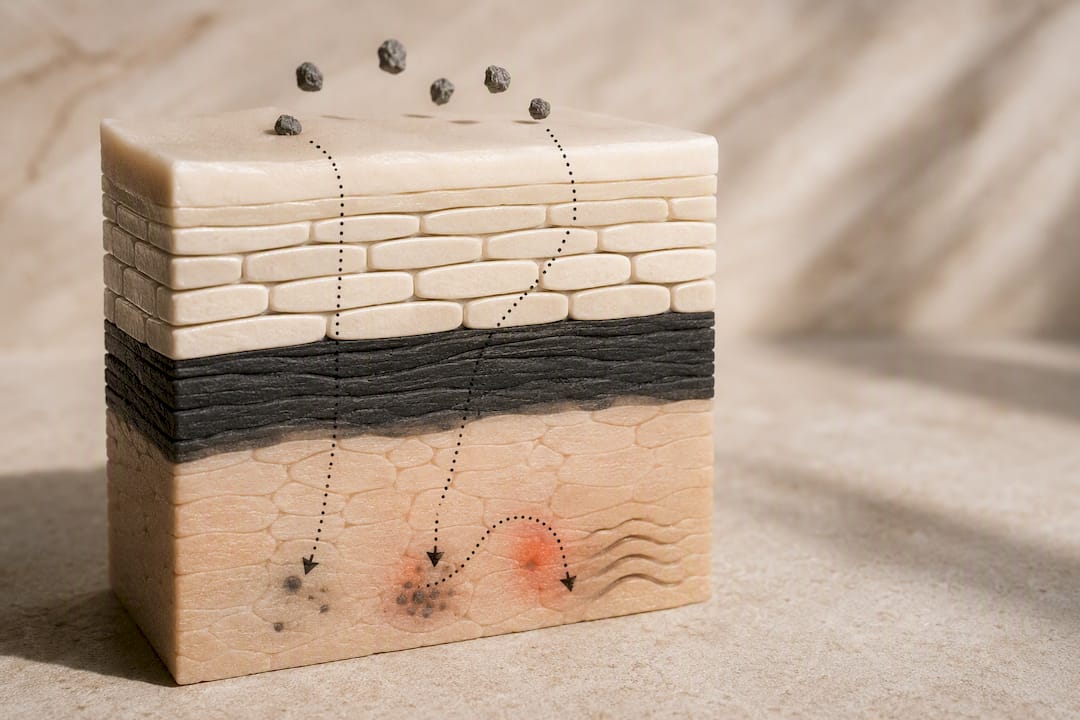
That’s a meaningful signal, but it comes with an important caveat: most of this evidence sits in vitro (cell-culture) or animal-model studies rather than large-scale human clinical trials. Nobody has run a long-term controlled study tracking human skin health against measured microplastic exposure from cosmetics specifically. The gap between “plausible biological mechanism” and “confirmed clinical harm in humans” is still wide, and it’s honest to say so rather than round preliminary findings up into certainty.
What does that mean practically? A few things are worth holding in mind:
- The skin barrier is a genuine physical obstacle. Whether microscopic plastic particles cross it in meaningful quantities during normal use is still being studied, not settled.
- People with already-compromised skin barriers, including those with eczema, active acne, or chronic dryness, are a reasonable precautionary priority group, since a weaker barrier function is the exact variable the proposed mechanisms depend on.
- Precaution doesn’t require panic. Choosing to avoid a known-avoidable ingredient category while the science firms up is a sensible, low-cost decision, not an overreaction.
Pro Tip: If you already manage sensitive or reactive skin, treat microplastic-free formulation as one more item on your existing checklist alongside fragrance-free and known allergen-free claims, rather than a brand-new worry to research from scratch.
The EU’s phase-out timeline, explained
The EU restriction on intentionally added microplastics, Commission Regulation (EU) 2023/2055, sets three staggered deadlines rather than a single cut-off date. That staggering is deliberate: rinse-off products are easier to reformulate, so they get the shortest runway, while make-up (where texture and pigment suspension are harder to replicate without polymers) gets the longest.
- Rinse-off products (cleansers, scrubs, shampoos): restricted from 16 October 2027
- Leave-on products (creams, lotions, body butters): restricted from 16 October 2029
- Make-up products: restricted from 16 October 2035
Here’s the detail that catches most shoppers off guard: these dates restrict new placement on the market, not the sale of existing stock. A retailer can legally continue selling inventory manufactured before the deadline until it sells through, which means products containing restricted polymers could realistically sit on shelves for a period after each cut-off. Journalistic coverage on the topic has flagged this exact point, noting that brands may legally sell existing stock containing restricted ingredients during transition periods, so consumer vigilance stays relevant well past the headline dates.
There’s also an enforcement reality worth naming plainly: definitions of “intentionally added” and testing thresholds still leave room for interpretation, and standardised checking methods across the EU aren’t fully settled. That gap doesn’t make the regulation meaningless, but it does mean a product being sold in 2026 or 2027 isn’t automatically compliant with the spirit of the coming rules just because it’s legally on the shelf.
Reading the label: how to spot microplastics on an INCI list
INCI lists almost never use the word “microplastic.” You’re looking for chemical names, and that’s the single biggest hurdle for most shoppers trying to do this properly.
- Turn the product over and find the full ingredient list, usually on the back or base of the packaging, listed under “Ingredients” or the INCI heading.
- Scan for these specific names: Polyethylene, Polypropylene, Polyethylene terephthalate (PET), Polymethyl methacrylate (PMMA), Nylon-12, Nylon-6, and any ingredient ending in “acrylates copolymer” or “crosspolymer.”
- Don’t assume “natural” claims on the front of pack guarantee a clean list on the back. Marketing language and actual formulation are two separate things, and checking the full guide to decoding INCI will show you exactly how brands can legally use vague front-of-pack claims.
- Cross-check unfamiliar names using an independent tool rather than guessing. Beat the Microbead’s guide maintains ingredient lists and scanning resources built specifically for this purpose, and it’s free to use.
- Watch for glitter and shimmer particles specifically. PET glitter is one of the most commonly overlooked microplastic sources in body products, often listed simply as “PET” or under a decorative-ingredient sub-heading.
- If a product’s ingredient list uses vague umbrella terms like “polymer blend” without naming the specific compound, treat that as a reason to look further rather than assume it’s fine.
Pro Tip: Photograph the ingredient list on your phone before you buy. It’s far easier to search five or six unfamiliar chemical names at home with a proper scanning tool than to try memorising them standing in an aisle.
The practical challenge here is that polymers get disguised under genuinely complex, legitimate-sounding chemical names, and a name you’ve never seen before isn’t automatically a red flag. Acrylates copolymers, for instance, appear in plenty of products for entirely functional reasons, and not every one is a synthetic microplastic in the strict regulatory sense. This is where a second-opinion tool earns its place: don’t rely purely on memory or a five-second glance.
Choosing microplastic-free skincare: a practical shopping checklist
A shortlist you can actually use, whether you’re standing in a shop or scrolling a product page at midnight:
- Check the full INCI list, not just front-of-pack claims, before adding anything to your basket.
- Search unfamiliar polymer-sounding names using an independent ingredient checker rather than trusting brand marketing alone.
- Favour brands that publish full ingredient transparency and, ideally, third-party testing results rather than vague “eco-friendly” language.
- Treat “natural” and “clean” as marketing terms first, and verify them against the actual list, as explored in this guide to natural skincare claims.
- Consider packaging too. Secondary microplastics can originate from plastic packaging breakdown, so comparing glass versus plastic packaging is a reasonable second layer of scrutiny.
Credible alternatives worth knowing:
Biodegradable and bio-based particles are increasingly replacing synthetic microbeads in cosmetic formulas. The industry review on sustainable opportunities names starch-based, cellulose-based, and lignin-derived microparticles as credible replacements that can replicate the sensorial and functional roles synthetic polymers once played, from gentle exfoliation to texture-building.
- Cellulose beads: plant-derived, biodegradable, commonly used for gentle exfoliation
- Starch-based particles: derived from corn or other plant starches, used as texturisers and fillers
- Silica: a mineral-based option often used for mattifying or light exfoliating effects
- Alginate and other natural polymers: derived from seaweed, used for film-forming and stabilising properties
None of these are automatically perfect. Biodegradable doesn’t always mean instantly harmless in every environment, and switching materials often requires different formulation expertise and supply-chain verification. That’s exactly why brands making the switch should be publishing third-party testing or material safety data rather than asking shoppers to take reformulation claims on faith.
On price: expect a modest premium for verified biodegradable alternatives in the near term, simply because the supply chains are newer and less scaled than decades-old synthetic polymer production. That gap should narrow as more brands and manufacturers make the shift.
How ethical formulation reduces microplastic risk
Formulation choices are where this problem actually gets solved, not in a lab report years from now, but in what goes into a bottle today. Afterhoursbodybutter builds its body butters and body care products around natural, chemical-free ingredients and fat-soluble vitamins, specifically because that approach sidesteps the need for synthetic polymer fillers and stabilisers in the first place.
The brand’s proof points matter here because they are checkable, not just claimed:
- Vegan and cruelty-free formulation, verifiable against the same ingredient-transparency standard this article recommends applying to every product you buy, explored further in this guide to cruelty-free and vegan labelling
- Products manufactured and packaged sustainably in the UK, reducing the packaging-related secondary microplastic pathway discussed earlier
- A focus on natural, chemical-free ingredients designed to address specific skin concerns like acne and dryness without leaning on synthetic film-formers
What should you actually ask a brand for, beyond marketing copy? Ingredient clarity that survives a direct INCI check, disclosure of any testing results rather than vague “eco” language, and honesty about existing stock during a reformulation period rather than silence. Brands that can answer those three questions plainly are the ones worth trusting with a repeat purchase.
Why this fight over ingredient lists actually matters
Here’s what I think gets missed in most coverage of this topic: the regulation everyone’s citing, with its 2027, 2029, and 2035 deadlines, was never designed to fix the leave-on product problem quickly. It was designed to fix the easiest problem first. Rinse-off scrubs got the short runway because reformulating a face wash is simple compared with reformulating a cream that needs to hold its texture, stability, and shelf life for two years in a bathroom cabinet.
That’s not a criticism of the regulation. It’s a reason not to relax just because a law now exists.
The actual lever conscious buyers have isn’t waiting for 2029. It’s choosing, right now, to reward brands that formulate around natural, transparent ingredients instead of leaning on synthetic fillers because they’re cheaper and easier to source at scale. Every purchase that skips a polymer-heavy cream in favour of a genuinely clean formulation is a small, real signal to that brand’s supply chain. Support the NGO tools doing ingredient verification work, ask brands direct questions about their polymer use rather than accepting front-of-pack claims, and treat the 2029 leave-on deadline as a floor, not a target to wait for.
— Darnell
Where After Hours Body Butter fits into a microplastic-free routine
This brand formulates vegan, cruelty-free body butters using natural, chemical-free ingredients and fat-soluble vitamins from the outset, rather than reformulating under regulatory pressure later. That’s the practical advantage for anyone reading this and wanting one less ingredient list to worry about: you’re not waiting for a 2029 deadline to find out what’s actually in the jar.
If you’ve been checking labels while reading this and want a body care option built without synthetic polymer fillers from day one, browse the After Hours Body Butter range and see the full ingredient list for yourself before you buy.
| Quick action | Why it matters |
|---|---|
| Scan INCI for polymer names before buying | Most microplastics hide under chemical names, not the word “plastic” |
| Prioritise leave-on products’ ingredient lists | Leave-on formats remain the most understudied and least regulated so far |
| Check brand transparency on testing | Verified claims outlast marketing language once shelves clear old stock |
| Choose formulations built without synthetic fillers | Sidesteps the 2029 leave-on deadline instead of waiting for it |
Sources
- Identification, Quantification, and Characterization of Microplastics in Skincare and Treatment Creams: A Potential Health Concern Related to the Exposure Pathway
- Beyond microbeads: Examining the role of cosmetics in microplastic pollution and spotlighting unanswered questions
- Microplastics in Cosmetics: Open Questions and Sustainable Opportunities
- Commission Regulation (EU) 2023/2055
This article is general information, not a substitute for advice from a qualified doctor. Consult a qualified healthcare professional about your own circumstances before acting on anything here.