

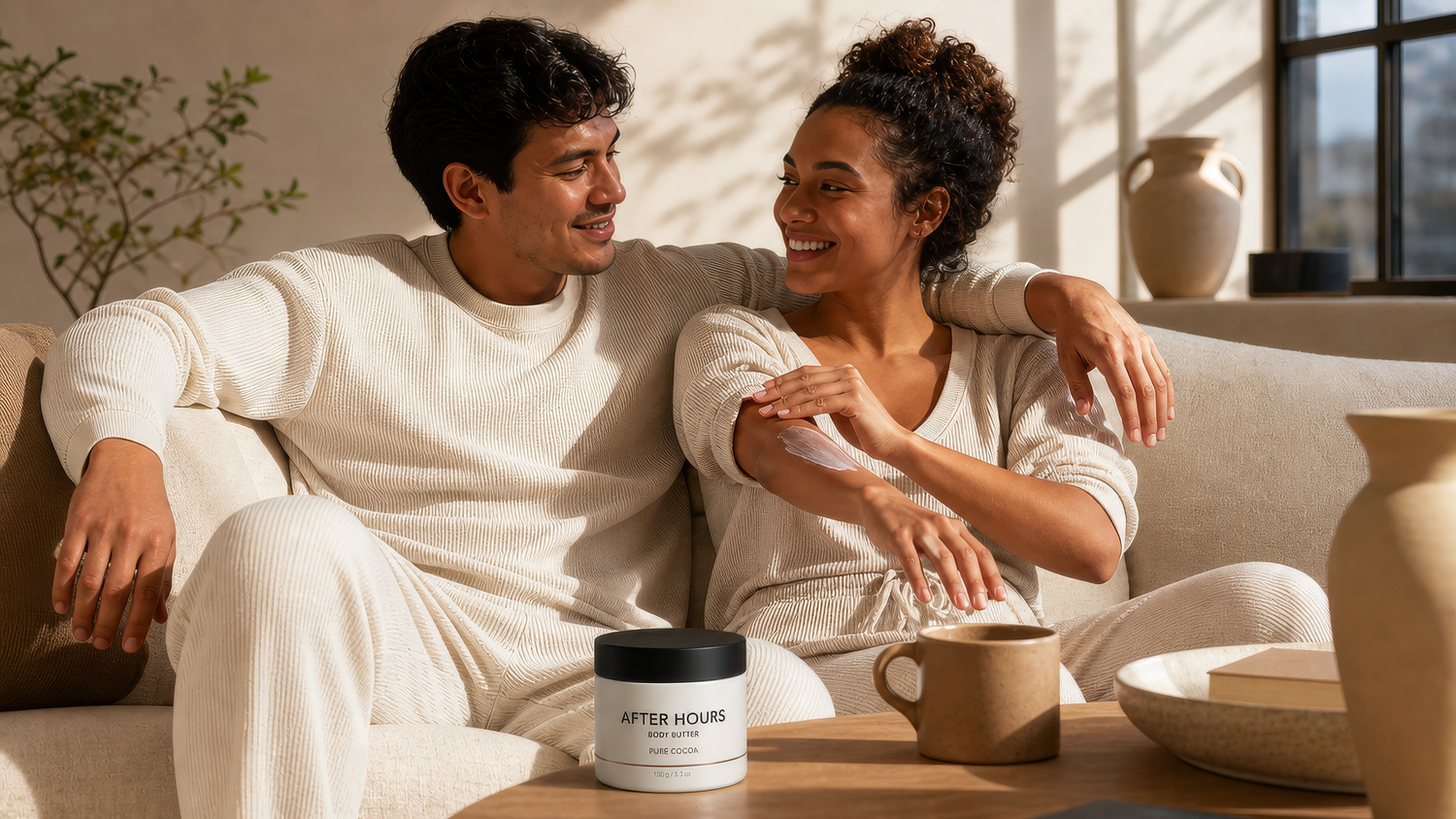

A waterless body moisturiser is an anhydrous, concentrated balm or oil that delivers more actives per application than a water-based lotion. It skips water entirely, relying on butters, oils and waxes to support your skin barrier for longer. Fewer preservatives, smaller packaging, and brands like After Hours Body Butter show what a well-formulated version looks like in practice.
TL;DR:
- Waterless formulas contain concentrated butters, oils, and waxes that provide more active ingredients per application and better barrier repair.
- They require longer application time and body heat to soften and spread, especially compared to quick-absorbing lotions with water.
- Choosing a product with transparent ingredient lists and proper storage instructions ensures effectiveness and sustainability.
- Proper application involves warming the product between palms, applying on damp skin, and avoiding direct sunlight during storage.
- After Hours Body Butter offers targeted, vegan, cruelty-free options with full ingredient transparency for specific skin concerns.
Table of Contents
- What “waterless” actually means and how it differs from lotion
- Ingredient guide: butters, oils, waxes and what each one actually does
- What to expect from waterless formulas versus water-based lotions
- How to apply and store a waterless body moisturiser properly
- Why waterless formulas often have a lighter footprint
- Choosing the right waterless body moisturiser: a quick checklist
- Why After Hours Body Butter is a credible waterless option
- The part of this conversation nobody has properly
- Try a waterless formula built around your specific skin concern
- Sources
What “waterless” actually means and how it differs from lotion
Anhydrous simply means without water. A standard body lotion is typically mostly water, emulsified with oils using surfactants and stabilised with preservatives that stop that water turning into a breeding ground for bacteria and mould. A waterless body moisturiser removes that entire category of ingredient. There’s no water to emulsify, so no emulsifier is needed, and far less risk of microbial growth, which means formulators can lean on fewer synthetic preservative systems.
This has a direct knock-on effect on what’s left in the jar. Every gram of a lotion diluted with water is a gram not doing active work on your skin. Strip the water out, and what remains is almost entirely functional: shea butter, plant oils, waxes, vitamins. That’s why a small amount of a solid body butter or oil-based skin moisturiser can outperform a much larger dollop of lotion. You’re applying a higher concentration of the ingredients that actually matter, not a diluted version of them.
The trade-off is texture and behaviour. Lotions pump, spread thin, and absorb fast because water evaporates and carries the formula into the skin. Waterless formats, whether a solid body butter, a balm, or a straight oil, need body heat to soften and spread. That’s a formulation choice, not a flaw, but it does mean the way you apply a hydrating body balm has to change from how you’d use a bottle of lotion. More on that shortly.
Ingredient guide: butters, oils, waxes and what each one actually does
Reading a label on a waterless formula is genuinely useful, because nearly every ingredient is there for a specific reason.
Butters form the backbone of most solid formulas. Shea butter is rich in oleic and stearic acids and carries natural vitamin A and E, both of which support barrier repair. Cocoa butter is firmer at room temperature and brings a higher concentration of fatty acids that help lock moisture in once it’s absorbed. Brands producing solid moisturisers commonly combine shea, mango and macadamia butters specifically because each melts and absorbs slightly differently, giving a more balanced finish than any one butter alone.
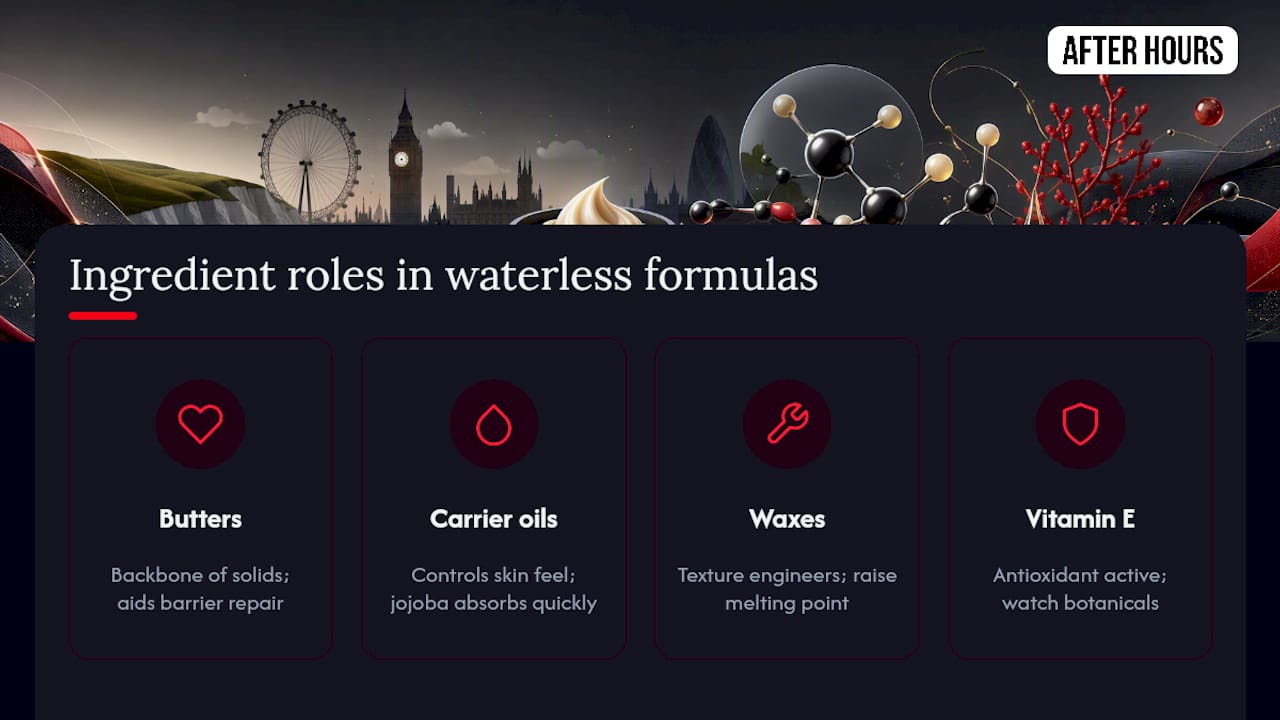
Carrier oils determine how a product feels on skin. Jojoba oil is structurally close to human sebum, so it absorbs quickly without feeling heavy. Sweet almond oil sits slightly richer and suits genuinely dry skin. Babassu oil, lighter again, is a common substitute for coconut oil in formulas aimed at acne-prone or blemish-sensitive skin, since it’s less likely to clog pores.
Waxes are the texture engineers. Beeswax and plant-based alternatives like candelilla wax raise the melting point of a balm, which is why a solid body butter holds its shape in the tub but softens upon contact with skin. Higher wax content generally means a firmer bar and a longer shelf life; too much, and the product can feel more like a coating than a moisturiser for dry skin.
Vitamin E is the most common functional active added on top, valued as an antioxidant. If you have sensitive or reactive skin, check for essential oil blends and botanical extracts specifically, since these are the most frequent allergen flags in otherwise gentle formulas.
What to expect from waterless formulas versus water-based lotions
The core benefit is durability. Concentrated lipids form a stronger occlusive layer on the skin’s surface, which slows transepidermal water loss, the process by which moisture escapes through the skin and leaves it dry again within hours. Peer-reviewed research on lipid-based topical treatments supports this mechanism: barrier-repair formulations rich in lipids help restore the skin’s protective function more effectively than lighter, water-heavy alternatives.
In practice, that translates to hydration that holds through a full day rather than needing three or four lotion top-ups. A well-formulated hydrating body balm shouldn’t feel greasy for long either. The initial richness you feel on application is the product warming and spreading; within a few minutes, most of it has absorbed and what’s left on the surface is doing its job as a barrier.
There are real limits worth knowing before you switch entirely. Absorption takes longer than a lotion, so if you’re getting dressed in a hurry, a waterless format needs a minute or two more patience. Very oily or acne-prone skin can find heavier butters like cocoa butter too rich for the face, though body use is generally less of an issue since skin there is thicker. And anyone with a nut allergy should check carrier oil sources carefully. Almond, macadamia and shea (a tree nut in botanical terms, though rarely allergenic) all warrant a second look on the label.
How to apply and store a waterless body moisturiser properly
Getting the technique right matters more here than with lotion, because the product behaves differently.
- Warm a small amount between your palms first. Solid butters and balms need body heat to soften; rubbing a cold chunk straight onto skin wastes product and spreads unevenly.
- Apply to slightly damp skin straight after a shower or bath, when pores are open and the barrier is primed to lock moisture in.
- Use less than you think you need. Because actives are concentrated, a coin-sized amount usually covers a whole limb.
- Massage in circular motions until the product has fully absorbed and skin no longer feels tacky.
Night-time use suits richer balms particularly well, since there’s no clothing friction to worry about while the formula finishes absorbing.
Storage is where waterless formats need real attention. Most solid butters and balms soften or melt above roughly 30°C, so keep tins away from radiators, car dashboards, and direct sunlight on a windowsill. If you’re travelling somewhere hot, pack the product in your hold luggage rather than a bag left in a warm car.
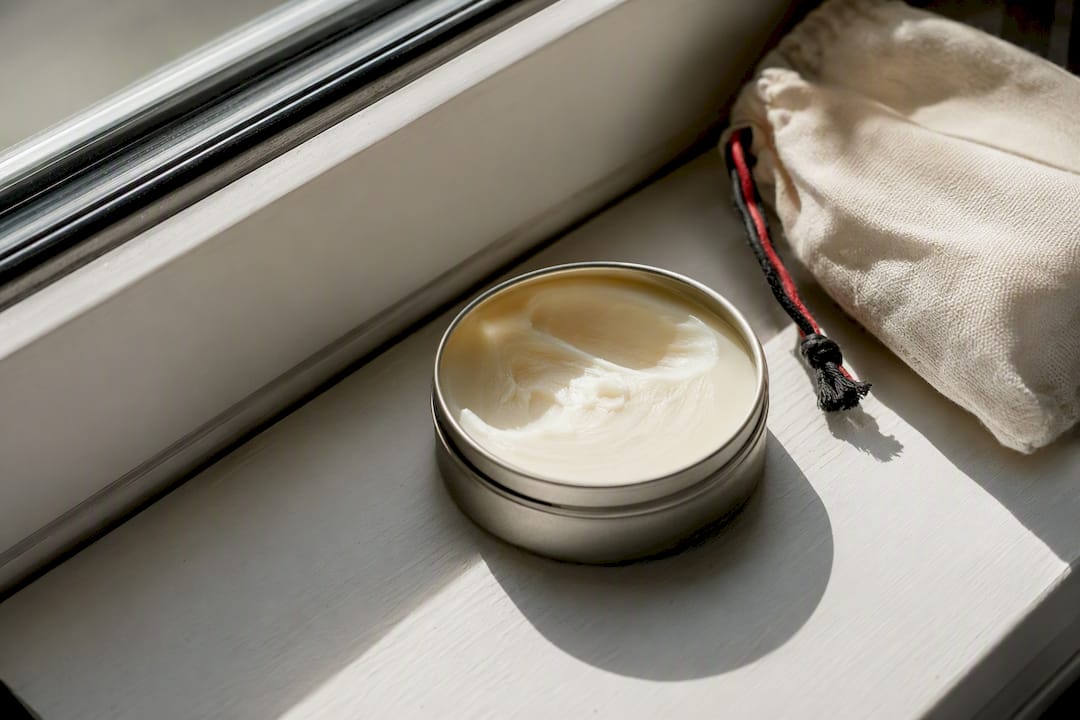
Pro Tip: For rough elbows, knees or heels, apply the balm, then cover briefly with socks or a sleeve. Body heat trapped against skin softens the product further and dramatically improves absorption on tougher areas.
Why waterless formulas often have a lighter footprint
Water is heavy, and shipping it around the country in plastic pump bottles adds up. Remove it, and a jar of solid body butter weighs a fraction of the equivalent lotion, cutting transport emissions and packaging volume in one move. That’s part of why solid oils and body butters are increasingly packaged in aluminium tins or push-up tubes rather than the plastic pumps standard lotions rely on.
Aluminium and tin are widely recyclable through standard kerbside collection, which plastic pump mechanisms often aren’t. Before trusting a sustainability claim, check three things: is the packaging actually recyclable in your area, does the brand disclose where ingredients are sourced, and is there a refill or return option rather than a new tin every time.
Choosing the right waterless body moisturiser: a quick checklist
Not every “natural” claim on a label holds up. Run through this before buying:
- Check the full ingredient list, not just the front-of-pack claims, and confirm water genuinely isn’t present or listed near the top.
- Look for stated melting behaviour or storage advice; a brand that tells you how to store the product understands its own formula.
- Scan for fragrance and essential oil listings if you have sensitive or reactive skin.
- Confirm the packaging is recyclable where you live, not just “recyclable” in theory.
- Avoid vague marketing language like “all natural” with no ingredient detail behind it, and be wary of heavy synthetic fragrance in anything marketed for sensitive skin.
Patch test any new product on your inner forearm for 24 hours before full use, and speak to a dermatologist first if you have eczema, psoriasis, or a known nut allergy, given how many waterless formulas rely on nut-derived oils.
Why After Hours Body Butter is a credible waterless option
After Hours Body Butter builds its range around vegan, cruelty-free formulas made without chemical fillers, with each product aimed at a specific skin concern rather than a one-size-fits-all approach.
- Formulated with fat-soluble vitamins and nutrients targeted at concerns like acne, dryness and irritation, not just general moisture.
- Manufactured and packaged in the UK with sustainability built into the process, not added afterwards.
- Ingredient lists are published in full on product pages, so you can check exactly what you’re applying before buying.
- Backed by practical guidance on waterless skincare covering both potency and sustainability trade-offs, and a step-by-step application guide for getting the most from a solid formula.
For anyone wanting to understand how humectants fit alongside occlusive butters, the brand’s guide to natural humectants for deep hydration is a useful next read.
The part of this conversation nobody has properly
Most of the advice on waterless skincare stops at “water-free means more concentrated,” as if that settles the matter. It doesn’t. The bigger story is what water was doing in your lotion in the first place: diluting actives, and demanding a preservative system to keep that water safe. Anhydrous formulas sidestep both problems at once, and that’s a formulation upgrade, not just a marketing angle.
Where conventional advice actually falls short is absorption time. Plenty of guides promise instant, lotion-like absorption from a solid butter, which sets people up to feel like they’ve bought the wrong product when a balm takes two minutes to sink in rather than thirty seconds. That patience is the trade for a barrier that holds up for hours longer.
If you’re switching over, prioritise the ingredient list before the packaging story. A gorgeous tin with vague “natural” claims and no allergen disclosure isn’t worth your money over a plainer jar with full transparency. Sustainability matters, but it’s the second decision, not the first.
— Darnell
Try a waterless formula built around your specific skin concern
After Hours Body Butter gives you a more direct route to the barrier-repair benefits covered above than a general-purpose lotion ever will, because each formula targets a specific concern (acne, dryness, irritation) rather than offering one blend for everyone. The ingredient lists are published in full, the butters and oils are vegan and cruelty-free, and the packaging is designed with the UK recycling system in mind rather than bolted on as an afterthought.
If you’re new to waterless formats, start with a single concern-specific butter rather than a bundle, patch test it on your forearm for 24 hours as with any new product, and build up from there. Visit the After Hours Body Butter shop to browse the full range and find the formula that matches your skin, and check the product page for the current returns policy before you buy.
Sources
- PubMed article on lipid-based treatments and barrier repair
- Luxurious Solid Oil Body Butter | Plastic-Free & Rapid Absorption – Heal My Hands
- Bestie’ Solid Body Moisturiser - Woohoo Body